

The White Sox reportedly agreed to terms with outfielder Tyrone Taylor on a two-year, $17 million contract on Tuesday night, a transaction that didn’t draw as many headlines as some of the other free-agent dominoes that fell earlier in the day. But we’re about to tell you why signing Taylor matters, at least more than you might initially think.
Overall, Taylor hit .279/.325/.502 in 97 games last season with the Mets and the Cubs. And in a 54-game stretch from June 28 through the end of the regular season -- following a month-long stint on the IL with a hip issue -- he was even better, slashing .352/.409/.648 with a 1.056 OPS. That’s a 188 wRC+, or production 88% better than league average.
Taylor only took 137 plate appearances in those 54 games, and we’ll get to the implications of that small sample size in just a little bit. But this is a player who entered his age-32 season with a 93 wRC+ across parts of seven big league seasons. He was coming off the worst season of his career in 2025, in which he was one of the weakest hitters in the Majors.
The difference in his production from one year to the next is remarkable.
Taylor's power output, by year
- 2025: 2 home runs // .319 slugging percentage // 3.8% barrel rate
- 2026: 11 home runs //. 502 slugging percentage // 8.7% barrel rate
Is it a small sample? Yes, it is. Taylor’s 241 plate appearances last year were his fewest in a single season since 2020. But consider this: In a 50-game stretch from May 17 through September 11, Taylor slugged .656. He was one of just eight players to have a slugging percentage north of .650 in a 50-game stretch at any point in 2026.
SLG above .650 in a 50-game span, 2026
- Yordan Alvarez (HOU)
- Alex Bregman (CHC)
- Byron Buxton (MIN)
- Pete Crow-Armstrong (CHC)
- Luis García Jr. (WSH/NYY)
- Shohei Ohtani (LAD)
- Ben Rice (NYY)
- Tyrone Taylor (NYM/CHC)
That’s a tough list to fake your way onto. You might notice the names not there, from Kyle Schwarber to Pete Alonso to Junior Caminero, three of the game’s preeminent sluggers. And yet there is Taylor, a platoon outfielder lurking among multi-time All-Stars and perennial MVP candidates.
If you were curious, Taylor's expected slugging percentage -- a Statcast metric that simply accounts for a player’s quality of contact, using exit velocity and launch angle -- was .475 in those 50 games. That’s still plenty good; Jackson Chourio’s .475 xSLG in 2026 ranked in the 87th percentile of MLB.
So, what happened here? And is this sustainable, in any way? The White Sox, at the least, seem to think there’s something here.
Let’s start with the simplest change: Taylor has never swung the bat faster than he did last season. His average bat speed was 71.6 mph, which is more or less in line with the league average (72.1 mph), and a 1.3 mph uptick from 2025. In September, Taylor’s 72.4 mph avg. bat speed was his fastest in a single month under Statcast’s bat-tracking data, which dates back to the 2023 All-Star break.
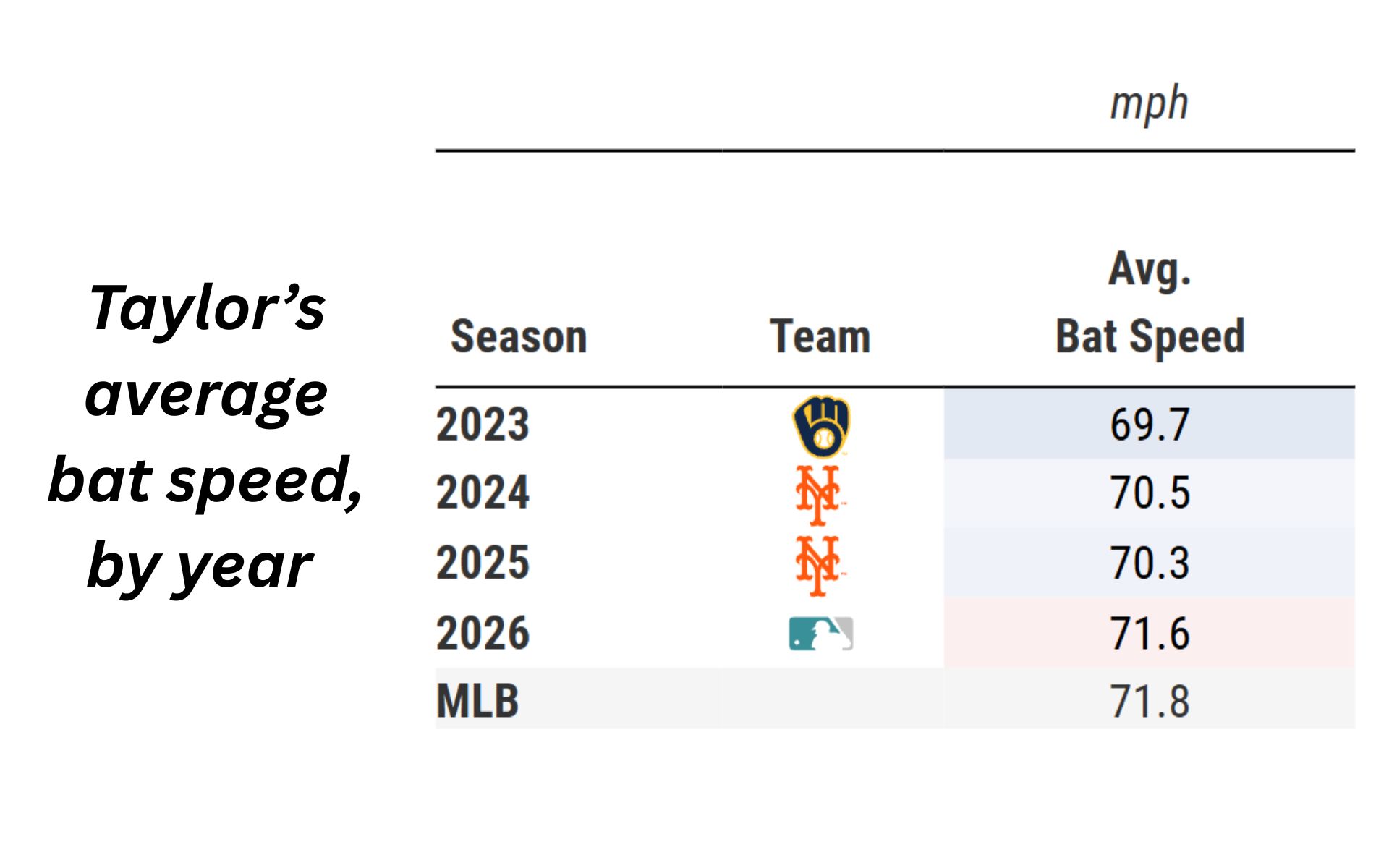
Taylor isn’t going to crack any leaderboards for how hard he swings the bat. But this still matters, and pretty significantly so.
Let’s use 72 mph as the cut-off point here. As it turns out, Taylor is a vastly more productive hitter when he swings faster.
Taylor's production by bat speed
- Swings 72+ mph: .366 BA, .774 SLG
- Swings <72 mph: .236 BA, .302 SLG
Taylor is swinging harder, and he’s more productive, which is all intertwined with the fact that he started pulling the ball more often. For most every hitter but your elite slugger, pulling the ball in the air is the best way to hit for power. It is just much easier said than done.
Taylor’s 53.3% pull rate in 2026 was a single-season high, as was his 27.7% pull air rate, or the percentage of pulled batted balls that were also in the air. He’s always pulled the ball at a high clip, but even this was a notable uptick. Only 24 qualifiers pulled the ball in the air more often than Taylor last season.
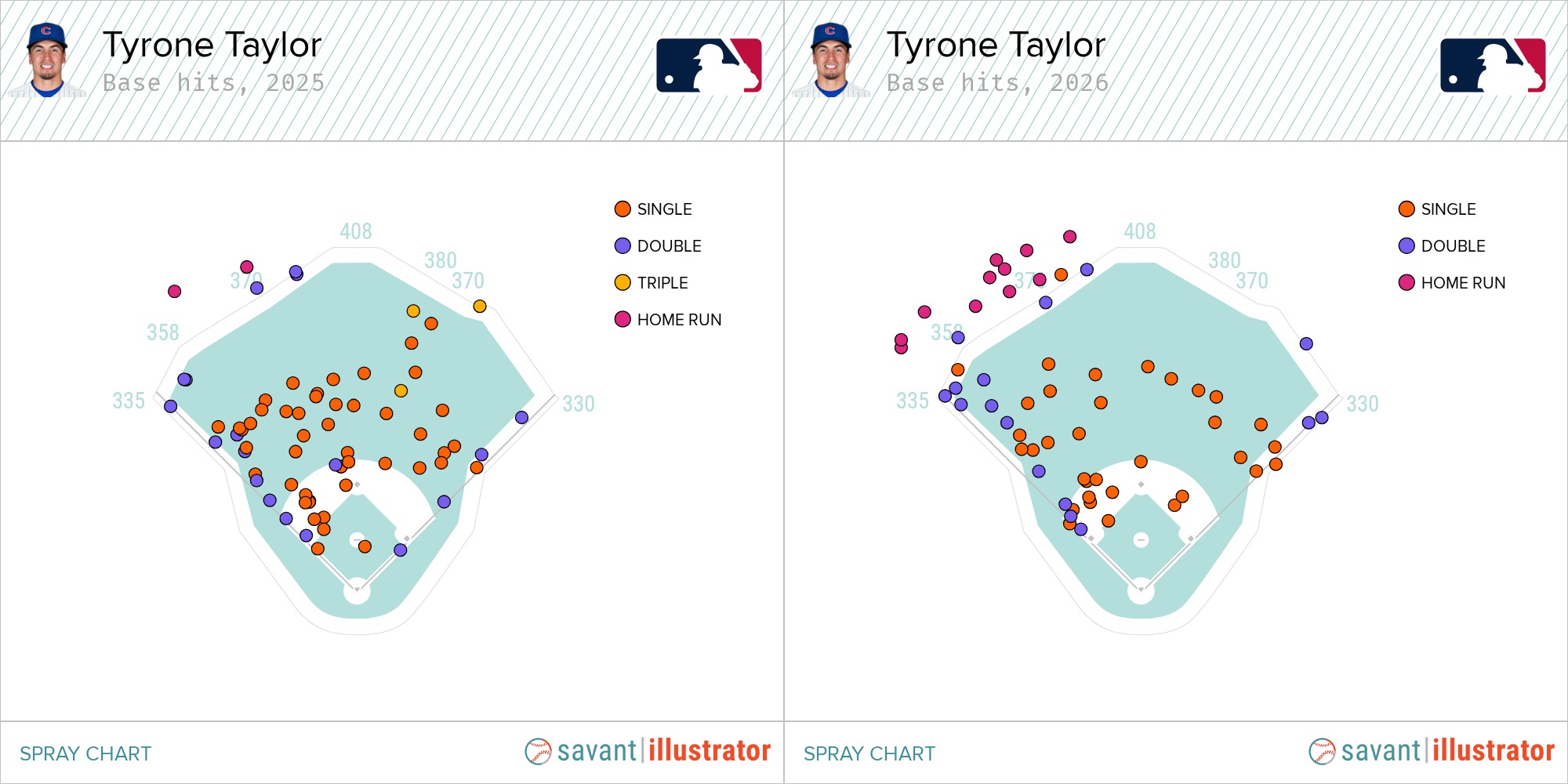
It’s not a secret what he was trying to do, either. Here’s what Jeff Albert, at the time the Mets director of hitting, told The Athletic in July:
“He started making adjustments a while ago, getting behind the ball and getting his swing path back to good positions, driving the ball in the air.”
It’s pretty easy to see that Taylor changed the shape of his swing, and the timing, too.
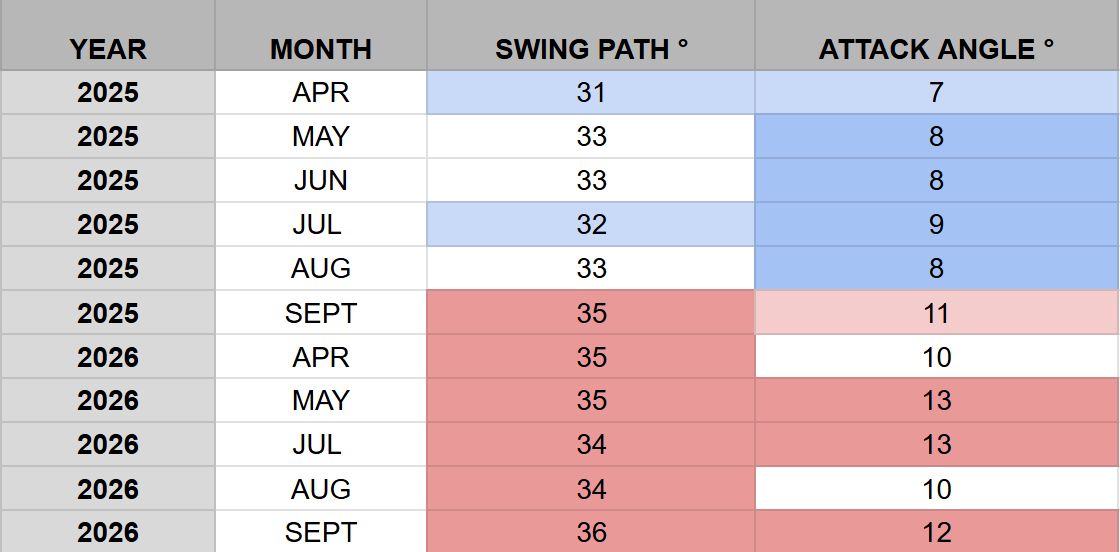
Taylor steepened his swing path. Albert is also talking in part about attack angle, a Statcast metric that measures the vertical direction that the sweet spot of the bat is moving at contact with the ball. A higher attack angle denotes a fly ball-oriented swing, because the bat meets the ball at a steep upper trajectory. In 2025, Taylor had an attack angle of 8°; this past season, his attack angle jumped to 12°. The league average, for reference, is about 10°.
Taylor has always had a pull-oriented attack direction, which measures the horizontal direction that the sweet spot of the bat is moving at contact. These metrics work together to explain Taylor’s power surge. At point of contact, between his attack angle and attack direction, he was well positioned to pull the ball in the air. A little more bat speed allowed him to get more production out of these batted balls.
The White Sox probably aren’t expecting Taylor to slug like this over a full season. But these are legitimate changes, and part of Taylor’s value comes from the fact that he is a righty-hitting outfielder. As MLB.com’s Mike Petriello explored last offseason, righty outfielders who can hit are an increasingly rare commodity. As a group, right-handed-hitting outfielders had a 100 wRC+ in 2026, which is the third-lowest in the Live Ball Era, which began in 1920.
And thanks to a few under-the-hood changes, Taylor seems to have raised his offensive floor.