
Baseball’s joy takes many forms, but certainly, one is its propensity to surprise. The novelty can be thrilling, particularly in a sport so keenly steeped in repetition.
Maybe you show up one day and witness a perfect game. What luck! Perhaps you have the good fortune to be in the building for a three- or even four–home run game. Could be you bought a ticket for a potential winner-take-all postseason game against your team’s most bitter rival only to see a rookie pitcher -- who grew up rooting for the other side in the blood feud -- go eight shutout frames with 12 K’s. Imagine that …
Sometimes, though, it’s less historic, more mundane. Still eyebrow-raising, just quieter. There are great defensive plays that can tickle the senses, superb individual pitches that defy physics, even pedestrian-seeming at-bats that turn into epic battles.
It’s all there, and it’s why you come back. If you want to boil the whole enterprise of baseball to its simplest attribute, perhaps you can sum up its appeal thusly: It’s the act of making something incredibly difficult look easy. Of making something impossible seem ordinary.
And the irony as you cheer on and idolize these superheroes on the field is that sometimes you learn to appreciate them most by watching it all fall apart. Or, to put it more plainly, sometimes you need to be reminded of how hard all of this is. It keeps you from taking it for granted.
On Aug. 13, 2016, Aaron Judge debuted in grand fashion, mashing a homer off the batter’s eye in center field at Yankee Stadium in his first career plate appearance. It was a special day in the Bronx, a ceremonial and almost metaphysical turn of the page. The night before, Alex Rodriguez played his final game, enjoying a brief on-field ceremony before heading into retirement. Judge’s inaugural outing then took place on a day when the Yankees honored the 20th anniversary of the 1996 World Series champions. The members of the Core Four -- Derek Jeter, Andy Pettitte, Jorge Posada and Mariano Rivera -- were in the press conference room in the bowels of the stadium, watching on the televisions and marveling as a new era of Yankees baseball began.
Only … after that remarkable first at-bat, no one who watched Judge over the next month and a half would have imagined what the future held. Three AL MVP Awards were the absolute last thing on anyone’s mind as Judge struggled to a .179 batting average with just three more homers over the next 26 games, striking out in exactly half of his at-bats as the Yankees played out the string.
Judge, it turned out, would be just fine. And 10 years later, there was every reason to believe that George Lombard Jr. will be as well, even as the Yankees’ top prospect endured a series of highs and lows during his first months in the Majors. So often, Lombard made impossible things look easy. At the same time -- particularly during one brutal six-game stretch that was historic for all the wrong reasons -- he made the simpler things look hard. Maybe it’s a blessing, an inadvertent level-setting to keep the hype at a manageable level. Or maybe it’s just the reality of a life in baseball, which just so happens to be something that Lombard Jr. knows all about.
“I’ve been in a position where I can see it in person so much throughout my whole life,” says the 21-year-old son of former big leaguer (and longtime coach) George Lombard Sr. “I feel like the more things you see happen, the more information you collect, and it’s easier to anticipate plays before they happen. Because you’ve already seen it.”
***
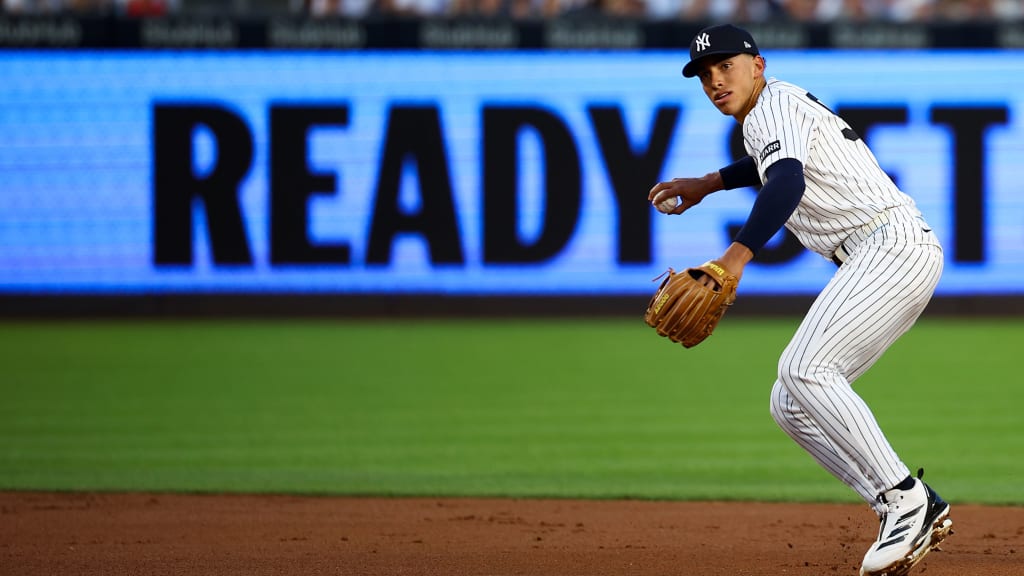
Eleven games into Lombard Jr.’s big league career, the defensive stats were downright mind-boggling. Not that it was surprising to see the sure-handed shortstop thriving. It was just how effortless it all looked. And the stats backed up the vibes.
Per the Fielding Bible, he had eight defensive runs saved in his first 100 innings. To offer some context, Toronto’s Ernie Clement led all big leaguers in DRS with 22 in 1,265 1/3 innings in 2025; the year prior, Daulton Varsho paced the Majors with 28 in 1,085 1/3.
It was 11 games of highlight-reel plays on a near nightly basis. But three weeks and 128 innings later, Lombard’s ledger stood at six DRS; he had a negative-2 mark over games 12 through 27 of his career, a run that included errors in six consecutive games from Aug. 21–27. No Yankee had managed that dubious feat since 1921.
If that week made you wonder what you were seeing, you weren’t alone. Which George, some asked, was the real one? No one was ready to write off the young prospect, but neither were they willing to deny what that their eyes were telling them.
Lombard’s teammates and coaches remained confident, as did the rookie himself, but manager Aaron Boone acknowledged the mental challenge he now faced. “You start not wanting to make a mistake,” Boone explained during the rough stretch. “But the good thing with George is, he’s so skilled and gifted out there, and foundationally, he’s really good, too. So, he will get through it. You’ve just got to get a few going and then start playing kind of carefree, free and easy a little bit.
“You’re supposed to make every single play, and you don’t make a couple, and instead of playing to go make every play, somehow you guard against a mistake. We’ve got to make sure we guard against that. But over time, he’ll be fine just because of how skilled he is and how good his foundation is.”
How skilled and good Lombard can be was evident long before his big league debut, but anyone who wasn’t already prepared for the shortstop’s debut learned fast. He was the youngest Yankee to make his debut at shortstop since Jeter, and he showed all the cool comfort in the spotlight that the Hall of Fame Yankees captain had for two decades in New York. In his second at-bat as a Major Leaguer, with his parents and girlfriend in attendance, Lombard laced an 0-2 pitch from Cardinals hurler Hunter Dobbins over the left-field fence.
“George Lombard Jr. has entered the yard and left it!” YES Network announcer Ryan Ruocco shouted as the rookie made his turn around first base and slowed to a trot around the bases.
It was one day after the Trade Deadline, fitting timing for Lombard to make his debut. The Yankees’ roster was basically set for the stretch run, and Lombard was going to be a part of the pennant chase. Before the game, Boone’s message to his new shortstop was simple, tailored to a player who had long since proved that he had the mental wherewithal to thrive in the sport.
“Go be you,” Boone said. “There’s always the unknown and things you’ve got to account for and things you’ve got to gain experience at. But in George’s case, we feel great about the person and the player.”
Dan Fiorito is Lombard’s first-base and infield coach, but before that, Fiorito coached up and down the Yankees’ Minor League system, and he has been working with Lombard since the team took him with its first pick (26th overall) in the 2023 Draft.
“He’s a sponge,” Fiorito says. “His love for the game comes out when you train with him, and he’s just somebody who wants to get better in every aspect of the game.”
Before games, Fiorito and Lombard regularly work on all parts of his defensive game, different drills that train his reflexes, his hands, his footwork, everything. The shortstop is used to putting in the work, and the joyful energy comes out as much in the preparation as it does during the in-game moments. You can watch a coach bounce balls to Lombard and see the young infielder barehand them, and then during the game, it all comes together. The tools are great, but they must stay sharpened.
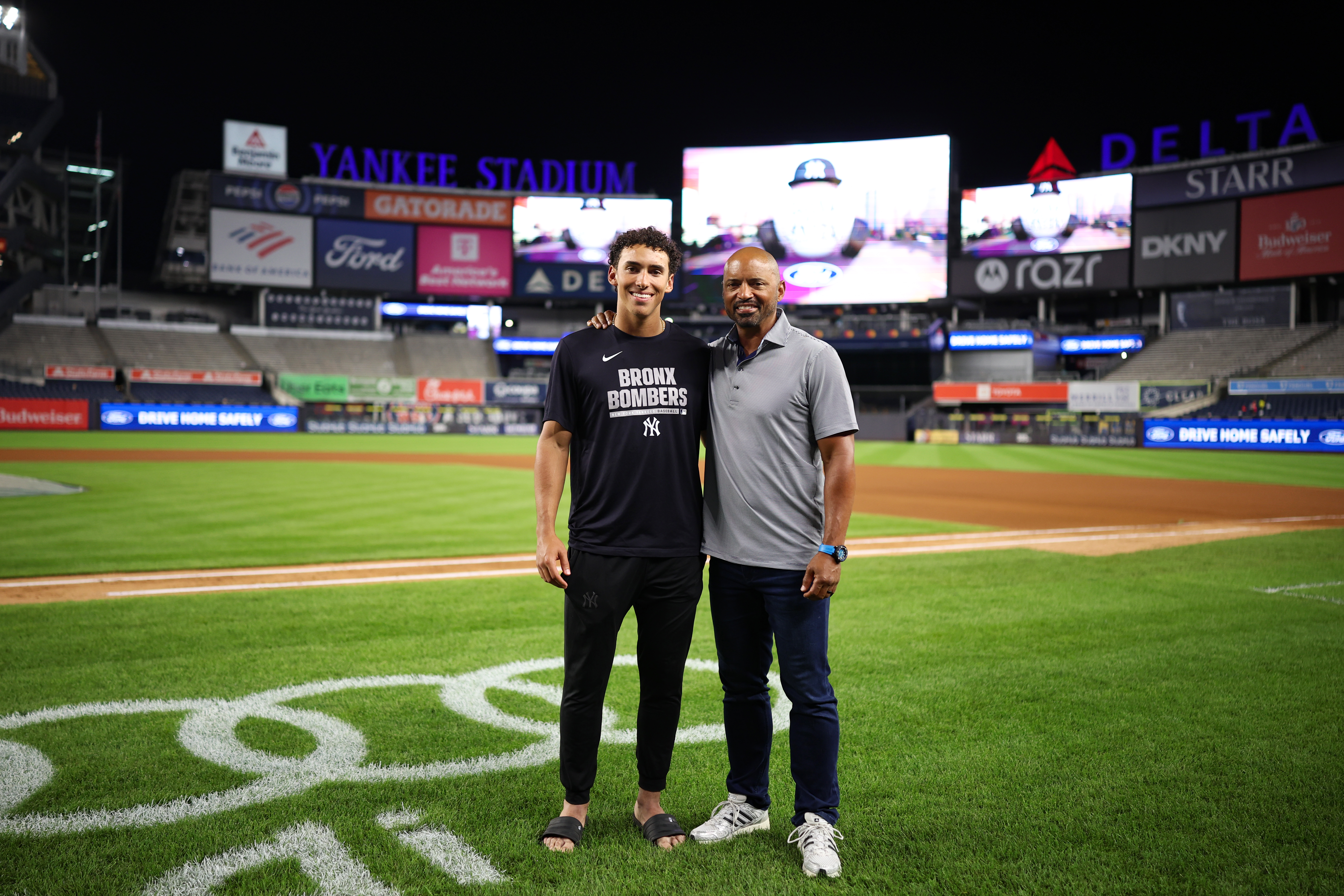
The instincts are innate. On Aug. 21, when a ball bounced awkwardly and Lombard had to turn his body, almost in midair, so that he could barehand the hopper and still fire to first, you could marvel at the play, or you could appreciate the thousands of grounders a player has to take, the myriad different bounces he has to see, in order to reliably react in that way.
Fiorito regularly thrills at the sight of a player who is locked in at every moment, a 21-year-old whose routine between pitches is textbook.
“Any good defender is going to think through the play, anticipate where they’re going to go with it,” Fiorito says. “But the awareness and the ability to do that for 150 pitches a night, the ability to concentrate for three hours every night, every single day, is something that, yes, we expect from everybody, but to bring it every single pitch is something that’s not easy to do. And for him to do that at 21 years old right now, I think it’s super impressive.”
Lombard’s teammates certainly notice it, as well. Ryan McMahon led all big leaguers in defensive runs saved in 2021, so he knows a thing or two about elite glovework. It didn’t take long for him to realize that the guy playing to his left had something special. “I like to think I have a good internal clock, and I know I definitely didn’t have it at 21,” McMahon says. “So, for him to have it at the premier defensive position is pretty impressive.”
Lombard doesn’t deny that the spotlight gets brighter when you move from the hotshot prospect, next-man-up category to become the starting shortstop for the New York Yankees. And whether he’s thriving or enduring the wildly uncharacteristic struggles, he knows that he can rely on all that is rooted beneath his feet. Keep the routine steady, keep the focus true, and it doesn’t have to feel as different as it obviously is. “The most comfortable part of it is playing the game, believe it or not,” Lombard says, looking back at a whirlwind first few weeks. “Being able to do all my routines that I’ve done all year, whether that’s defense, hitting, in the weight room -- everybody here has allowed me to carry over what I do and pop it in place here.”
It’s all about the foundation. For George Lombard Jr., it always has been.
***
Boone understands a baseball foundation as well as anyone. The ninth-year skipper is part of a three-generation baseball family, the grandson of Ray Boone, the son of Bob and even the brother of Bret. “I grew up in a Major League clubhouse, literally, from the time I was a baby,” he says. “My dad retired my senior year in high school; it’s all I knew.” The Yankees’ manager is keenly aware of the advantages that he enjoyed as a Boone, the ways that it made him comfortable in what might be incredibly intimidating environments.
These days, Boone manages a team filled with guys who had similar upbringings to his own. Ryan Weathers and Cody Bellinger both have fathers who played in the Majors (including for the Yankees), and Luis García Jr.’s father enjoyed a brief big league career but a long run playing pro ball in the Dominican Republic. Yankees third-base coach Luis Rojas, the son of Felipe Alou, is part of one of the most legendary families in baseball history.
If you’re looking for ways to tamp down the pressure of playing in the Bronx, there aren’t too many more effective strategies than spending time in the environment as a kid. “For me, it was just being around big leaguers all the time,” says Weathers, whose father, David, pitched 19 years in the Majors, including for the 1996 world champs. “You watch them work. When I was younger, I would go to Reds games, watching Joey Votto take BP, watching Brandon Phillips take BP. Jay Bruce, Ken Griffey Jr. The list goes on and on.
“You just kind of pick up on some little stuff.”
But Boone also knows that it’s hardly a one-size-fits all genetic trait. “I’ve been around guys that grew up in that environment that don’t necessarily have the best makeup,” he says. That, so far, has certainly not been a problem for Lombard. “In George’s case,” Boone says, “There’s no question it has benefited him.”
Lombard Sr. was Bellinger’s first-base coach when the outfielder played for the Dodgers, so he remembers his new teammate from back when he was 13, running around and taking grounders, knowing how to handle himself around Major Leaguers. While Bellinger was just 7 years old when his father, Clay, played his final game, Lombard Jr. was around the sport’s elite for much longer, and Bellinger isn’t alone in feeling like those years spent practicing in empty big league stadiums are evident in the ease with which Lombard Jr. not only plays the game but also carries himself.
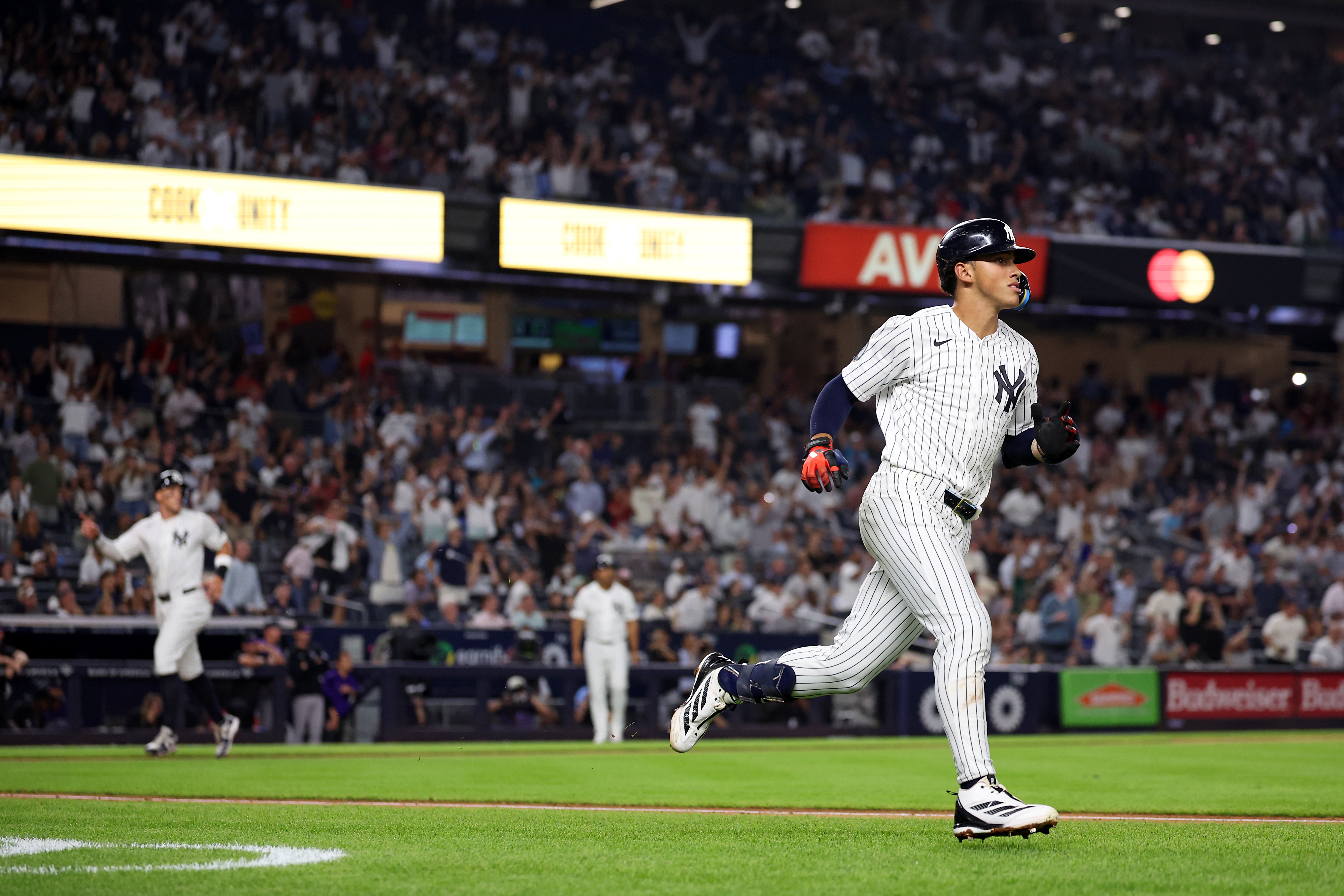
“Behind every single one of those moves and that comfort is years and years of proper reps,” McMahon says. “The feel, the way he feels out a ground ball, the internal clock, it can really only come from reps and repetition and understanding what you’re doing.”
To Jazz Chisholm Jr., it’s even more simple: “He had years of experience before he ever got to the field.”
If the Yankees’ clubhouse seems built around family ties, you can also glimpse some of that same future that Bellinger once saw. Over the last two years, Paul Goldschmidt’s son, Jake, has been a regular around the clubhouse. Now 11 years old, his father -- and his father’s teammates -- marvel at the maturity Jake displays, the way he’s able to be around without ever being a distraction.
Last year was the first time that the Goldschmidts got to enjoy a summer together around a big league ballpark, and Paul is incredibly grateful to the Yankees for letting it happen. He spent the offseason talking to friends in other lines of work, urging them to find ways to bring their own kids into their professional lives when possible. The benefits that Goldschmidt sees cover so much of life and baseball and parenting and the way all three intersect. He knows that the grounders he hits to Jake in an empty Yankee Stadium and the late-night drives home from the ballpark will make for core memories and also great baseball experiences, but he’s just as intent on talking about the ways that he sees Jake and his sister, Emma, maturing by being around a professional environment.
“They get put in situations where they’re the only kids with adults,” he says. “They’ve flown around this country to every major city, and whether that’s talking with TSA agents or flight attendants or pilots or people at the hotels or Uber drivers, they get put in a lot more adult environments than I did as a kid, and hopefully that helps them.”
There’s another, perhaps less obvious connection, though. Goldschmidt is a model teammate, beloved by seemingly everyone he has ever played with. He is also a veteran, much closer to the end of his career than the beginning. And never is that more evident (and maybe even painful) than when a new 21-year-old prospect earns a callup.
So, as Goldschmidt considers the benefits that a player like Lombard Jr. might have gotten from a childhood very similar to what his own son is experiencing, there’s a salient point that bears mentioning. “I’m 17 years older than him,” Goldschmidt says. “He’s only 10 years older than Jake.” Maybe that helps a young kid feel more comfortable around adults. Maybe it helps a young player feel at ease. Maybe it gives a 39-year-old veteran a seat at the cool kids’ table. Or maybe, it works over time to establish the environment every team seeks to create, a foundation that pays dividends generations down the line.
“I remember just loving that part of my life,” Lombard says of his youth. And now that his upbringing has become his occupation, he benefits from the comfort it provided him, the instinctual ability that comfort allows, and the control those instincts give him over every moment on the diamond.
***
How, then, do you measure the first few months of George Lombard Jr.’s career? Is it in the highs or in the lows, or is it somewhere in between? The highlight plays were expected, and the prospect delivered. The errors? No one saw them coming in bunches the way they did, but to Lombard’s credit, he never wavered. Lessons are tough at the big league level, where everyone is watching. But like Jake Goldschmidt watching his father strike out, Lombard grew up seeing the other side -- the work that players put in, the effort it takes to fix problems, the mental strength they need to brush off adversity.
“The more I’ve matured, the more I’ve learned about everything, the more I’ve prepared myself to deal with that,” Lombard says, perfectly echoing what any parent or coach might want to hear, and making you remember that as he grew up, those two roles were one and the same. “I want to stay on the attack. I want to stay aggressive. I want to keep playing my game.
“Things might happen on their own, a little out of your control. But everything that I can control is going to stay the same.”
It’s a tough lesson for a young kid but an important one. The game, Lombard reminds you, is the easy part. The fun part. The occasionally wild part. On the same night that he debuted for the Yankees, his brother, Jacob, made his professional debut for the Marlins’ Single-A affiliate in Jupiter, Fla. Talking on the phone after their milestone games, Jacob told George that he was able to glimpse a TV behind one of the bars in the stadium concourse, and he caught sight of George trotting around the bases. And while George was getting ready for an at-bat later in the game, Cam Schlittler came up the stairs to the dugout from the clubhouse tunnel and told George that his brother had also homered.
It was quite a night for the Lombards as a group, and for George Jr., personally. There will be more. There will probably be errors that come in bunches because baseball is an impossible game to master. But there will also be defensive plays that defy physics because Lombard is that good, his instincts that keenly honed.
And his sense of timing? That’s plenty impressive, too. On Old-Timers’ Day this year, as a cadre of Yankees greats looked on, Lombard hit a crucial homer, a momentous blast that called to mind the generational intrigue of Judge’s first long ball. A few weeks later, the day after Judge returned from an injury that left the Yankees’ offense reeling for most of the summer, Lombard mashed the team’s first grand slam of the season to break a meaningful September game wide open.
The kid has a flair for the dramatic, but that may never be the thing that stands out the most. Lombard has been hailed for his near-perfect makeup since Yankees fans first learned his name. The assumptions that the Lombard name carried were no doubt helpful, but now it’s time for him to carve his own path, to replant the roots that supported him to this point.
“I see George, and I see the maturity,” Rojas says. “I see that anything can happen right now in his game, and he’s going to show up for his next at-bat, he’s going to show up for the next play. You see the level of maturity of a guy who has been around in the game, who goes through the same adversity, makes the same mistakes. You see that all the time.
“You’re a Lombard, and you want to do what your dad did. So, you even take it a step further. You work extra. I didn’t want to be ‘Felipe Alou’s kid.’ I always wanted to be myself and work extra. You can tell George has done that.”
Jon Schwartz is the deputy editor of Yankees Magazine. This story appears in the October 2026 edition. Get more articles like this delivered to your doorstep by purchasing a subscription to Yankees Magazine at www.yankees.com/publications.