





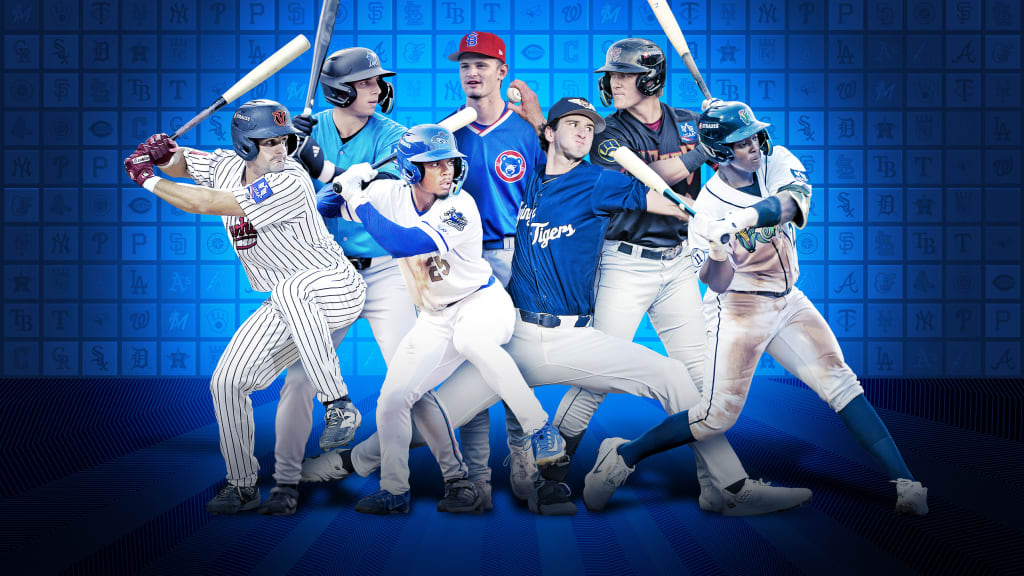
You can only make one first impression.
Organizations handle recent Draft picks in all sorts of ways. Sometimes, they’ll hold them back for lighter work at the Spring Training complex, work that continues into fall instructs or bridge-league play. Sometimes, they’ll push them out to an affiliate to get their feet wet in pro ball and establish a foundation on which to build moving forward.
More from MLB Pipeline:
• Top 100 prospects | Stats | Video | Podcast | Complete coverage
For the latter group, post-Draft performance can often be a mixed bag with some struggling out of the gate after long high-school or collegiate seasons and subsequent layoffs before the Draft. But if nothing else, all in-game looks are more information about players, and you’d rather get off to a good start than a bad one.
Here are the best professional debuts from the 2026 Draft from each of the 30 farm systems:
Jump to: AL East | AL Central | AL West | NL East | NL Central | NL West
AMERICAN LEAGUE EAST
Blue Jays: Jake Bennett, 1B/OF (not ranked)
The eighth-rounder was just a $1,000 signing as a senior out of Dallas Baptist, where he hit .346/.475/.776 with 19 homers over 43 games in the spring, and he very much carried his hard-hitting ways to Single-A Dunedin. Bennett had a .278/.388/.639 slash with seven long balls over 23 games in the pitcher-friendly Florida State League, and the data backed up the slugging-heavy numbers with a 114.4 mph max exit velocity and 111.3 mph 90th-percentile average EV in the small sample. He primarily played DH for Dunedin, but Bennett hit enough to draw more attention heading into next year.
Orioles: Ty Head, OF (No. 15)
Head hit 14 homers, swiped 26 bags and played an outstanding center field as a Draft-eligible sophomore, allowing him to rise into the second round even though he hit only .291 for the year. He has 20-20 potential with an advanced approach at the plate, showing some of it off by hitting a combined .310/.395/.437 over 21 regular season games across both levels of A ball.
Rays: Grady Emerson, SS (No. 1/MLB No. 12)
Only two players from the Rays’ 2026 class played after the Draft this year (18th-round pitcher Nate Smithburg being the other). So the fact that the second overall pick, who was still playing high-school ball in Texas only months earlier, saw time at Single-A Charleston (including a run to the Carolina League Finals) is notable. Emerson only went 9-for-55 (.164) with a triple in his 14 total games with the RiverDogs, but this was all about giving him a look at full-season ball to prepare him for his first full season at age 19 in 2027.
Red Sox: Owen Hull, OF (No. 8)
After finishing second in NCAA Division I in hits (103) and RBI (87) and third in doubles (27) while leading North Carolina to a runner-up finish at the College World Series, Hull turned pro as a supplemental second-rounder and continued to rake. Featuring growing power and plus speed, he slashed .337/.436/.531 with three homers in 24 High-A games.
Yankees: Anthony Potestio, 3B/SS (not ranked)
Known much more for his on-base skills than his power at UC San Diego, Potestio matched his college career high with five homers in 19 Single-A games. The 11th-rounder batted .333/.413/.684 and drew 19 walks in 80 plate appearances.
AMERICAN LEAGUE CENTRAL
Guardians: Alejandro Garza, 2B (not ranked)
Garza's bat-to-ball skills stand out more than any of his physical tools, and he struck out just 5 percent of the time in three college seasons at Cal Poly. A 15th-rounder, he hit .347/.405/.472 with a 14 percent K rate in 18 Single-A contests.
Royals: Zion Rose, OF (No. 6)
A surprise pick to many at No. 6 overall, Rose was assigned to High-A Quad Cities out of the gate and was a part of the River Bandits’ Midwest League championship squad, hitting .241/.367/.299 with one homer and an 18/17 K/BB ratio over 23 total games between the regular season and playoffs. His 2026 isn’t done yet, however, and that’s why he’s the pick here. The Royals sent the former Louisville outfielder to the Arizona Fall League to make up for some of the at-bats he missed due to ankle and hamstring injuries in the spring, and entering Wednesday, he’s gone 7-for-23 (.304) with a homer, a triple, six walks through his first six games for Surprise.
Tigers: Cameron Flukey, RHP (No. 5)
Flukey was out for two months for Coastal Carolina in the spring due to a rib stress fracture, but that didn’t scare the Tigers away from taking him 22nd overall in July. The missed time did allow the 6-foot-6 righty to get a rare early taste of the Minors for a college arm, and he responded to the opportunity by throwing 10 ⅓ scoreless innings for Single-A Lakeland, striking out 14 and walking seven in the process. He relied heavily on a 93-95 mph four-seamer that averaged 19 inches of ride and also mixed in a cutter, slider, curveball and changeup for a full arsenal.
Twins: Vahn Lackey, C (No. 2/MLB No. 18)
Lackey joined a long list of Georgia Tech catchers to go in the first round (Jason Varitek, Matt Wieters, Joey Bart, Kevin Parada) when the Twins took him No. 3 overall after he slashed .397/.519/.772 as a junior with the Yellow Jackets. He has the potential to be a plus hitter with plus power at the highest level and after getting his feet wet with a .759 OPS in 15 games with Single-A Ft. Myers, he hit .316/.500/.500 over 10 games with High-A Cedar Rapids.
White Sox: Clay Burdette, OF (not ranked)
Burdette offered one of the best combinations of physicality (6-foot-2, 215 pounds) and athleticism in the 2026 class, which landed him in the seventh round and allowed him to surpass 2017 eighth-rounder Rylan Bannon as the highest-drafted position player in Xavier history. He displayed well above-average raw power and plus speed while slashing .274/.381/.481 with two homers and 13 steals in 29 Single-A contests.
AMERICAN LEAGUE WEST
Angels: Gavin Grahovac, 3B (No. 10)
After missing most of his sophomore year at Texas A&M because of a torn left labrum, Grahovac returned to hit 22 homers and greatly cut down his strikeout rate in 2026, helping him land in the third round. He kept on mashing during a 24-game debut in the Single-A California League, with 14 extra-base hits (eight homers) in 92 at-bats for a 1.043 OPS.
Astros: Logan Hughes, OF (No. 3)
Hughes' track record of performance at Stetson and Texas Tech and his penchant for hard contact made him one of the more desirable college bats in the 2026 crop, though a bit of a surprise first-round pick at No. 17 overall. He lived up to his reputation in his debut, hitting .333/.443/.605 with four homers and eight steals in 21 Single-A games.
A’s: Drew Burress, OF (No. 2/MLB No. 37)
Burress might be undersized at his listed 5-foot-9, but he has plenty of thump at the plate. He went No. 8 overall in the Draft as the highest-ranked college outfielder in the class following a junior season that saw him post a 1.130 OPS for Georgia Tech. He homered in his first pro at-bat with Single-A Stockton, and hit seven total in 28 games to finish with a .291/.431/.591 line.
Mariners: Ace Reese, 3B (No. 8)
Reese started at Houston then spent two years raking at Mississippi State, with 45 homers over his sophomore and junior seasons. After landing in the first round (No. 24 overall) with the Mariners, he made a very strong first impression with 100 plate appearances for Single-A Inland Empire, finishing with a .440/.530/.667 OPS (eight doubles, three homers).
Rangers: Kaden Carpenter, OF/1B (not ranked)
The highest-drafted player in Utah Valley history, Carpenter became a ninth-round senior sign after slamming 17 homers during the spring. Known for producing high exit velocities, he batted .229/.393/.476 with six homers in 31 Single-A games.
NATIONAL LEAGUE EAST
Braves: Carter Beck, OF (No. 14)
The Braves got a PPI pick thanks to Drake Baldwin’s Rookie of the Year win, and they used it to take Beck, the Missouri Valley Conference Player of the Year at Indiana State after he hit .346/.446/.637 as a junior. After signing, he hit .409 over 11 games with Single-A Augusta and though he cooled off with a move to High-A Rome, he finished with a .283 average and .400 OBP, walking nearly as much as he struck out over 29 total games.
Marlins: Jacob Lombard, SS (No. 4/MLB No. 65)
The son of former big leaguer George Lombard and brother of Yankees rookie shortstop George Lombard Jr., Jacob featured some of the best all-around tools among 2026 prepsters and went 14th overall out of a Miami high school. The Marlins immediately challenged him by sending him to Single-A, and he responded by hitting .220/.343/.390 -- good for a 98 wRC+ at age 18 -- with four homers and 11 steals in 22 games.
Mets: Ryan Tayman, C (not ranked)
After two years at Cal, Tayman transferred to Cal Poly for his junior year and exploded with a career-best 18 homers, more than triple his sophomore total of five. He won co-Big West Player of the Year honors for that effort and also was named Most Outstanding Player in the Los Angeles regional for his postseason work. After going to the Mets in the ninth round, he carried those hard-hitting ways to Single-A St. Lucie, where he hit .316/.432/.579 with five homers in 21 games. His work on defense and against offspeed stuff will deserve monitoring, but this is a strong start.
Nationals: Zack Konstantinovsky, RHP (not ranked)
After missing the 2025 season due to injury, Konstantinovsky returned to the Rutgers rotation this spring and showed enough stuff to go to the Nats in the 14th round as a redshirt sophomore. He made four appearances (one start) for Single-A Fredericksburg after signing for $150,000, and didn’t allow a run or walk while fanning eight over six scoreless innings. It was a small sample, sure, but the quality 80-83 mph changeup that was his best pitch with the Scarlet Knights carried over to pro ball, eliciting eight whiffs on 16 swings against it in the Carolina League.
Phillies: Reece Moroney, 2B/SS (not ranked)
A three-year starter at shortstop for Rhode Island who hit .370/.426/.494 as a junior, Moroney went in the 10th round of the Draft to the Phillies. He’s a steady defender who mostly played second base during his pro debut while continuing to show off his excellent bat-to-ball skills by hitting .429/.515/.518 over a brief 14-game stint with Single-A Clearwater after signing.
NATIONAL LEAGUE CENTRAL
Brewers: Sawyer Strosnider, OF (No. 16)
The 2026 second-rounder provided one of the highlights of the Minor League Baseball season when he hit his first pro homer to his father on Aug. 19. But the TCU product was more than that, hitting .276/.388/.448 with nine extra-base hits and seven steals in his 22 games with High-A Wisconsin after the Draft. Strosnider is a power-speed threat in a deep Brewers system but will need to improve his contact and groundball rates to maintain this level of production at higher levels.
Cardinals: Owen Henne, INF (not ranked)
St. Louis was widely seen as having the deepest class in this year’s Draft, and if the organization’s sixth-rounder out of Division II Seton Hill continues to produce like this, it could look even deeper in quick order. Henne went 12-for-55 (.218) in 16 games for Single-A Palm Beach, but of those 12 hits, eight went for extra bases with four homers and four doubles. He added nine walks and only 11 strikeouts in that time too. Henne rotated between second, third and shortstop on the defensive side as he worked his way into St. Louis’ infield depth chart.
Cubs: Caden Sorrell, OF (No. 7)
Sorrell has two grandfathers who played in the Majors -- Tom Griffin and Billy Sorrell -- and the tools to reach that level. His plus raw power, speed and arm strength prompted the Cubs to select him in the second round, after which he slashed .295/.347/.523 with five homers and eight steals in 22 Single-A contests.
Pirates: Chris Rembert, 2B (No. 9)
Rembert parlayed his plus hit tool and excellent knowledge of the strike zone as a Draft-eligible sophomore into being taken by the Pirates in the supplemental second round. After hitting .343 at Auburn, he got his feet wet with Single-A Bradenton, hitting .284 with a .415 OBP and nine steals in 18 games
Reds: Justin Lebron, SS (No. 3)
Perhaps the toolsiest, and most enigmatic, hitter in the Draft class, Lebron’s uneven junior season at Alabama, where he hit just .229 in SEC play, led to him lasting to the Reds’ pick at No. 18 overall. The Reds sent him out to High-A Dayton for his debut and all of his tools were on display over 23 games as he posted a .940 OPS with eight homers and six steals before helping the Dragons reach the Midwest League Championship Series.
NATIONAL LEAGUE WEST
D-backs: Ryder Helfrick, C (No. 2)
Arizona’s strength on the farm is its catching, and the D-backs bolstered that by taking the Arkansas backstop 15th overall in July. Helfrick came as advertised offensively, showing off good power with five homers and a .521 slugging percentage in 24 games with Single-A Visalia while struggling against breaking balls and offspeed leading to a 26.4 percent K rate. His defense and arm strength behind the plate, along with the pop, can help paper over some of the hit-tool concerns.
Dodgers: Caleb Johnson, SS (unranked)
A four-year starter at Jacksonville State, Johnson is a switch-hitter with good actions at shortstop, gap power and baserunning savvy. The 13th-rounder batted .293/.375/.537 with five homers and nine steals in 22 Single-A games.
Giants: Tanner Mally, OF (unranked)
Mally went in the 17th round after winning the NCAA Division I batting title with a .446 average and setting Western Michigan records with 87 hits and a .554 on-base percentage. A career .400 hitter in college, he has elite bat-to-ball skills and well-above-average speed that translated into a .383/.523/.494 pro debut with eight steals in 24 Single-A games.
Padres: Joe Tiroly, INF (unranked)
After transferring from Rider to Virginia as a junior, Tiroly’s lone year with the Cavaliers began with a foot injury in the fall, so it was promising to see the seventh-round pick's 2026 end on a powerful note. Playing for the California League champion Single-A Lake Elsinore, the infielder went 27-for-84 (.321) with seven homers and five doubles in 22 games between the regular season and playoffs and picked up five hits and three steals over the three-game Championship Series against San Jose.
Rockies: Daniel Jackson, C (No. 6)
Jackson won the Golden Spikes Award after becoming the first Division I catcher to post a 25-25 season while winning the SEC triple crown (.379, 32 homers, 87 RBI). After the Rockies took him in the Competitive Balance Round A, the right-handed hitting backstop slashed .309/.408/.593, with five doubles and six homers in 22 games for Single-A Fresno.