



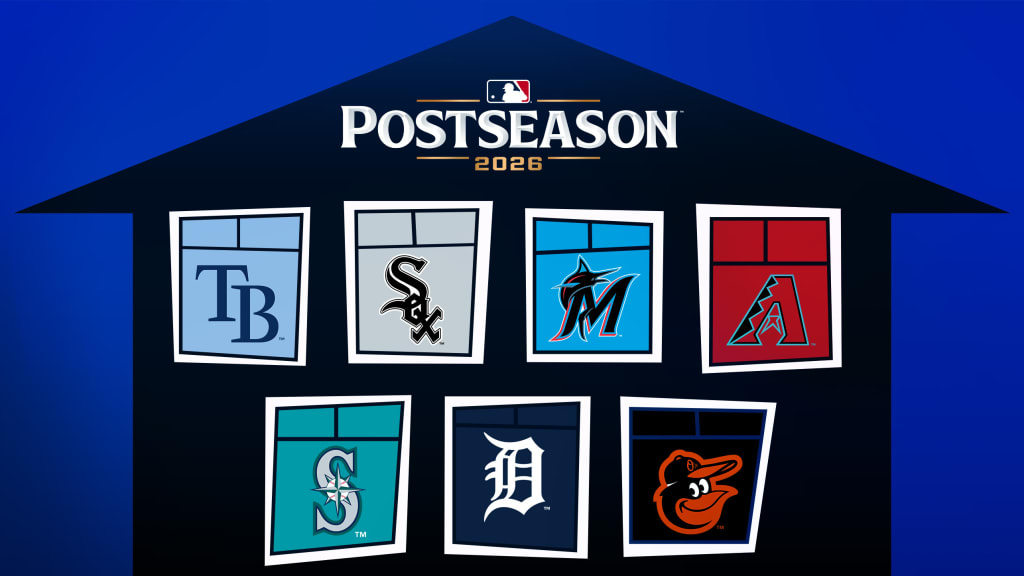
There's no place like home.
For seven playoff hopefuls, that saying is especially true.
These contending clubs have lopsided home/road splits, faring significantly better in their home ballpark than on the road. As we work through a critical stretch between the All-Star break and the Aug. 3 Trade Deadline, these sort of quirks become magnified.
Let's explore a little further to see why these home/road splits are happening for the following seven teams.
All stats and records below are through play on Saturday.
Tampa Bay Rays
35-15 at home; 21-26 away
Not only have the Rays been excellent at home this season -- their .700 win percentage at home is best in the Majors -- but they are, quite literally, back home. The Rays returned to a refurbished Tropicana Field after damage from Hurricane Milton forced the club to play its home games at Tampa's George M. Steinbrenner Field in 2025.
The Trop is a noted run-suppressing environment. On a three-year rolling basis, only three parks have been worse for hitters. What's interesting, though, is that Tampa Bay's three big bats -- Junior Caminero, Yandy Díaz and Jonathan Aranda -- have thrived at Tropicana Field this season. They are all at least 150 points in OPS better at home than on the road. And those three players account for the bulk of the Rays' offensive production, so it's not exactly a surprise that Tampa Bay has the fourth best OPS at home (.779) compared to the 22nd best OPS on the road (.684).
Chicago White Sox
31-17 at home, 20-29 away
Whereas the Rays can pin their stark home/road splits on their offense, the White Sox can look to their pitching. In 48 home games, Chicago has pitched to a 3.18 ERA, the third lowest in the Majors. But on the road, the White Sox have a 5.05 ERA in 49 games; only two teams -- the Royals and the Twins -- have posted a higher ERA away from home. For whatever reason, 10 of the 12 games in which Chicago has allowed 10+ runs have come away from Rate Field.
What gives? This is a little bit about BABIP (batting average on balls in play), which is often used as a proxy for luck. These are at-bats where a hitter makes contact and the ball does not leave the park. At Rate Field, White Sox pitchers have allowed the lowest BABIP in baseball (.262); on the road, they've allowed a .301 BABIP.
Miami Marlins
31-20 at home, 21-27 away
Despite its spacious dimensions, loanDepot park actually plays right down the middle: Using Statcast-fueled park effects, we can see that it's been a neutral environment over the last three years.
Here's one notable difference, though: Sandy Alcantara loves pitching at home. This season, Miami's ace has a 4.48 ERA in 70 1/3 innings on the road, compared to a 3.26 ERA in 66 1/3 innings at home. This isn't new, either. Alcantara's ERA has been at least a full run better at home than on the road in each of the last five seasons -- even last year, when he posted a career-worst 5.36 ERA, Alcantara was significantly better at home (4.40 ERA) than on the road (6.92 ERA). That matters here, especially amid rumors that the Marlins are planning to keep Alcantara through the Deadline as they find themselves in the thick of the pennant race.
Arizona Diamondbacks
28-21 at home, 22-27 away
We'd expect the D-backs to be a more productive offense at home, given that only Coors Field has been a better run-producing environment than Chase Field over the last three years. Things have played out that way, with Arizona averaging 4.53 runs per game at home and 4.14 runs per game on the road.
But there's more going on here, starting with the club's two best hitters. Corbin Carroll has a .937 OPS at Chase Field and a .720 OPS at home; Ketel Marte's splits are similar, with an .844 OPS at home and a .705 OPS on the road. They're hitting the ball harder at home, and that's true for the team as a whole: Arizona's hard-hit rate is much higher at home (39.5%) than on the road (35.8%). That's not the case for any other team in this story. But for the D-backs, the quality of contact is better at home, and it's part of the reason why the record is better, too.
On Thursday, Arizona embarks on a 10-game, four-city road trip that will carry the club right up to the Aug. 3 Deadline.
Seattle Mariners
28-21 at home, 21-29 on the road
On a three-year rolling basis, T-Mobile Park has been the worst hitting park among regular MLB fields. This year, it hasn't had much of an impact on the Mariners' offense, in part because Seattle just hasn't hit much in general: Its .684 OPS is fourth lowest in the Majors.
But playing at home sure has helped the pitching staff. The Mariners have pitched to a 3.16 ERA at home, which is lowest in the Majors and nearly a full run better than their 4.09 ERA on the road. Notably, T-Mobile Park is baseball's biggest strikeout factory, and it's not particularly close. Seattle's pitchers have benefitted, with a 25.9% strikeout rate at home (fourth best in MLB) compared to a 20.8% strikeout rate on the road.
In the muddled AL West, it bears watching that the Mariners have a pivotal four-game series against the Rangers, in Texas, at the end of the week.
Detroit Tigers
27-23 at home, 19-29 away
We explored this one back in May, when the Tigers looked like two completely different teams depending on where they were playing. Things have turned around lately, though. Since June 1, Detroit has been the best team in the American League with a .632 winning percentage; in that span, the Tigers have gone 12-5 away from Comerica Park, including an impressive three-game sweep at Yankee Stadium.
The Tigers' three best hitters -- Riley Greene, Dillon Dingler and Kevin McGonigle -- all have an OPS of .800 or better at home and on the road. That wasn't the case through the first five weeks of the season, when each player had an OPS at least 100 points better at home than on the road.
Of note here, the Tigers are in the midst of a six-game road trip and then return to Comerica Park to begin a seven-game homestand. Those two stretches seem likely to dictate their Deadline fate, with a decision on Tarik Skubal looming.
Baltimore Orioles
28-25 at home, 20-26 away
Changes to Camden Yards have made it more of a hitter-friendly park again; since the left-field wall was moved in ahead of the 2025 season, only three parks have been better run-producing environments. The O's have hit for more power at home (.418 SLG) than on the road (.373 SLG), with the club's standout catchers -- Samuel Basallo and Adley Rutschman -- owning the largest splits. Of note, this was a thing last year, too: As a team, Baltimore posted a .371 SLG on the road and a .419 SLG at home.
The schedule-makers haven't exactly done the Orioles any favors here: Baltimore will play six of its next nine games away from Camden Yards with the Deadline looming. Maybe the tide is starting to turn, though, with a sweep in Houston over the Astros to run their winning streak to seven.