



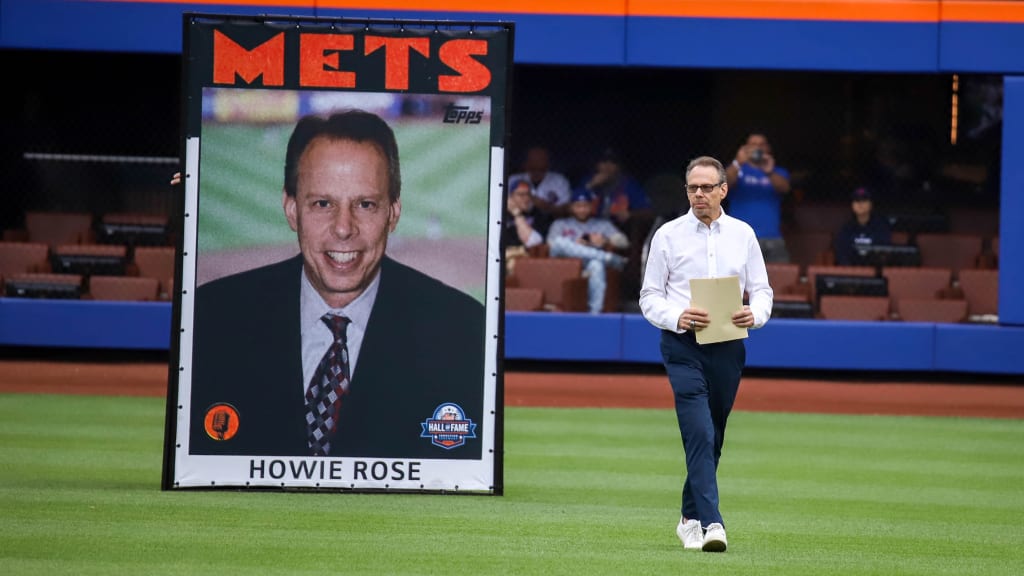
Note: This feature originally ran in a 2023 edition of Mets Magazine, before Howie Rose was inducted into the Mets Hall of Fame. It has been edited and updated for Rose’s retirement ceremony, which was rescheduled for Opening Weekend 2027 due to inclement weather on Sunday.
NEW YORK -- The seats were always the same: Section 1, Row 1, upper deck at Shea Stadium right behind home plate. Afternoon games in those days began at 2 p.m., so after taking the Q27 bus from Springfield Blvd. and 73rd Avenue in Bayside, Queens, to Main Street in Flushing, Howie Rose and his childhood friend Richard Joseph would walk the rest of the way over the Roosevelt Avenue Bridge, making sure to arrive at the ticket office before the stadium gates opened.
Once noon hit, the boys would sprint up the escalator to their general admission seats, which may as well have been reserved. So personal were those seats that Rose and Joseph once carved their initials into the wood, staking their claim to a tiny bit of real estate some several hundred feet above home plate. Joseph would spend a dollar or two on hot dogs. Rose preferred the salami sandwiches he brought from home, sometimes eating two or three in a sitting.
Little could either boy know that within a few decades, Rose would graduate down the stadium tiers into the radio booth, then across the parking lot to Citi Field and eventually, during the latter stages of one of the most decorated careers in modern baseball radio, into the Mets Hall of Fame. He and Gary Cohen in 2023 became the fourth and fifth broadcasters to earn that honor, joining Rose’s idols Bob Murphy, Lindsey Nelson and Ralph Kiner (Class of 1984).
“Every team along the way has had their own Murph or Gary or Howie or whoever,” said Rose, who will retire following his final game on Sunday. “Some of that, I think, is predicated on longevity. But you don’t get to achieve longevity without having made that connection.”
That connection to the fans, to a city, to a franchise runs so deep it would be impossible to forge. Always self-deprecating, Rose balks at the notion that he brings some sort of extraordinary talent to baseball broadcasting. What he brings is unparalleled institutional knowledge, honed decades ago in the wooden seats of Section 1, Row 1.
“There’s really nobody like Howie,” said Wayne Randazzo, Rose’s broadcast partner from 2015-22. “Nobody could ever be like Howie, because he first and foremost has watched pretty much every game the Mets have ever played. So he has this innate sense of history -- and a long history -- that nobody else has.
“You could never do it with the Yankees. ... It’s just an impossibility with any other team and in any other sport the way it is with the Mets and with Howie.”
Indeed, Rose was born at the perfect time to develop his Mets-pertise: 8 years old when the franchise played its first game, 15 when it won its first title, early 40s when he became a regular in the broadcast booth, early 50s when he became the team’s lead play-by-play man. Though the franchise is now well into a seventh decade of existence, it’s no exaggeration to say Rose has missed almost nothing.
“His level of understanding the condition of being a Mets fan is unparalleled,” Cohen said.
The extension from love affair to career was only natural. From a young age, Rose reveled in the idea of becoming a broadcaster, even while keeping those hopes grounded in reality. Among the many summer matinees he and Joseph attended was an Aug. 4, 1966, game against the Giants, whose ace Juan Marichal retired the first 17 batters in order. Down as many as five runs that afternoon, the Mets staged a comeback in the eighth before Ron Swoboda hit a walk-off, three-run homer in the ninth.
“All the way home on that Q27 bus, all I could think of -- because I knew I would never be the one hitting that home run -- was how did Lindsey, Bob and Ralph make it sound?” Rose recalled. “What were their calls like? In retrospect, I kind of knew even then that that was something I would really like to do someday. Knowing that the events I just saw were going to create a memory for somebody who was watching or listening, I wanted to be the one creating those memories.”
“He never wavered from his desire to be a sportscaster,” Joseph added, noting that Rose used to bring a tape recorder to hockey games at Madison Square Garden to practice his play-by-play skills. “And then it was amazing, because things just started falling into place.”
Upon graduating from Cardozo High School in Bayside and Queens College in Flushing (each stop inching him closer and closer to Shea), Rose broke into the broadcasting field in 1975 as one of the original voices of Sports Phone, a call-in service providing scores and information to New York City fans. He became the sports director of WHN radio before pivoting his career mostly to hockey. Broadcasting the Rangers in the early 1990s provided Rose with his first signature call of “Matteau! Matteau! Matteau!” which retains a place in team lore to this day.
But hockey, Rose says, is entirely different from baseball. Hockey is technical: Track the puck, call out the names of who’s handling it, then let your color commentator chime in during a stoppage in play. The pace of baseball, by contrast, is leisurely. There is more time to consider, more time to err.
There is also more time to tell stories, which has become Rose’s forte. His yarns are not simple recollections. They are rich with detail, often invoking his Queens upbringing, a slice of Mets history, or some of his favored Yiddish phrases. In retelling his adventures as a kid, Rose easily recalls the names of storefronts and landmarks along his route from Bayside to Flushing.
“The two years that we worked together felt like having a running conversation with myself,” Cohen said. “I call him my brother from another mother. We didn’t know each other growing up, but we had similar backgrounds and similar experiences growing up as Mets fans. … People talk about my knowledge of the Mets? His is so far above mine in terms of the minutiae he remembers and can weave wonderful stories about.”
In many ways, Rose learned how to broadcast baseball on the fly, at the Major League level, after he took a job hosting the Mets’ pre- and postgame shows. Though he knew the fundamentals, Rose often credits Cohen -- who went on to his own long and successful broadcasting career -- for teaching him the nuances of how to call a game on the radio. Unlike TV broadcasters, who have no need to describe every detail that viewers can see themselves, radio announcers are the eyes for their audience. They must perfect the art of describing a game in rich detail while still giving the biggest moments a chance to breathe.
“He’s really good at telling stories, and his play-by-play fundamentals are very strong,” Randazzo said. “He’s everything you could possibly want in a local baseball radio announcer.”
There is one other balance Rose strikes as well as anyone -- that of a childhood Mets fan who burns for the team to win, but who does not allow those personal biases to seep into his broadcasts. Although he, Cohen, Al Leiter, John Franco and David Wright are the only Mets Hall of Famers who grew up rooting for the team, no one would accuse Rose of being a homer. Still, he counts calling 2015 National League Championship Series Game 4 among the highlights of his career. For his entire baseball broadcasting life, Rose yearned to say the words, “the Mets have won the pennant!” That night, he finally could. Nine years later, Rose made another of his most famous calls, when Pete Alonso hit a go-ahead home run in National League Wild Card Series Game 3.
Now, a new memory looms before him. During a recent game, a simple glance at the Mets’ pinstripe uniforms -- the same look they have worn in some form or fashion since the 1960s -- slipped Rose into reverie. Earlier this month, Rose mentioned to former Yankees manager Joe Torre that the thought of retirement was beginning to make him emotional.
“Don’t fight it,” Torre told him, as Rose recollected the conversation. “Meaning, ‘Feel every bit of it. Don’t run from it. Just absorb it.’”
These days, Rose does not need the Q27 bus to travel to Mets games. He no longer brings salami sandwiches from home or rushes through the gates the second they open, determined to be the first one up the escalator. But in so many other ways, nothing has changed. For Rose, the Mets Hall of Fame may as well be Section 1, Row 1, upper deck at Shea Stadium -- a place he long ago carved his initials and his identity into an old wooden seat.