



Turn on a Mets game these days, and it sure feels like Carson Benge is always in the middle of something.
Between pulchritudinous catches in right field and a string of jaw-dropping outfield assists, the 23-year-old is making a rather compelling National League Rookie of the Year case.
Benge's emergence isn't limited to his highlight-reel plays in the field, either. He's doing a whole lot of damage with his bat, too.
Heading into Friday night's game against the White Sox, Benge has a 127 Weighted Runs Created Plus (wRC+) since May 1. In other words, over the last three-and-a-half months, his offensive production has been 27% better than league average. That ranks 28th best among qualified hitters in that span, sandwiched between Matt Olson (130 wRC+) and Bobby Witt Jr. (127 wRC+), a pair of perennial All-Stars bound to factor into this year's MVP conversation.
Benge has been so good for so long that it's rather easy to forget what his first few weeks in the big leagues looked like -- and we mean this in a literal sense.
Sure, Benge's growth at the plate is partially a story of a highly touted prospect looking a whole lot like a highly touted prospect. He made his MLB debut on Opening Day as the No. 16 overall prospect in baseball, per MLB Pipeline, and there's a reason that the Mets created an opportunity for him amid their roster overhaul last winter.
But there's a little more to this. Benge figured something out. In late April, he changed his batting stance, a pivot that aligns neatly with his midseason turnaround.
So much of how, and where, a batter stands in the box comes down to comfort. This isn't about having a good stance or a bad stance. This is almost entirely about how a player actually feels in the box facing big league pitching.
Every day, Benge arrives at the ballpark and feels comfortable.
"It feels good," Benge said on Wednesday beside his locker at Citi Field, hours before he launched a two-run home run that powered the Mets to another win. "That's all you want."
Things weren't always like this, though.
Benge carried a .143/.229/.206 slash line into the Mets' game against the Twins on April 19. He had just two extra-base hits in his first 19 big league games.
New York's coaching staff approached Benge with an idea: How did he feel about changing his stance? As it turns out, he was already thinking the same thing.
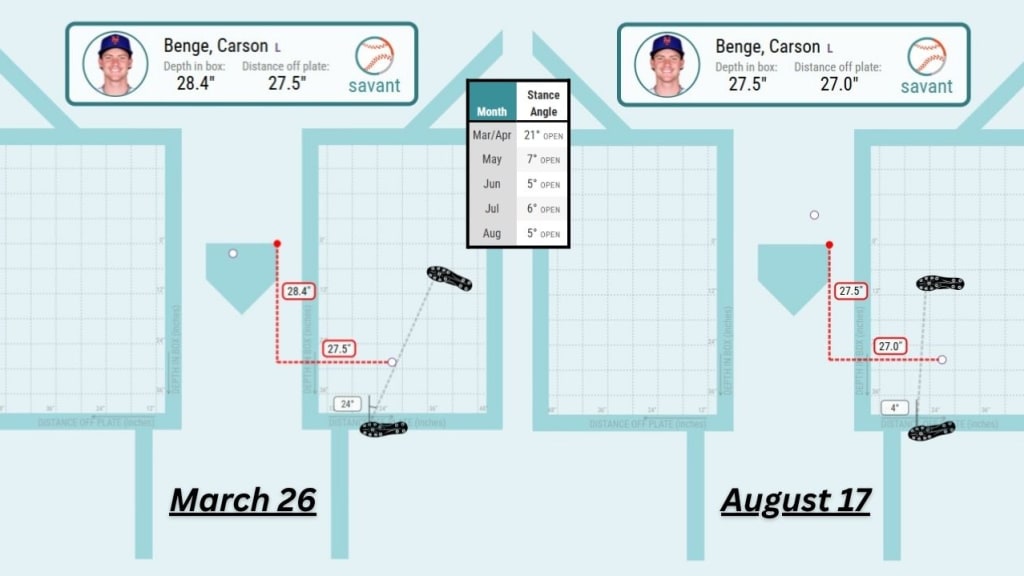
On April 19 against the Cubs, Benge’s stance was 23° open. Two days later, his stance was 14° open. Two days after that, on April 23, Benge recorded his second multi-hit game of the season.
His stance has stayed mostly the same since the beginning of May.
Keep in mind what this means here: A 0° stance would be totally neutral, with feet parallel to one another and aligned on a direct line to the pitcher’s mound. You can see the changes that Benge made below, specifically looking at the positioning of his front (right) foot.
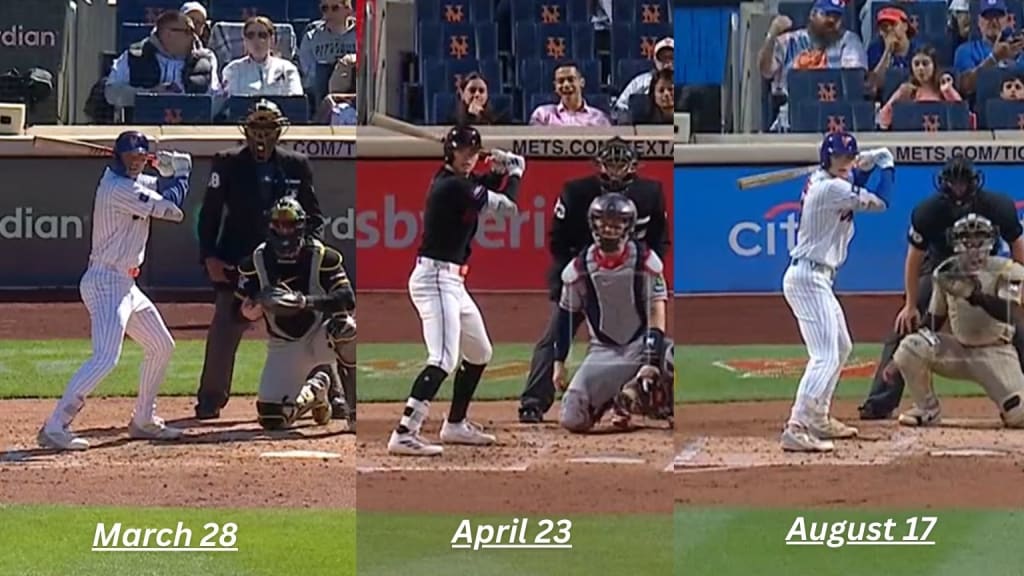
"I closed it off a little bit," Benge said. "I felt like, coming from staying still and then trying to get back is easier than a bigger move. It's less forward motion when I'm closed. I settled it down a little bit, and it's really working now."
The adjustment came easily. Benge used an open stance in college at Oklahoma State and throughout the Minors, but because other elements of his pre-pitch routine -- like his leg kick -- remained the same, he was able to make the change on the fly. With consistent, everyday reps, Benge also had ample opportunities to test his new stance in a game setting.
He hasn't tinkered with anything else. One tweak made all the difference.
"I still feel comfortable with it," Benge said. "I feel like it just allows me to be on time more."
And now we're really getting at why all of this matters. Hitting is timing. We can use Statcast's bat path metrics to show that Benge is right: His new batting stance allows him to be on time more often.
First, we can look at Benge's attack angle, which measures the vertical direction of the sweet spot of the bat at contact with the ball. Through April, Benge had one of the lowest attack angles in the Majors, at 1°. Since May 1, though, Benge's attack angle is 7°. That's still below the league average (10°), but it's within the ideal range of 5° to 20°, which is where swings produce more value for the batter.
What does this have to do with timing? Well, the barrel of the bat is moving differently throughout a hitter's swing. It starts negative with a negative attack angle as the bat travels downwards, and then ends very high as the bat moves upwards into a follow-through. What this all means is that Benge's bat is moving at the optimal angle at the right time, and his new stance -- with fewer moving parts -- is at least partially responsible.
"I feel like I'm in my legs more," Benge said. "I'm staying back behind the ball, not lunging at it. That's where it helped me."
There are a few other ways that this has played out, too. For one, Benge is hitting for more power. He has a .453 slugging percentage since May 1 -- a top-50 mark among qualified hitters -- compared to a .278 SLG through April that ranked 13th lowest.
He's also become one of the game's best fastball hitters, and there's no better way to see if a hitter is on time than to look at his performance against fastballs.
Benge vs. fastballs
- Through April: .226 BA / .264 expected BA
- Since May 1: .342 BA / .327 expected BA
There are 276 hitters to have at least 100 plate appearances end in a fastball since May 1. Of that group, Benge has the seventh-highest batting average and the sixth-highest expected BA, right ahead of Shohei Ohtani (.323 xBA).
Everything is clicking these days for Benge, though that's really nothing new. Things have been trending this way for a while. And one simple change in the batter's box made all of this possible.