

This story was excerpted from the Cubs Beat newsletter. This edition was written by Jared Greenspan. To read the full newsletter, click here. And subscribe to get it regularly in your inbox.
Last season, you’d have been hard-pressed to find a starting pitcher with a more streamlined arsenal than Ben Brown. The lanky right-hander threw his four-seam fastball and knuckle curveball 96% of the time.
In an era where seemingly everyone is throwing more pitches, Brown’s three-pitch repertoire (which also included a fledgling changeup) was remarkably unique. It also didn’t exactly work. Pitching in a swingman role for the Cubs, Brown posted a 5.92 ERA in 25 games (15 starts) with a 65 ERA+, meaning he was 35% worse than league average.
This year is a different story.
Brown is armed with a new two-seam fastball, which he designed over the offseason alongside Mets pitcher Clay Holmes. In turn, on a Cubs pitching staff that has been ravaged by injury, Brown has emerged as the team’s most valuable hurler. And it’s not exactly close.
Most valuable Cubs pitchers, 2026
By FanGraphs WAR (fWAR)
Ben Brown: 1.6 fWAR
Matthew Boyd: 0.8
Shota Imanaga: 0.7
Edward Cabrera: 0.4
Colin Rea: 0.3
Brown has pitched to a 1.92 ERA in 17 appearances (five starts), and the 26-year-old is back in the rotation, too. He authored a brilliant start in St. Louis on Saturday night, tossing seven innings of one-run ball in a 6-1 Chicago victory. The new Brown was on full display. Last year, he allowed some of the hardest contact in the game, running a seventh-percentile barrel rate and a sixth-percentile hard-hit rate. This season, loud contact is hard to come by; instead, he’s running a 51.5% ground-ball rate that ranks in the 86th percentile of MLB.
How did we get from A to B? It starts with the two-seamer.
Brown has tried to incorporate a third pitch to his arsenal in the past, whether it be the slider he scrapped in the Minor Leagues or the kick-changeup that he’s still developing. “Throwing another pitch was always a challenge for me,” Brown said last June.
All pitchers operate differently on that front. Some can pick up stuff quickly. Others, even in a day and age where technology allows for rapid pitch development, require some more time. Holmes, whom Brown worked with over the offseason, falls into the first camp; he added three pitches in the 2024-25 offseason in order to build a starter’s arsenal. Brown leans the other way.
As MLB.com’s Jordan Bastian detailed in March, the pair worked together at Provero Performance and Rehab outside of Nashville, Tenn. Holmes helped Brown find a two-seam grip that worked. Brown’s goal, as relayed to FanGraphs’ David Laurila, was to get a “good distinction” between his four-seamer and two-seamer. He’s certainly done that.
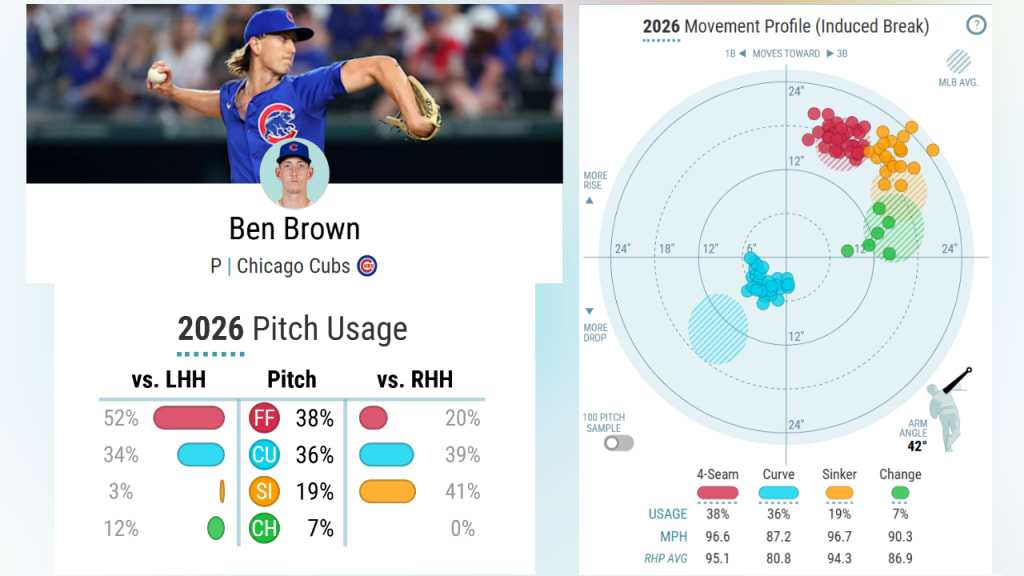
Brown’s two-seamer isn’t much of a sinker -- it’s more of what Blue Jays pitcher Dylan Cease recently described to me as a “riding” two-seamer. It drops 3.3 inches less than comparable two-seamers, based on velo and release height. But it has enough arm-side movement -- 14.8 inches -- to give it a distinctly different look from his four-seamer.
Brown also tunnels his two fastballs out of the same window, which makes it difficult for hitters to time up: Both the four-seamer and two-seamer look the same out of Brown’s hand and travel at the same speed on their way to the plate. But by the time they arrive at the plate, they’re moving differently.
Now, this is relatively low-hanging fruit. Same-sided sinkers are en vogue again. So are multiple fastball shapes. And four-seam fastball usage is, of course, on the decline.
But since Brown finally has a grip that works for him, he can reap the benefits. He’s throwing his two-seamer 41% of the time to righties, who are hitting just .206 off the pitch without an extra-base hit. The two-seamer has taken a lot of the onus off of his four-seamer, which right-handers saw 57% of the time last season and hit .319 with a .474 slugging percentage against. Now, he’s throwing his four-seamer to righties just 20% of the time, largely cutting out a pitch that led to a lot of damage against him.
Comparing Brown’s performance against right-handed hitters
2025: .272 BA / .404 SLG
2026: .151 BA / .198 SLG
Only four right-handed pitchers are holding right-handed hitters to a lower batting average than Brown’s .151 mark (minimum 80 plate appearances against right-handed hitters). Brown is in pretty accomplished company: Drew Rasmussen, Shohei Ohtani, Chase Burns and Cam Schlittler.
The addition of the two-seamer isn’t the only reason for Brown’s breakout. His fastball velocity is up an average of 0.8 mph, one of the largest year-to-year increases among qualified pitchers. (And, if you’re wondering, the velo is holding as a starter, too: He sat at 96.5 mph with his four-seamer in his most recent start against the Cardinals.) Brown is also better against left-handed hitters, and his two-seamer isn’t much of a factor there -- he throws it just 3% of the time.
Overall, this is a development that the Cubs, and Brown, have been waiting on for a few years now. New pitch in tow, he looks like the best version of himself.