



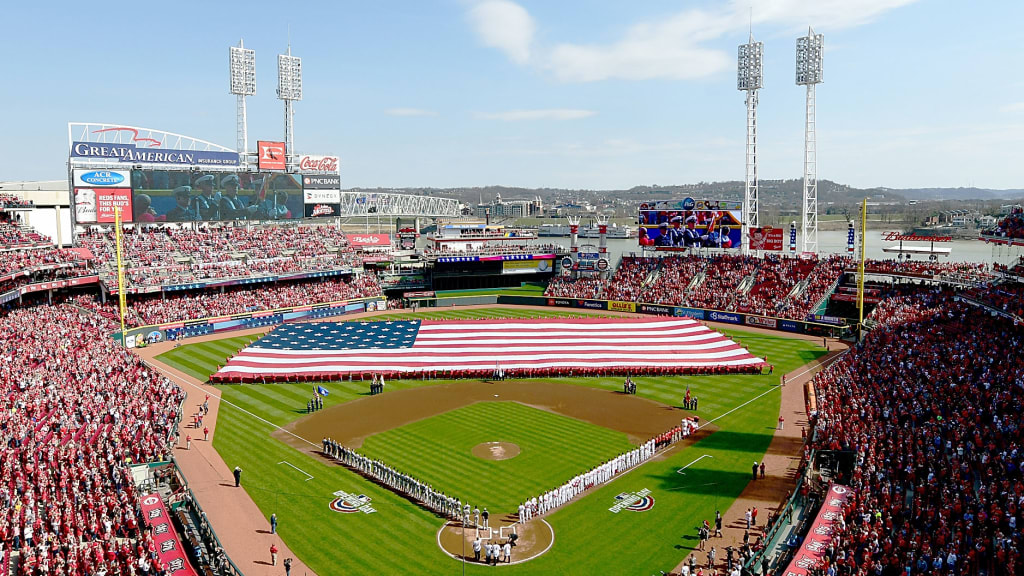
CINCINNATI -- Hitters love it. Pitchers, not so much.
Great American Ball Park has some of the cozier dimensions among Major League stadiums. Pitchers often complain that a fly ball that would be a routine catch in most facilities is often a home run at GABP.
The numbers back up that frustration. Since GABP opened in 2003, there have been a Major League-leading 5,034 home runs hit there through the 2026 season. Oriole Park in Baltimore is ranked second with 4,854 homers.
According to Statcast’s 2026 park factors — which are calculated on a three-year rolling basis — GABP was tied for the fourth-highest home run park factor in MLB at 113. That means that for batters and pitchers who played both at GABP and elsewhere, 13% more home runs were observed at GABP.
Why are the dimensions so friendly to hitters? Much of that was borne out of necessity but not entirely.
Unlike predecessor Riverfront Stadium, which had a stadium acreage of 48, GABP has an acreage of 29. It was built on a smaller footprint between Riverfront and the arena currently known as Heritage Bank Center. While half of the seats are on the lower level and closer to the action, the upper decks are steeper.
Because the new stadium was essentially wedged into its downtown location, architects had to create a gap of separation between the upper decks on the third-base side to keep the seats from encroaching Fort Washington Way on Interstate 71. Some have speculated that the wind patterns through the gap help push baseballs driven toward right field.
Riverfront Stadium was a shared facility for the Reds and the NFL’s Cincinnati Bengals. When the Bengals moved to their own stadium in 2000, the Reds demolished the outfield section of seating ahead of the 2001 season to make room for GABP.
The fence dimensions for Riverfront Stadium had to be changed to accommodate construction of the new ballpark. The left-field corner was moved from 330 to 328 feet. Center field went from 404 to 393 feet and the right-field distance was 325 feet.
GABP’s outfield dimensions closely mimic those of Riverfront. The left-field distance is 328 feet with a 12-foot wall, center field is 404 feet and right field is 325 feet, with both having a wall height of 8 feet.
“It was a way of trying to still keep a little bit of the old stadium,” said Rick Walls, the executive director of the Reds Hall of Fame. “Of course, the gaps aren’t the same, but your corners in right field, center field and left field are Riverfront numbers.”
Fans often ask why the Reds don’t simply move the fences back a few feet. That would require the removal of hundreds, if not thousands, of seats. The street of Mehring Way is just outside the ballpark on the right-field side.
“We took a really hard look at that. We looked at everything -- moving the wall back, making the wall taller. I would say, in the end, it’s not going to change,” Reds president and CEO Phil Castellini said on Oct. 1, 2026. “Because of the dynamics of the infrastructure, there just weren’t ways to easily do it. The infrastructure and the utilities that are behind – foul pole to foul pole – you just can’t move certain things.”