



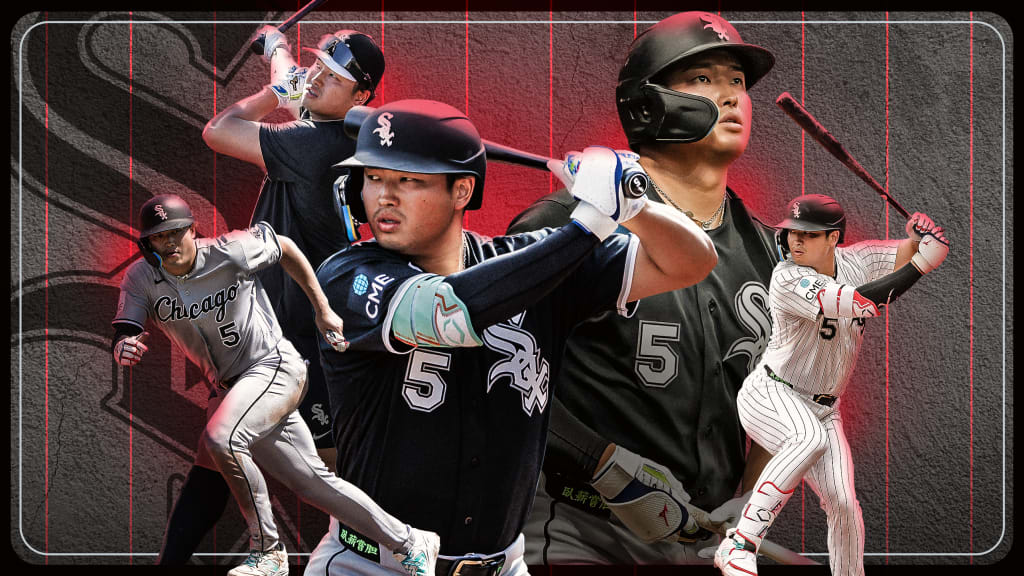
Entering his first year in the Majors, the scouting report on Munetaka Murakami was loud and clear: He’s going to strike out just so, so much, but he’s going to absolutely splatter baseballs when he manages to make contact. The hope? That he does enough of the latter to outweigh the former.
So far, so good. Murakami hit a homer in each of his first three games in the Majors, then later tied a rookie record by hitting a home run in five consecutive games, all while striking out more than 30 percent of the time. Only the red-hot Yordan Alvarez has more homers, and only four batters – Mike Trout and Ben Rice among them – have a higher walk rate than Murakami’s 19.3%. Put it all together, and his 168 OPS+ ranks fourth, behind only Alvarez, Rice and James Wood. If you can do that, no one will care how often you strike out.
Still, if those strikeout and walk numbers seem like a pretty large share of his times to the plate, they are. Another way to think about Murakami’s first month in the Majors is to break down the way his plate appearances end, like this:
- Strikeouts: 32%
- Walks: 21%
- Homers: 9%
- Other hits: 11%
- In play, outs: 27%
“Other hits,” it should be pointed out, are entirely singles. He’s yet to have a double, or a triple. Not one. When he hits it, as the old saying goes, they stay hit.
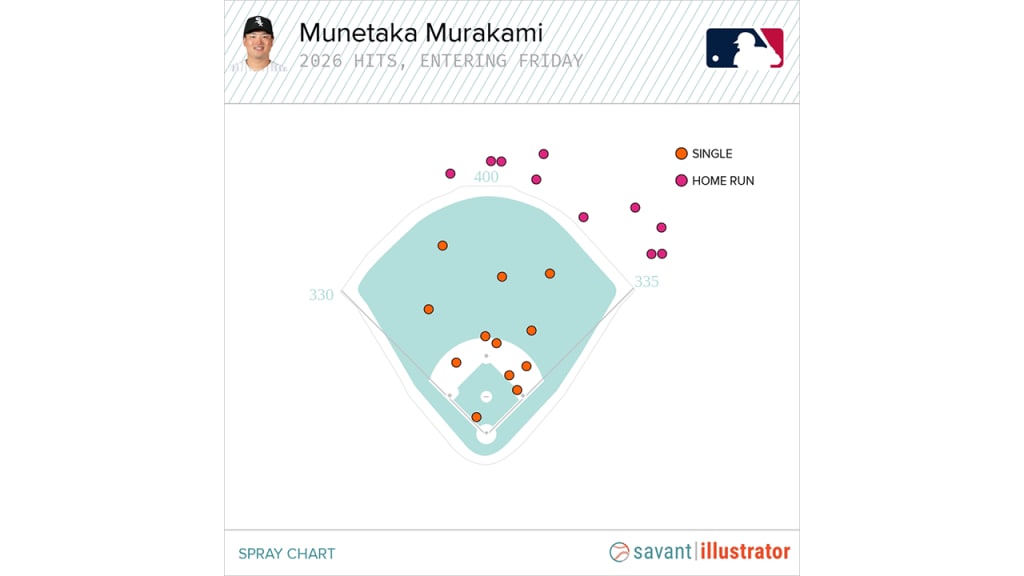
Looking at that breakdown, you can see that one-half of the time, he’s striking out or walking. Throw in the homers, and that’s 60% of plate appearances that don’t end with a ball in play. That’s the “three true outcomes” you’ve probably heard about – meaning plate appearances that can’t be affected one way or another by the fielders – and, were that to keep up, it would merely be one of the five highest such rates in a season with at least 100 plate appearances on record, ever. More importantly, the first three seasons are “Joey Gallo 2023, Joey Gallo 2015, and Joey Gallo 2019,” and it's Gallo's name that comes up more than anyone as a comparable.
That being the case, the only question people really want to know is, “Well, can he keep it up?” While that’s obviously unknowable, the signs are a little more favorable than you might think.
For one thing: While striking out 30% of the time is a lot, it’s also not the 40%-plus marks that Gallo regularly ran, either. It’s more Schwarber-eque than Gallo-esque, and while no one would mistake Kyle Schwarber for a contact hitter, it’s also the the difference between “being one of the biggest slugging stars in the game” and “last we heard, he was trying to make a comeback as a pitcher.”
While it’s higher than you ideally would want, you can be a 30% strikeout hitter and still be a productive bat, so long as you offer enough value when you do hit the ball. It’s not hard to find examples of this over the last half-decade; Wood, Matt Chapman, Schwarber, Trout, and Elly De La Cruz are but a few examples of those high-strikeout/high-value hitters, because, again, striking out 32% of the time is still considerably far away from what Gallo was doing.
Nor, really, is having a month like Murakami is having that unprecedented. With the month nearly over, his slugging percentage has been at or above .600 at the end of nearly every day, and his K% is 32% – which, he if ends April that way, would make him one of 42 players to ever have a performance like that in a month where they stepped to the plate at least 100 times.
(As you’d expect, these are almost entirely in recent decades; the only player to ever do it before 1992 was Hall of Famer Tony Pérez, who managed to strike out 30% of the time in August 1970 – a season where he’d finish third in the NL MVP voting.)
Among those previous 41, they break down like this:
- 29 made at least one All-Star team
- 12 did not
While not a perfect way to look at it – it doesn’t count Nick Kurtz last year, who somehow managed to do it over a full season without doing it in any individual month – that’s a good rate of return, and the “made at least one All-Star team” somewhat undersells the skill in that group. Aside from Pérez, it includes current or obvious future Hall of Famers like Trout, Shohei Ohtani and Jim Thome, as well as legendary sluggers like Sammy Sosa and Mark McGwire, multiple-time All-Stars like George Springer, Ronald Acuña Jr., Ryan Howard and Rafael Devers, or other big-power/big-whiff guys like Eugenio Suárez and Chris Davis.
It’s the other dozen that present the downside, the lingering possibility that this doesn’t work out. These are big-power, huge-strikeout flashes in the pan who couldn’t make it work for very long, like Chris Carter, Matt Davidson or Patrick Wisdom. As a first baseman, there’s a little extra pressure here, too; Gallo, at least, was a quality outfielder for several years, and others on our list -- like Luis Robert Jr. and Byron Buxton -- have been, too.
So far, Murakami has proven that this level of strikeout and this level of power will work out just fine. But what happens when the league adjusts? No one thinks the power will go away; his track record in Japan makes that clear enough. No one thinks he’ll become a contact hitter, either; the strikeouts are baked into the profile. His entire career comes down to this question: Can he keep the strikeouts around 30%? Or will they get at or above 40%, the Gallo-esque danger zone?
There’s one thing in the profile that’s key here: Don’t swing at what you can’t hit.
If you take a look at those who didn’t really work out here, part of the strikeout issue was that they simply swung too much. Robert has a 57% career swing rate, Keston Hiura had a career 51% swing rate, Wisdom ran 48%, and on and on.
Murakami, however, has a 38% swing rate. It’s one of the 20 lowest marks in the game. His chase rate is in the 94th percentile, also one of the best marks in the game. It’s all a lot closer to Kurtz and Trout than it is Wisdom, and it might be crucial. If you can’t make enough contact when you swing -- and all indications are that Murakami cannot, because he does indeed have one of the 10 highest swing-and-miss rates in the game -- then one way to get around that is a lot easier said than done: Don’t swing a whole lot.
Put another way, he’s doing something that seems backwards, given how massive his homers can be. When he doesn’t swing, he’s been worth +9 in Statcast Run Value, tied for sixth-best, meaning he’s collecting value by working counts in his favor or drawing walks. When he does swing, he’s been worth +1 run, because the value gained by the homers is about the same as the value lost by all the whiffs.
That seeming ability to understand the strike zone might just be showing up somewhere else, too. While Murakami is a seemingly unremarkable 4-2 in the six ABS challenges he’s initiated, he also leads the Majors in Statcast’s “Overturns vs. Expected” metric, which takes into account count, outs, pitch location, challenges left, and the situational leverage. For example: You might not have noticed it, but last week in West Sacramento, Murakami drew a ninth-inning four pitch walk … but only after overturning both the second and third pitches from the called strikes they initially were.
The initial fear -- that he’d strike out so much that it wouldn’t matter how much raw power he had -- hasn’t been assuaged yet. It’s not even the end of April. He’s still new to most pitchers. He’s striking out enough that there’s really not that much room to accommodate any real increase.
It’s almost entirely why the White Sox were able to get him on a mere two-year deal last winter. But so far, we’ve learned that the power is extremely real, and that the plate discipline is a real mark in his favor.
So far, so good -- and more or less, as expected, too.