


CHICAGO -- So much history has taken place at Wrigley Field, but only a select few franchise icons have been honored with their likeness forged in bronze.
Outside of the Friendly Confines, the Cubs established “statue row” during 2022 to display the effigies of the franchise’s all-time great players. Tributes for Hall of Famers Ernie Banks, Fergie Jenkins, Ryne Sandberg, Ron Santo and Billy Williams are currently on display in Gallagher Way. A statue honoring legendary broadcaster Harry Caray stands near the entrance to the bleacher seats on the opposite side of the ballpark.
Here is a breakdown of the Cubs icons who are immortalized at Wrigley Field:
Broadcaster: Harry Caray
The Cubs' home opener festivities on April 12, 1999, included the unveiling of a statue of Caray, who called games for nearly two decades on the North Side. The tribute was installed a little more than a year after Caray's passing ahead of the '98 season.
The likeness of Caray depicts him wearing a Cubs jacket and his signature glasses, raising a microphone with his right hand and pointing to onlookers with his left. A cluster of fans are below Caray, who is larger than life as he bursts from the top of Wrigley Field
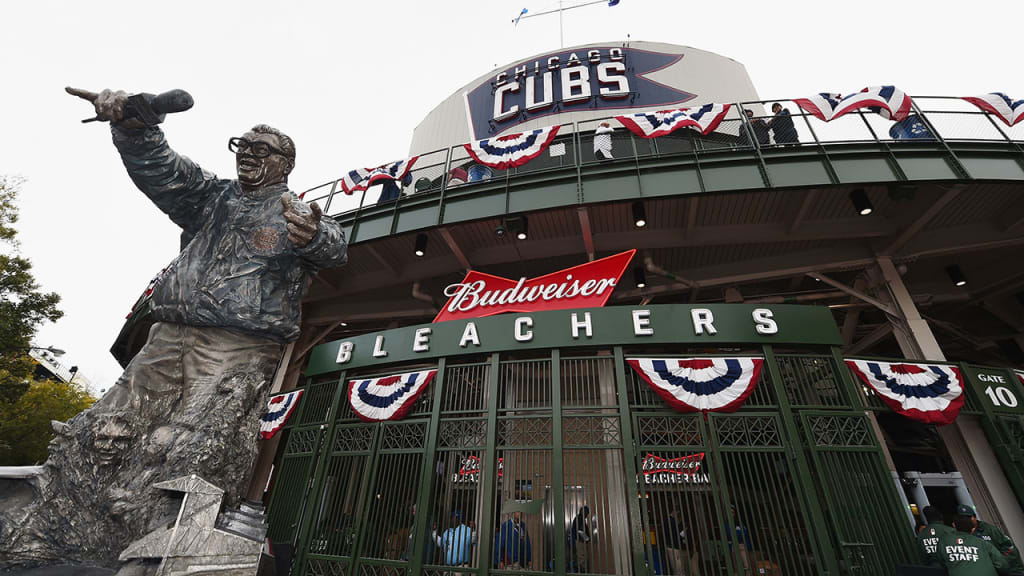
"He looks like he's ready to say: 'Let me hear ya,'" Dutchie Caray, Harry's wife, said at the ceremony in 1999.
Caray was famous for leading the fans in song during "Take Me Out to the Ball Game" as part of the seventh-inning stretch.
The statue originally had its home at the corner of Sheffield Avenue and Addison Street on the southeast side of the Friendly Confines. It was moved and rededicated on Sept. 1, 2010, at the corner of Sheffield and Waveland Avenues, by the entrance to the bleachers.
Caray, who came to the Cubs in 1982 after a decade spent on the South Side broadcasting games for the White Sox, was known to have called some contests from the bleachers. At the rededication ceremony, Dutchie Caray even joked that her late husband may be the only broadcaster ever to take a shower out there (at old Comiskey Park).
Player: Ernie Banks
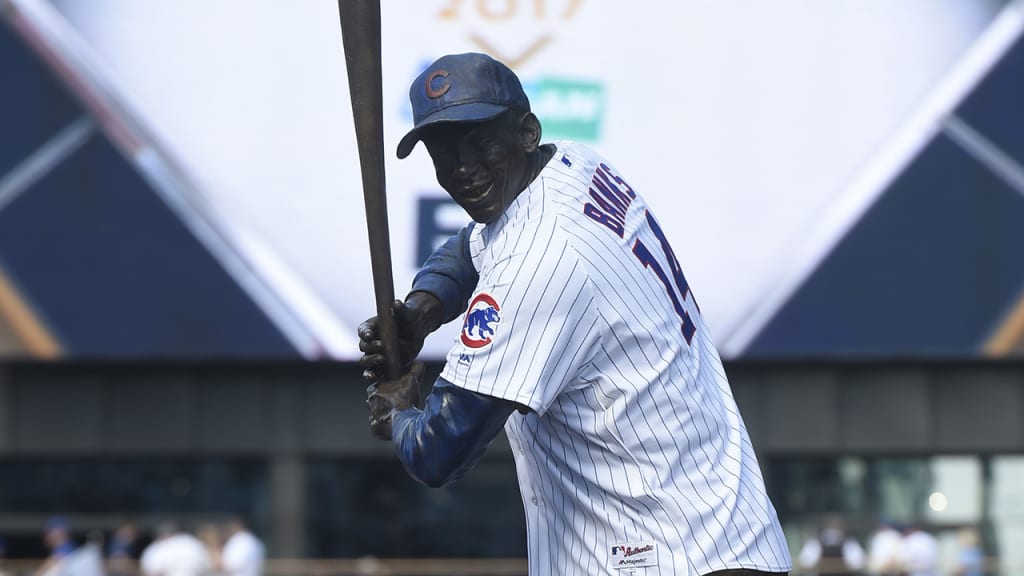
The statue of Mr. Cub features a smile on Banks' immortalized face as he stands in his signature stance. That was fitting, considering the joy that the Hall of Famer brought to his team and its fans throughout his legendary career.
"It's the best," Banks told reporters at the dedication ceremony on March 21, 2008. "This is the epitome of American life to be able to have this honor bestowed upon me, think about that. Just me. And when I'm no longer here, I'll still be here. It's amazing. This is amazing to me."
Go figure that it was raining on the day that Banks -- famous for his "Let's play two" catchphrase -- received the bronze honor. Known for his sunny personality, Banks threw out the first pitch and sang "Take Me Out to the Ball Game" on that day in 2008.
Banks spent all 19 of his Major League seasons with the Cubs, breaking the team's color barrier with his debut in 1953. A shortstop initially, and later a first baseman, Banks belted 512 homers, won back-to-back National League MVP Awards in '58-59, made 14 All-Star teams and won a Gold Glove Award.
"Ernie was truly a trailblazer," Williams said during the unveiling ceremony. He paved the way for so many African Americans."
Player: Fergie Jenkins
A towering figure and icon of the Cubs in the 1960s and '70s, Jenkins was welcomed by the blaring of trumpets at his statue unveiling in May 2022. Wearing a black cowboy hat and a Cubbie-blue blazer, a man with a statuesque frame was thrilled to see his likeness alongside some of his former teammates.
"Ernie, Billy and Ronny," Jenkins said, peering at the statues to his left that morning. "Believe me, I am humbled. I stand here a proud man, also humbled."
It was a well-deserved honor for one of the greatest pitchers in Cubs history.
Jenkins pitched in 19 seasons overall in his Major League career, spending parts of 10 with the North Siders. The big, durable righty finished as the Cubs’ leader in strikeouts (2,038) and starts (347), ending his career overall with 284 wins, 267 complete games, 49 shutouts and 3,192 strikeouts in 4,500 2/3 innings.
Jenkins won at least 20 games in seven seasons, including in six straight seasons with the Cubs from 1967-72. Within that stretch, he picked up the National League Cy Young Award in '71. Jenkins made three All-Star teams, started on Opening Day for the Cubs in seven seasons and was elected to the Hall of Fame in 1991.
The statue of Jenkins depicts him in the middle of his delivery, striding forward with his glove tucked and his right arm cocked, ready to unleash one of his signature fastballs. A replica of the statue is also on display in Jenkins’ hometown of Chatham, Ontario, in Canada.
Player: Ryne Sandberg
Sandberg stood at a podium on June 23, 2024 -- on the 40th anniversary of a performance known simply as “The Ryne Sandberg Game” -- and was in awe of how many people he saw before him. Fans filled Gallagher Way and were spilling into Clark Street. That year’s Cubs team joined fans behind the Cubs icon, watching from above on the ramps of Wrigley Field.
Everyone on hand was there to celebrate Sandberg being honored with a statue fitting of his presence.
“You don’t get a statue by yourself,” Sandberg said that day. “Every one of my teammates and coaches stands right there with me.”
Sandberg suited up for the Cubs in 15 seasons, establishing himself not only as one of the franchise's all-time greats, but one of the best all-around players in baseball history. The former second baseman was known for both his power and speed, while playing the kind of stellar defense that netted him nine consecutive Gold Glove Awards (1983-91).
On that famous June afternoon in '84, Sandberg put himself and the Cubs on the map with a five-hit showing that included seven RBIs. Within that, he launched a pair of late game-tying homers off Cardinals closer Bruce Sutter in the nationally broadcast game. The Cubs went on to win the division and “Ryno” picked up the '84 NL MVP.
Sandberg ended his prolific career as baseball’s all-time leader in homers as a second baseman (277 of 282). He was a 10-time All-Star and seven-time Silver Slugger recipient and was inducted into the Hall of Fame in 2005. Sandberg scored 100 runs seven times, belted at least 25 homers six times, stole 30 bases five times and had two 100-RBI seasons.
Late in 2023, Sandberg shared publicly that he was battling prostate cancer. He went through treatment and was able to be on hand for the unveiling of his statue, which includes his signature flip-up sunglasses and depicts the legend in a defensive stance. Sandberg died on July 28, 2025, at the age of 65.
Player: Ron Santo
The statue of Santo -- a beloved player and broadcaster for the Cubs -- was dedicated on Aug. 10, 2011, at the corner of Sheffield Avenue and Addison Street before moving to its current location. It depicts him in his days as a slick-fielding third baseman, and the statue is frozen at the moment before Santo unleashes a throw across an invisible diamond.
"Wrigley Field was his favorite place on Earth," Cubs broadcaster Pat Hughes said during the ceremony in 2011.
The statue was dedicated less than a year after Santo died from complications from bladder cancer and diabetes in December 2010. The ceremony was packed with fans to celebrate one of the icons in the team's long, storied history.
Santo suited up for the Cubs from 1960-73 and helped call games from 1990-2010.
On the field, he had 337 homers (out of 342 in his career) with the Cubs, collected five Gold Glove Awards and made nine All-Star teams. Santo was voted into the Hall of Fame by the Veterans Committee in 2012. In the booth, Santo was not shy about his love for the team, calling games as their biggest fan.
"He connected with all of us because he was our fan," Cubs chairman Tom Ricketts said at the ceremony in 2011. "He was the beating heart of Chicago Cubs fans everywhere."
Player: Billy Williams
The likeness of Sweet Swingin' Billy Williams depicts him finishing one of his smooth left-handed strokes. It was a perfect tribute for one of the greatest hitters in Cubs history and was dedicated on Sept. 7, 2010.
"When they told me about the unveiling in Chicago, I thought this day couldn't come here fast enough," Williams said at the ceremony in 2010. "This is beyond a dream for a kid growing up in Whistler, Alabama."
Williams suited up for the Cubs in 16 of his 18 seasons from 1959-74. He was the 1961 NL Rookie of the Year, a six-time All-Star and a one-time batting champion. And to think there was a moment early in his career when Williams considered walking away from the game.
Cubs scout Irv Griffin signed Williams to $1,500 and a cigar before the 1956 season, but the young outfielder grew weary by '59 in the Minor Leagues. The racism he encountered while playing in Texas convinced Williams to go home to Alabama, where former Cubs scout Buck O'Neil paid him a visit and played a role in changing Williams' mind.
"It could have worked out a different way," Williams said in an interview for the Hall of Fame’s website. "It was just lucky that Buck O'Neil came down. Buck knew exactly what he was doing."
Williams went on to pile up 426 homers and 434 doubles, hit .290 in his career and had nearly as many walks (1,045) as strikeouts (1,046). From 1963-70, Williams also set an NL record (at the time) with 1,117 consecutive games played. It all added up to a place in the Hall of Fame with Williams’ induction in 1987.