


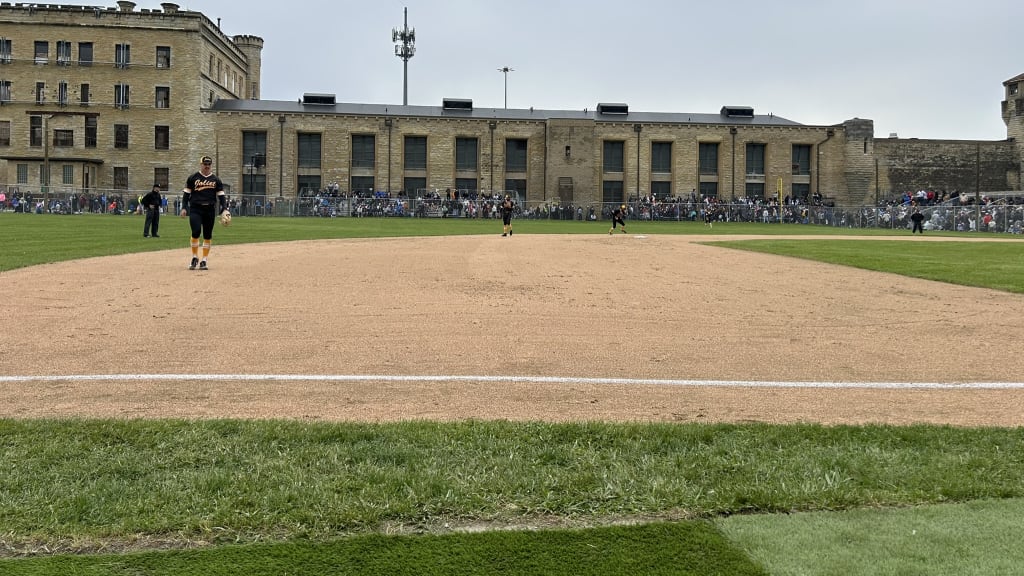
JOLIET, ILL. -- The Joliet Slammers' name and primary logo, a guard tower flanked by barbed wire-topped walls, is an homage to Old Joliet Prison. On Thursday, the team played a game at the facility that inspired its name, attracting 5,500 fans eager to spend an afternoon in jail.
The notorious penitentiary opened in 1858 and regularly hosted ballgames between inmates beginning in 1914. The Big House Ballgame, a Frontier League exhibition contest against the Gateway Grizzlies, brought baseball back to the prison for the first time since it closed in 2002.
It is perhaps not surprising that this unorthodox endeavor has the name Veeck attached to it, a surname synonymous with outside-the-box baseball thinking.
Night Train Veeck -- yes, that is his real name -- is the son of Mike Veeck, grandson of Bill Veeck and great-grandson of William Veeck Sr. He is part of the Slammers' ownership group, along with his father and Hollywood icon Bill Murray, and currently serves as the team's executive vice-president of sales and marketing.
"It takes a village, or as I've now termed it, it takes a prison to be able to do this thing," said Veeck, adding that there were some operational challenges. "Where do I begin? It doesn't have any electricity or running water. Obviously, we've got to get the the field going. We've got to get the bleachers out here, the netting, the fencing, you name it."
Veeck was joined at the game by Murray himself, who told a reporter from CBS News Chicago that being involved with the Slammers "just sounded like a lot of fun." Night Train, after all, was "the latest of the Veecks."
"I had friends from Joliet, the great Jim Downey from 'Saturday Night Live' and [retired Illinois State Senator] Pat McGuire," added Murray. "I like Joliet, it’s a fun town and it’s got a lot of history."
Murray's fellow Chicago comedy legends John Belushi and Dan Akroyd played a key role in cementing Old Joliet Prison's place in pop culture. 1980's "Blues Brothers" begins with Belushi's character, "Joliet" Jake Blues, getting released from the prison and reuniting with his brother Elwood. Fans dressed in the iconic dark suits and sunglasses worn by Jake and Elwood were a common sight during Thursday's game, none of them more striking than Casey Papp and his 6-year-old son, Declan.
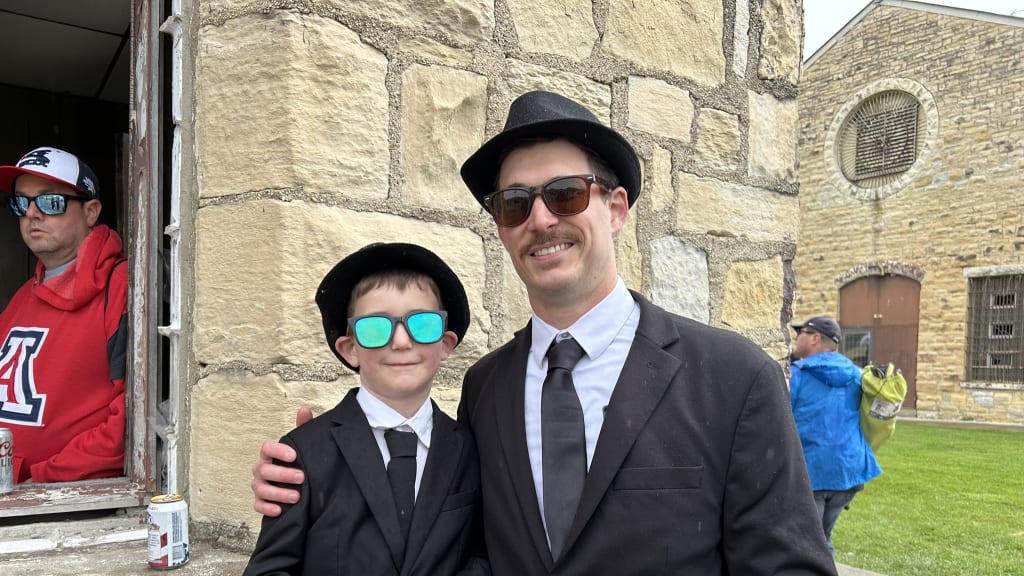
"He wears this costume every Sunday to church. Every chance he gets he wears it, since Halloween. It was kind of a given we’d show up," said Casey. "We had Blues Brothers and baseball. Those things come together, we couldn’t miss it."
"I was here for the popcorn," added Declan.
Former big leaguer and current Cubs broadcaster Ron Coomer brought a different type of local perspective to the proceedings.
"I was saying to my nephew who’s broadcasting the game for Joliet, Lonnie Wilkins, all my life we wanted to stay out of here, not come in here," he said. "And now we’re seeing a ballgame here. So it’s pretty cool. The one thing that stood out to me when they were talking about doing this is, all the people my dad’s age from this area, they would come out here and play ball against the inmates. So it’s really kind of gone full circle."
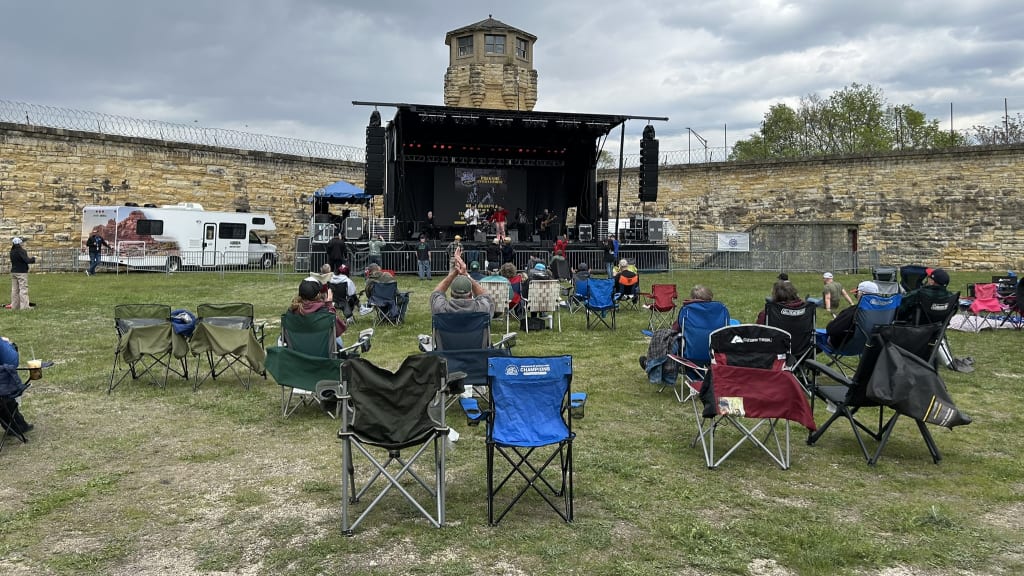
The Big House Ballgame served as the official kickoff of a Route 66 centennial celebration, commemorating the "mother road" that starts in Illinois and ends in Los Angeles. It may seem strange to celebrate the freedom of the open road within a place designed to take away one's freedom, but the Old Joliet Prison of today is a tourist destination that can be worked into a Route 66 road trip.
"The big narrative is what we’re doing with the prison," said Greg Peerbolte, the CEO of the Old Joliet Prison Historic Site. "The city of Joliet and the prison itself really grew up together and they are, for better or worse at times, synonymous with one another. The big idea is that we’re reclaiming this site, a former maximum security penitentiary and a place with plenty of bad problematic history, into a community space. I think that’s the most powerful part of the message."
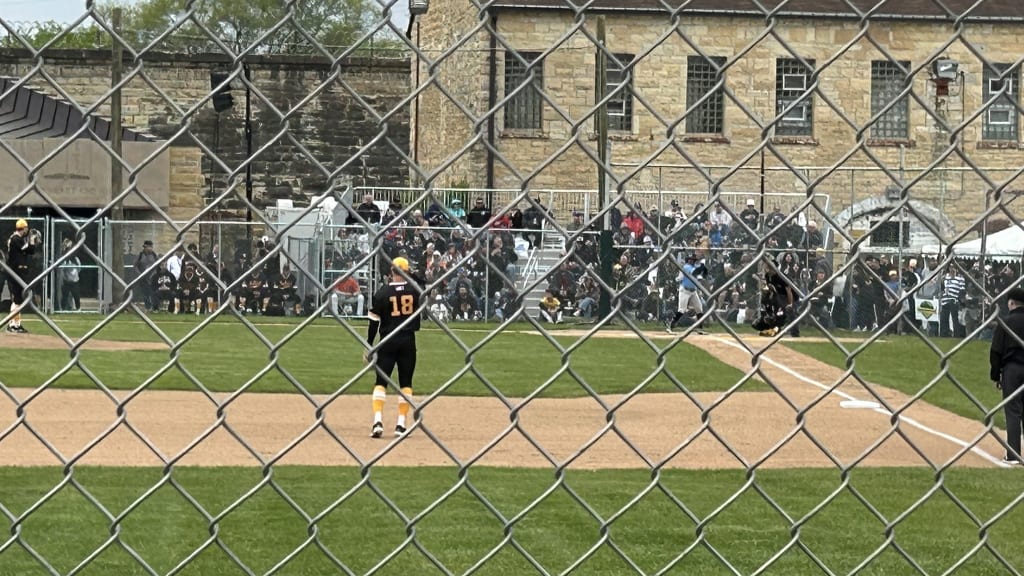
Amid the costumes, live music and carnivalesque atmosphere the ballgame itself almost felt like an afterthought, especially as cold temperatures and steady rain took hold in the later afternoon. The playing field, ringed by bleachers on three sides, featured dimensions of comical (for a professional game) proportions: 230 feet to left field and 280 feet to center and right. When in prison, you make do with what you've got.
"It felt like backyard makeshift Wiffle ball," said Slammers right fielder Blake Berry. "Because they had the rules, [like] if you hit a homer [to right field] it has to be over the whole prison, but if it hits the side of the building it’s a double. Fun rules like that, it was a cool experience, totally different.
"I did horrible today," he added with a laugh. "Every ball I hit on the ground because I was trying to hit it in the air."
In baseball, as in prison, leaving the yard is harder than it looks. The Gateway Grizzlies -- based in Sauget, Ill. -- handily won the game, 14-3. The Slammers won aesthetically, however, as they wore sharp yellow and black uniforms modeled after those worn by baseball playing inmates at Old Joliet Prison.
While Veeck said that it "took a prison" to pull this game off, Peerbolte looked at it differently.
"It took a Veeck, as we like to say," he said. "From our first meeting and walk through with Night Train and his team, over a year and a half ago, we started talking about what is possible. ... Right people, right place, right time."