


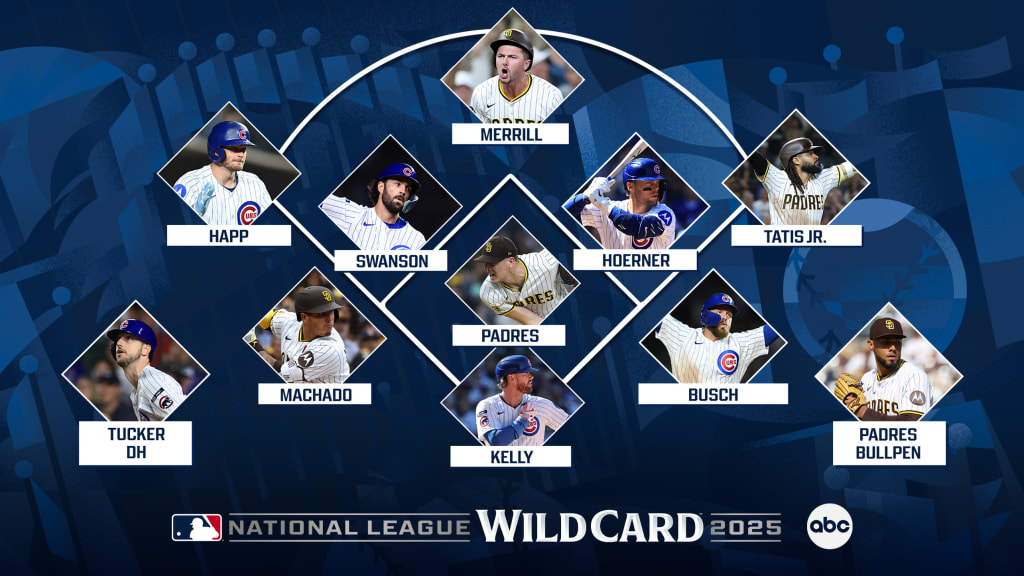
For the first time since 1984, somehow, the Cubs and Padres are set to square off in the National League playoffs. It hasn't been quite that long since they've seen each other this season, but it might feel like it; while the two clubs split their six games in 2025, their entire head-to-head slate was wrapped up by April 16.
Needless to say, there's not a whole lot you can take away from games that happened more than five months ago, not that head-to-head matchups tell you a whole lot about what's going to happen in a playoff series, anyway.
All we can do, then, is look at who's here, who's healthy, and who's hot. Let's see who has the edge, position by position.
Catcher
This is actually a lot closer than you’d think, because if you simply went by full-season Wins Above Replacement, you’d see “Cubs 7th, Padres 28th,” smile and move on. Big gap. Fair enough.
Of course, the Padres upgraded from Martín Maldonado (57 OPS+) to Freddy Fermin (76 OPS+) at the Deadline, and Carson Kelly hasn’t exactly kept up his “what if I hit like Barry Bonds” .360/.507/.840 (1.347 OPS) line from April. Since the Deadline, San Diego’s catchers have hit a little better than Chicago’s, but neither have been incredible. Chicago’s catchers are better on defense, even with Maldonado no longer in the picture for San Diego.
There’s not a ton of daylight here, because this isn’t a huge strength for either side. We like catcher defense, and Kelly has the highest offensive upside of any of the four likely backstops. Chicago gets the smallest of edges.
Advantage: Cubs
First base
While Ryan O’Hearn has seen more time at first base lately for San Diego, that’s mostly because Xander Bogaerts’ absence has caused the infield to shift around, and with Bogaerts back in the lineup, it’s likely that Luis Arraez returns to first base. We all know where this is going: If you value making contact above all else, then Arraez is the best hitter alive. If you value what happens once that contact is made, then it’s not quite so rosy. It’s a personal, aesthetic choice. We can’t solve that right now.
Anyway: By Arraez’s own standards, this has been the weakest full season of his career. Not only does Michael Busch have 34 homers and a 150-ish-point OPS advantage over Arraez, he’s a rangier fielder, too. This isn’t a hard call here.
Advantage: Cubs
Second base
For Chicago, Nico Hoerner is having the same kind of season he has every single year, which is to say “slightly-above-average bat with 30-ish steals and elite-level defense.” It’s not flashy, but by at least one version of WAR, he’s been the most valuable overall second baseman in the game this year.
Meanwhile, Jake Cronenworth is having a pretty good season himself, rebounding from two just-OK seasons to post his best year since his All-Star 2022 season. But he’s surely not the defender that Hoerner is, and there’s not much of an argument that he’s a clearly superior hitter, either.
Advantage: Cubs
Shortstop
Assuming Bogaerts is at full strength after missing much of September with a foot injury, his presence resets the San Diego infield in a big way – they’re better off when the middle infield is not Arraez/Cronenworth, as it was for most of the time while he was unavailable. But Bogaerts and Dansby Swanson hit almost identically well in 2025, and they hit almost identically well in the second half, and how do you even try to split that apart?
Even the defense gets tricky, because while Swanson has the better reputation, and was better in 2024-’25, the 2025-only metrics say that Bogaerts took a big step forward. Given the reasonable question about whether Bogaerts is at 100% due to the foot, and Swanson’s long-time defensive excellence, and even the fact that Swanson’s underlying quality-of-contact in the second half was considerably better, we’ll lean Cubs here -- but it’s about as close as it could be.
Advantage: Cubs
Third base
This one might be easier if we had any idea what to expect from Matt Shaw, who has had a very inconsistent rookie season, to say the least. At one point early in the season, he spent a month back in Triple-A. In June he was barely playable (.193/.247/.289); in August he slugged .547 with noticeably improved defense from earlier in the year. He got off to a brutally slow start in September (.170/.286/.191 through the 18th), but he’s been better in the final week.
It’s not that very likely future Hall of Famer Manny Machado hasn’t also had some major ups-and-downs, because he's had a roller-coaster season himself. But overall, Machado had a superior year, and the track record is without question in his favor. Even with Shaw somewhat surprisingly holding a mild defensive edge, the difficulty in knowing what you’ll get from him at any given time tilts this toward the Padres -- though by less than you’d think.
Advantage: Padres
Left field
One of the best moves any team made at the Deadline was San Diego’s acquisition of Ramón Laureano, who arrived with O’Hearn from Baltimore and solidified what had been one of the weakest left-field situations in the game. Unfortunately for the Padres, Laureano fractured a finger on Wednesday and will be unavailable for at least the Wild Card series. The obvious replacement is Gavin Sheets, who has had a generally solid season. However, with the Cubs likely to start multiple lefties in this series, it might end up being the inexperienced 29-year-old Bryce Johnson in the lineup at times.
The Cubs have no such concerns, because Ian Happ, like Hoerner, is having the exact same season he has every single year -- which is to say, 20-something homers and offensive performance 20% above league average. They know what they have in left. San Diego, at the moment, does not.
Advantage: Cubs
Center field
It’s almost laughable how large a gap this would have been for the Cubs for much of the season, as Pete Crow-Armstrong put up the bulk of what would be a 30/30 season with elite defense -- and was at least getting mentioned in early-season MVP talk. And then what happened, as they say. Well, what happened was one of the largest second-half dropoffs in recent memory, as a first-half .847 OPS has dropped to .634 in the second half, even leading to a break to “reset.”
On the other hand, Jackson Merrill hasn’t quite had the same impact as he did in his rookie season, thanks mostly to hamstring and ankle injuries as well as a concussion. But he’s been fantastic since his return, with a .961 OPS and seven homers in September; he actually has a Top 15 slugging percentage in MLB this month.
If that was just a hot streak from someone with no track record, we’d question it. (It’s not.) If Crow-Armstrong looked anything like he did in the first half, it wouldn’t matter either way. (He doesn’t.) Right now, as things stand, we’d take Merrill.
Advantage: Padres
Right field
This is more than a little tricky, because Kyle Tucker has missed almost all of September with a calf injury, and while he did end up returning to play DH in the final weekend, he didn’t pick up his glove, and it’s not clear he’s available to play the field at this point. That means the Cubs will likely play Seiya Suzuki in right; utilityman Willi Castro is also an option, though he’s done little since being acquired from Minnesota.
Suzuki is finishing off his fourth consecutive strong season, though it’s more complicated than that. While he got off to a fantastic start (.867 first-half OPS), he sputtered badly after that (.673 in the second half), and he’d been primarily the team’s DH for months before being pressed into regular outfield service in September. Since Fernando Tatis Jr. rates again as one of baseball’s best defensive right fielders and he outhit Suzuki by a ton in the second half, this isn’t a hard one -- especially since Tatis' weekend power display gives you confidence the illness that limited him in the final week won't be a concern.
Advantage: Padres
Designated hitter
If you actually know who the Cubs will start here, you have an advantage over us. Presumably this will be Tucker … unless it’s Justin Turner … unless it’s Moisés Ballesteros ... unless it’s Suzuki, because Tucker makes it back to right field. It’s not much clearer on the Padres side, though Laureano’s injury probably means this is Sheets (if Johnson is in left) or O’Hearn. That is itself a complication because they’re both lefty hitters, against some likely left-handed Cubs starters.
Long story short: If Tucker is healthy and if Tucker is here, he’s easily the best option of any of the players mentioned. It’s likely both sides do a fair bit of mix-and-matching here.
Advantage: Cubs
Starting rotation
It’s probably safe to say that for both clubs, this isn’t a particular strength, with a number of names who would be solid mid-rotation options on most contending teams, yet no one who you would view as A True Number One. It’s indisputable that the second-half Cubs rotation (3.48 ERA) has been better at run prevention than San Diego’s (4.28), but that matters less than you’d think now given that breakout rookie Cade Horton is going to miss the series due to injury.
That means that Shota Imanaga and Matthew Boyd are likely to start the first two games against Nick Pivetta and either Michael King or Dylan Cease. Pivetta is easily the best of these names this year -- he might even get some love on the bottom end of Cy Young ballots -- and while he's not near the Skenes/Skubal tier of aces, he's the best we'll see here.
Ultimately, we’re going with the Padres simply because Horton, who was such a second-half phenomenon, is unavailable -- and without him, we feel a lot less good about Imanaga, who led the Majors in homers allowed (and had a 6.51 September ERA), and Boyd, who took a massive step back in the second half. It's a great example of October being about who you have now, not what regular season stats said you were.
Advantage: Padres
Bullpen
The Cubs bullpen, it’s important to note, has made a pretty massive in-season turnaround. As we detailed here recently, a group that was one of the weakest in the Majors at strikeout rate early on has transformed into one of the best -- going from the fourth-weakest K% in the first half to the fourth-best in the second half. That’s a credit to Brad Keller, who has turned into a sneaky-excellent reliever, and a whole lot of turnover that’s brought in names like Andrew Kittredge and Taylor Rogers.
It’s been so good, in fact, that we might take them over nearly any other postseason relief group. Of course, the “nearly any other” is doing a lot of work here, because San Diego already had an elite bullpen, and then they went out and added Mason Miller, who has merely struck out fifty-four percent of the batters he’s faced as a Padre. It does, admittedly, hurt that the injured Jason Adam won’t be available, but it’s not like they’re short on elite stuff between Miller, Jeremiah Estrada, Robert Suarez, Kyle Hart, and Adrian Morejon anyway.
The Cubs bullpen is really good, better than you think. The Padres bullpen is exactly as good as you think. It’s elite.
Advantage: Padres
Prediction
The biggest strength of the second-half Cubs was the massive improvement of their bullpen, but the Padres have an even stronger set of relievers, which negates that. We actually like the Cubs roster top-to-bottom better, because there's a real power edge there, and if this series were happening in July, we’d probably lean Chicago. But given the recent struggles of Suzuki, Imanaga and Crow-Armstrong, plus the uncertain health status of Tucker and the absence of Horton, the timing here isn't the best for Chicago. Give us the team with Mason Miller, basically.
Padres in three