



“Run prevention is where we fell short this year,” Mets president of baseball operations David Stearns said during a press conference at the end of the 2025 season. “It’s where we need to get better.”
He doubled down on that sentiment this month, saying competitors had told him that, “your defense wasn’t close to good enough.”
Over the course of this offseason, a whole bunch of offense went out the door in Queens. (The outgoing quartet of Pete Alonso, Brandon Nimmo, Jeff McNeil and Starling Marte accounted for nearly 40% of the team’s 2025 home run total.)
Meanwhile, the run prevention phrase became something of a pejorative among fans, particularly because: A) little had been done to improve the starting rotation, and B) the new corner-infield tandem of Jorge Polanco and Bo Bichette would make the Mets the first team since 1948 to start multiple non-rookie infielders with essentially zero experience at a new position, per MLB.com’s Sarah Langs.
It made for an odd look, to be sure, particularly in the weeks where it seemed like there were only departures, not arrivals. But much is different after the last week, now that they’ve signed Bichette and traded for center fielder Luis Robert Jr. and top pitcher Freddy Peralta.
Suddenly, the 2026 roster is starting to come together. So let’s try to answer this question: Will this year's Mets prevent runs better than last year's?
It’s doable, but it's also a tricky question, because “run prevention” is a catch-all term in baseball for both defense and pitching, and while those work in tandem, those aren’t really identical units, either.
How poor was the run prevention last year?
Well, it wasn’t great. The Mets allowed 715 runs, the 13th-most in the Majors. Among the dozen teams who allowed more runs, 11 of them had losing records, because allowing lots of runs is bad. (The outlier there is the Blue Jays, who made it to Game 7 of the World Series, further underscoring how offense-fueled that group was, along with the importance of late-season rotation addition Trey Yesavage.)
It’s easy to break it down. The 2025 Mets pitching was fine, not great, just OK. The defense was less than that.
Pitching rankings
- Strikeout rate: 15th-best
- Statcast quality of contact allowed: 16th-best
- Ground-ball rate: 17th-best
Fielding rankings
- Outs Above Average: 21st
- Fielding Run Value: 19th
While Outs Above Average is simply about the seven non-pitcher/catcher fielders turning batted balls into outs, Fielding Run Value also includes the value of outfield arms, turning double plays, and catcher framing, blocking, and throwing – and Mets catchers, mostly because of Luis Torrens, actually rated pretty well there (sixth-best unit).
If you look at the FRV team rankings, the trend is clear: You don’t have to have elite defense, but it sure helps. The top five fielding teams all made the postseason, and only two of the bottom 10 teams (Philadelphia and Seattle) did the same.
For the Mets, the issues were obvious. First base and right field were serious weaknesses. Multiple other spots were just OK. Shortstop Francisco Lindor was fine, but he’s usually a lot more than fine. Only Torrens and outfielder Tyrone Taylor rated as any sort of real plus. This doesn’t even show Mark Vientos, who racked up a minus-6 FRV in relatively limited time at third base.
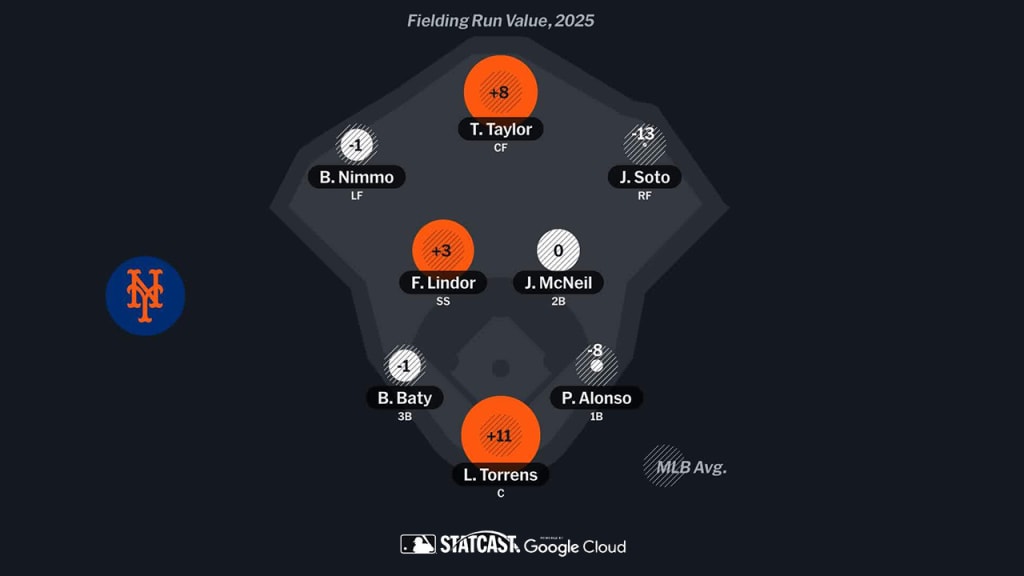
Despite Alonso’s reputation at being good at scooping throws, he rated as among the weakest defensive first basemen in the game for several years now (last in 2025, second to last over the past five seasons). Meanwhile, his regularly off-target throws directly contributed to the hamstring injury that ruined pitcher Kodai Senga’s season and spurred the team’s second-half slide. Juan Soto has never been a particularly skilled defender, but he also performed at a near-career-worst rate with the glove in his first year with the Mets.
All those rankings, pitching and defense, probably match the eye test for Mets fans. A pair of mediocre units complementing each other, basically. But that was last year. What about this upcoming year?
How different can you expect the 2026 defense to be?
Setting aside the catching unit, which returns the same players – and it’s worth noting here that Francisco Alvarez improved his framing considerably after a midseason demotion – it’s at least a very different lineup. In fact, it's likely that only shortstop and right field will be manned by the same players who took the majority of innings there last year.
Let’s start with the easy ones. At second, McNeil was never really a problem, but trade acquisition Marcus Semien has been among the most elite defenders at the position over the past three years. In center, Taylor was very good, and Robert has rated as a strong defender annually ever since arriving to MLB. If Taylor and/or rookie Carson Benge (the No. 16 overall prospect described by MLB Pipeline as being good enough to manage center, but “above-average if he has to make a full-time move to the corners”) end up playing left, that should be an easy upgrade over Nimmo.
That’s two obvious upgrades. Otherwise, there’s two important questions to answer.
1) Can Soto improve with the glove?
Costing his team 13 runs on defense, Soto was tied for baseball’s weakest non-catcher defender. He’s obviously not there for his fielding, but that’s still a big chunk of value given back. He knows it, too, giving an interview this month that suggested that in the same way he focused on improved baserunning last year – to wild success, stealing 38 bases – this year’s focus is on defense.
As David Adler dug into, there aren’t many examples of improvement from that level, but there are some, like when Eddie Rosario went from baseball’s weakest outfielder in 2019 to merely below-average the next few years, or when Adolis García and Bryce Harper each rebounded from dreadful fielding years to show improvement. Perhaps more importantly, there’s also this: In his first year in his new home, Soto was minus-10 runs in the first half, but only minus-2 runs in the second half. Familiarity might matter.
Confidence level: moderate
2) Can Polanco and Bichette learn new positions quickly?
Look, we won’t know until we know. Let’s not pretend otherwise. Stearns said the team will have four shortstops in the infield, “and that’s a pretty distinct advantage." While that’s technically true, neither Polanco nor Semien has played short in years, nor are likely to do so ever again.
The trick here really comes down to Polanco and Bichette, the two veterans each attempting to play new positions. Before Bichette signed with the Mets and it seemed likely a move to second was coming, we made the argument that a great recent comparison was that of his once-and-now-future teammate, Semien, who had also been a below-average shortstop before becoming an excellent second baseman.
Second is not third, obviously. But what caught our eyes was when FanGraphs released its 2026 Mets ZiPS projections earlier this week, and both Bichette and Polanco were projected to be not only capable, but somewhat good. When asked, Dan Szymborski, the projection creator, noted that the system has “a historical data of moves … and uses the player's range/arm/error stats (and their base speed) to make an estimate.”
While Bichette’s throwing arm is not particularly strong – last year, it was in just the 36th percentile – similar to that of Alex Bregman and Matt Shaw, meaning it might just be “good enough,” strength-wise.
Confidence level: also moderate
So, does this all lead to better run prevention?
Don’t forget the pitching, of course, and it’s not just Peralta. The Mets also signed relievers Devin Williams (who is valued a lot more highly than his 4.79 ERA would indicate), Luke Weaver and Luis García, and added Tobias Myers in the Peralta trade, all while bidding farewell to Ryan Helsley, Tyler Rogers, Ryne Stanek and Edwin Díaz. Of course, you also expect more from rookies Nolan McLean and Jonah Tong, and there’s a lot of moving parts here.
The good news is that it seems like more strikeouts are likely, with current projections having the rotation tied for the 10th-best strikeout rate and the bullpen tied for fifth. Any decrease in batted balls would take pressure off the defense, of course, though overall, both are somewhat in the middle of the pack once again.
It all comes down to this: It’s plausible. Perhaps even likely. Polanco doesn’t have to be great to make the first base defense better than it was, just competent. Bichette has a higher bar to clear at third, but the New York third basemen were roughly average last year, which is an attainable outcome. Second base and left field are all but guaranteed to be better. There’s actually a version of this where this is among the best up-the-middle defenses in the entire sport, if Robert stays healthy and Alvarez’s late-season framing improvements stick. It’s not that hard to see Soto being slightly less damaging in his second full season, or Lindor bouncing back when he's not playing through a broken toe.
Whether that leads to enough offense and more wins is a separate conversion. But as far as the defense goes? Color us “cautiously optimistic,” which is certainly more than would have been said if last year’s defensive unit returned intact. Perhaps that alone was worth the effort.