



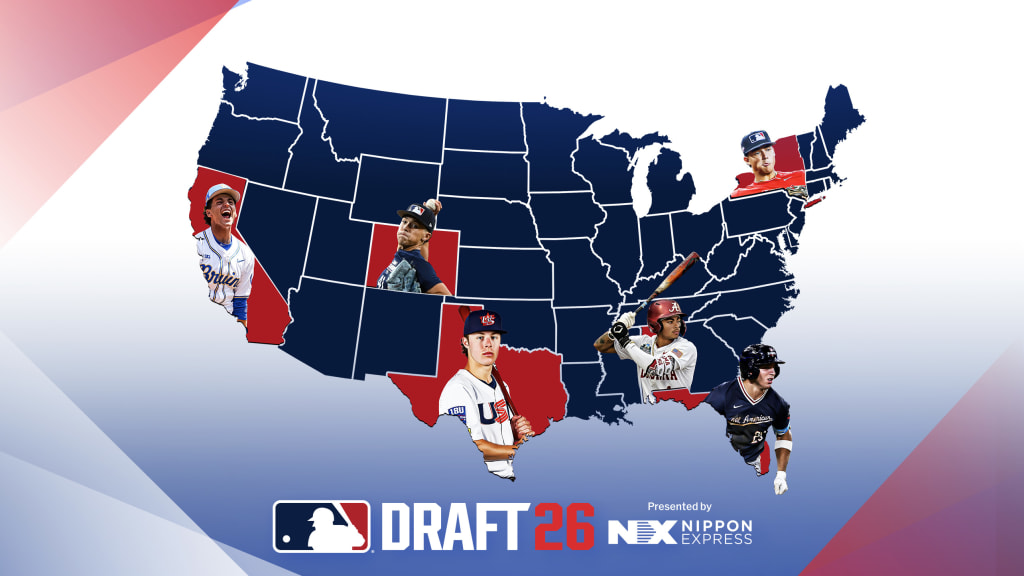
Everybody is from somewhere.
The annual First-Year Player Draft helps share the tapestry of baseball’s North American geography with players from all corners of the United States, Canada and Puerto Rico expected to hear their names called when Day 1 of the process begins this Saturday in Philadelphia.
Just think of the discussion surrounding the White Sox and the No. 1 overall pick this year. The three prospects you’ll hear come up most often are a UCLA shortstop (Roch Cholowsky), a Texas high school shortstop (Grady Emerson) and a Georgia Tech catcher (Vahn Lackey). That’s coast-to-coast coverage, and it illustrates just how wide a net each organization has to cast to find the best talent for the future of their farm systems and MLB clubs.
2026 MLB DRAFT PRESENTED BY NIPPON EXPRESS
Day 1: Saturday, July 11 (Rounds 1-4)
• 1:00-2:30 p.m. ET - Picks 1-10 (NBC/Peacock)
• 2:30-4:30 p.m. ET - Picks 11-40 (MLB Network, MLB.com, MLB.TV, MLB+)
• 4:30-7:45 p.m. ET - Picks 41-135 (MLB.com, MLB.TV, MLB+)
Day 2: Sunday, July 12 (Rounds 5-20)
• 11:30 a.m.-7:30 p.m. ET (MLB.com, MLB.TV, MLB+)
Coverage
Here are the best prospects from each state heading into the 2026 Draft:
(Note: Not every state has a player likely to be considered over the course of this year’s 20 rounds. However, each state's name links to a list of eligible players from that state in the Draft tracker.)
Alabama: Justin Lebron, SS, Alabama (No. 9)
On four out of the five tools, Lebron would have a chance at going first overall. He’s a plus-plus runner with 60 grades on his power, arm and fielding tools. But after hitting .229 with 27 strikeouts across 125 plate appearances in SEC play, the Crimson Tide shortstop carries enough questions with the bat that he is expected to go later Saturday. A team that takes him will be one that believes enough in its hitting development department to help Lebron meet his considerable ceiling.
Alaska: No one
Arizona: Cole Carlon, LHP, Arizona State (No. 26)
The 6-foot-5 southpaw moved into the Sun Devils’ rotation for the first time this spring and posted impressive results with a 3.87 ERA and 133 strikeouts in 83 2/3 innings. His 38 percent strikeout rate led Big 12 qualifiers. Carlon sits around 94 mph with his fastball but can touch 98, while his 87-88 mph short slider earns plus-plus grades after generating a ton of whiffs in the spring.
Arkansas: Ryder Helfrick, C, Arkansas (No. 11)
Helfrick showed signs of his slugging breakout in the summer of 2024 when he tied for the Cape Cod League with 11 homers, and since then, he’s gone deep 33 times as a sophomore and junior with the Razorbacks. He earns strong reviews for his defensive acumen as someone who called pitches in school, and his 65-grade arm should be a weapon behind the plate at the next level. He can struggle against non-fastballs (dinging the hit tool) but his overall profile is strong enough that he should become the first Razorbacks catcher to go in the first round in program history.
California: Roch Cholowsky, SS, UCLA (No. 2)
Being a shortstop with back-to-back 20-homer seasons at UCLA would have been enough to make Cholowsky a special talent in the Draft. Being a hitter with an equal 36/36 K/BB ratio this spring kicks that up a notch. Being a potential plus defender at the six with a 60-grade arm to boot … well, that makes him an option at first overall and one of the best collegiate shortstops in recent memory. Cholowsky may have “slipped” from No. 1 to No. 2 in the rankings, but he’s still a potential franchise cornerstone for some club out there and a player who could arrive in the Majors quickly.
Canada: Sean Duncan, LHP, Terry Fox (B.C.) HS (No. 66)
News broke last month that Duncan would need Tommy John surgery, but there are still enough raw materials here for the Vanderbilt commit to hear his name called over the weekend. He had started to show a fastball velo uptick to 95 mph before the injury, and his changeup flashed at least above-average with good arm speed. He could go in the first three rounds and rehab with his pro club.
Colorado: Ethan Wachsmann, RHP, Grandview HS (No. 87)
Hailing from the same alma mater as Kevin Gausman, Wachsmann certainly has size at 6-foot-5, and there’s already good fastball velocity in the mid 90s and up to 97. A picking team will dream of adding even more heat as the righty works his way through the Minors, as well as developing another above-average pitch beyond his curveball. Wachsmann is committed to Wake Forest.
Connecticut: Bryce Hill, RHP, Greenwich Country Day (No. 156)
The 6-foot-5 righty caught attention at a Cape Cod League workout at Fenway Park last summer, and since then, he’s shown a mid-90s fastball with sink and a hard slider that looks like a potential above-average pitch. He wasn’t a big showcase participant beyond that Cape outing, however, leaving some to wonder how he could do outside of the northeast. Hill is committed to Stanford.
Delaware: Osiah Kelley, SS, Sussex Central HS
Named the Gatorade Player of the Year in the First State, Kelley hit .470/.576/.758 with two homers, 12 steals and only seven strikeouts over 20 games for Sussex Central. His speed especially drew high praise from opposing coaches. He is likely headed to the University of Maryland to begin his collegiate career.
District of Columbia: Robbie Lavey, C, George Washington (No. 188)
Lavey batted above .310 in all three of his years at GW and mixed in a decent showing on the Cape with Orleans last summer to help scouts believe he could be a solid catching prospect at the next level. His left-handedness in the box and above-average throwing arm are his best assets for clubs looking to bulk up their backstop pipelines.
Florida: Jacob Lombard, SS, Gulliver Prep (No. 5)
As the son of Tigers bench coach George Lombard and the brother of top Yankees prospect George Lombard Jr., the 6-foot-3 shortstop certainly has a name many across the baseball industry recognize. But Lombard is a high-quality prospect in his own right with plus power, 65-grade speed and the potential for above-average defense at shortstop. The Miami commit could go 20 or so picks higher than his brother, who was selected 26th overall in 2023.
Georgia: Vahn Lackey, C, Georgia Tech (No. 3)
You’ll hear “late bloomer” attached to Lackey through much of the Draft process, and that comes in only a positive sense. Overlooked by many as a high-schooler, Lackey blossomed into the best catching prospect in the 2026 class by exhibiting plus power and consistent contact over his final two years on campus. He has a huge arm from behind the plate and can move well back there, giving him rare five-tool potential as a backstop. Lackey hit .397/.519/.772 with 20 homers and 15 steals in 61 games this spring on his way to winning the Johnny Bench Award.
Hawaii: Judah Ota, OF, Iolani HS
Ota has a massively projectable 6-foot-5 frame and it’ll be exciting to see how power could come as he adds even more muscle to it in the years ahead. He’ll need that pop if he is to head to a corner outfield spot as expected, though he’ll also have to answer questions about his ability to make contact against non-fastballs, having struggled against them in showcases last summer. An MLB Draft Combine participant, Ota is committed to Arkansas.
Idaho: No one
Illinois: Landon Thome, 2B/3B, Nazareth Academy (No. 34)
Jim Thome’s son has pushed himself into first-round conversations by showing improved strength and bat speed as a senior, bolstering the belief that he could hit for both average and power at the next level. He also improved his speed and defense after working with Jake Cronenworth over the offseason, though many still expect him to move off shortstop as a pro. He has a Florida State commitment if he doesn’t sign out of the Draft.
Iowa: Ryan Stedman, RHP Valley HS (No. 211)
Stedman has shown an ability to sit 93-95 mph (and touch 97) at times with his fastball this spring, and that should just be the start as he fills out more of his 6-foot-3 frame. His low-80s changeup pops most among his secondaries, though a low-80s curveball and upper-80s cutter could end up as average pitches too. Maintaining decent control while adding power to his repertoire would be a likely focus in the pros, if he does sign away from an Iowa commitment.
Indiana: Jack Radel, RHP, Notre Dame (No. 44)
“He’ll likely get more Draft exposure when he heads to Notre Dame next year.” That’s what we wrote about Radel when he was named the top South Dakota prospect out of high school in 2023. Three years later, and mission accomplished. The 6-foot-5 righty posted a 3.29 ERA with 116 strikeouts and 22 walks in 87 2/3 innings with the Fighting Irish this spring, while showing a 93-95 mph fastball, mid-80s slider and upper-80s cutter that project as possible above-average offerings. He’s also maintained his strike-throwing abilities from his prep days, aiding his case to go in the first two rounds Saturday.
Kansas: Dee Kennedy, SS, Kansas State (No. 79)
Kennedy got LASIK surgery after his sophomore year with the Wildcats, and the results have been incredible with his strikeout rate dropping from 30.3 percent to 18.4 as a junior. He also sported a .357/.461/.733 line with 20 homers and 22 steals on his way to being named an All-Big 12 First-teamer. Kennedy has played second base, shortstop and third base as a collegian and has enough arm for anywhere on the dirt.
Kentucky: Tyler Bell, SS, Kentucky (No. 10)
Bell bet on himself when he went unsigned by the Rays as the 66th overall pick in 2024, only to suffer a torn labrum in his left shoulder in his first game this spring. It’s still a bet likely to pay off. He performed capably enough as a Draft-eligible sophomore despite the injury to make himself an option in the first half of the first round as a switch-hitting shortstop who can display at least average hit and power tools while sticking to the premium position. He still has plenty of room to grow his game once healthy too.
Louisiana: Derek Curiel, OF, LSU (No. 12)
Curiel withdrew from the 2024 Draft to head LSU and hit above .340 in each of his two seasons in Baton Rouge. His line-drive, all-fields approach gives him the chance to be a plus hitter, and his above-average speed helps his odds of playing in center field the higher he climbs. A flat swing and only OK strength limits his power and may keep him out of the Top 10 this weekend, but the overall profile will still earn him a high selection.
Maine: No one
Maryland: Brayden Martin, 3B/OF, Maryland
Martin posted some eye-popping stats as a junior with the Terrapins; his 95.4 percent overall contact rate was second-highest among Division I (min. 150 pitches seen), while his chase rate was just 11 percent. That culminated in a .352 average, .488 OBP and 20/56 K/BB ratio over 56 games. But it also came with just two homers and a swing rate below 30 percent. Martin won’t be able to be passive at the next level, but it’s tough not to be intrigued at just how good the hit tool can be in the right farm system.
Massachusetts: Brody Bumila, LHP, Bishop Feehan HS (No. 23)
Bumila had already had internal brace surgery in May 2025, and the recent news that he’s suffered another UCL injury had clouded his status as a potential first-rounder heading into Draft Week. But any team still willing to consider the Texas commit will be thinking of his triple-digit fastball and 6-foot-9 frame. Once healthy, Bumila is expected to focus on getting his slider and changeup up to at least average MLB standards, considering he didn’t need much more than the heater in the Bay State.
Michigan: Colby Turner, 2B/OF, Michigan
Turner was an All-Big Ten selection at second base after hitting .366/.432/.625 with 14 homers, 10 steals and just an 11 percent strikeout rate in 57 games this spring, though he’s expected to profile better defensively in left field. He can hit the ball hard but will need to tighten up his swing decisions after expanding the zone too much against most pitch types with the Wolverines.
Minnesota: Isaac Morton, RHP, Minnesota (No. 172)
It’s been quite the journey for Morton after turning down a sizable offer from the Brewers as 2023 19th-rounder to his limited playing time over two years at Texas A&M to an impressive junior year with the Golden Gophers that ended with an elbow injury and Tommy John surgery. Throwing from a sidearm delivery, the 21-year-old earns above-average to plus grades on his 93-95 mph running fastball and high-spin, mid-80s slider, but he’ll have to show that stuff can return post-procedure.
Missouri: Caden Bogenpohl, OF, Missouri State (No. 93)
The 6-foot-6 lefty hitter shows plus-plus raw power with exit velocities up to 119 mph, but high ground-ball rates limited his slugging output over the course of his collegiate career; he went from hitting 20 homers as a freshman to only six this past spring. Bogenpohl moves with good speed underway, especially for his size, but seems likely to head to a corner outfield spot as a pro, heightening his need to mash.
Mississippi: Eric Booth Jr., OF, Oak Grove HS (No. 6)
Booth has some serious ceiling as a plus-plus runner who also has enough power to dream on future 20-25-homer seasons in the Major Leagues. The left-handed hitter’s setup at the plate can be a bit unorthodox with his hands held away from his body, but he pulls them in enough to find the barrel with some regularity. He just turned 18 on July 4, and it’s likely the center fielder gets taken early enough to eschew his Vanderbilt commitment.
Montana: No one
Nebraska: Carson Jasa, RHP, Nebraska (No. 173)
Jasa stands 6-foot-7 but is surprisingly more of a breaking-ball-heavy arm than a tall firebreather. He can touch 98 with his fastball, but its subpar shape has led him to go to his tight upper-80s slider and 78-82 mph curveball more; the deuce was especially dominant this spring with opponents going just 6-for-111 (.054) with 81 strikeouts against it. Jasa improved his walk rate from 18.6 percent in ‘25 to 12.3 percent this spring but still comes with reliever risk.
Nevada: Andruw Giles, OF, Basic HS (No. 157)
Basic HS has been known to produce several notable members of the Southisene family in recent Drafts, but this year, it’s Giles who has surged to the front of the pack. After elbow soreness forced him to DH at last year’s Area Code Games, the lefty-hitting outfielder has gained some momentum after showing off decent power and hitterish traits in pro workouts this spring. The team that takes and tries to sign him away from an Oregon commitment will see plenty of potential in the bat, even if Giles ends up in a corner spot on the grass.
New Hampshire: Nate Isler, RHP, Dartmouth
Isler more than doubled his strikeout rate from 14 percent as a Dartmouth sophomore to 27.5 percent this spring, while finishing with a 4.98 ERA over 11 starts (65 innings); he used that performance to earn a spot on the Cape this summer. He can touch 97 with his fastball, while his 81-84 mph slider is his best whiff generator.
New Jersey: Peyton Bonds, OF, Rutgers (No. 81)
Bonds will generate plenty of fan interest as the son of Bobby Jr., grandson of Bobby and nephew of Barry, but he has plenty of skills to make a name for himself too. He hit .352 with just a 12.7 percent strikeout rate as a Rutgers junior this spring, though he was limited by a hamstring injury. He answered some of the questions about his power by hitting 12 balls over 100 mph and four above 110 at the Draft Combine.
New Mexico: Dylan Blomker, RHP, La Cueva HS
Coming out of Albuquerque, Blomker played both ways this spring, hitting .395 with seven homers while sporting a 1.99 ERA with 113 strikeouts in 53 2/3 innings on his way to winning Gatorade Player of the Year honors in the state. He showed a 92-94 mph fastball that he could blow by batters at the top rail during last year’s showcase circuit, and his 80-82 mph slider drew strong reviews too. He has a commitment to LSU, the alma mater of fellow New Mexican Alex Bregman.
New York: Aiden Ruiz, SS, The Stony Brook School (No. 32)
Ruiz is lauded heavily for his defensive work at shortstop as a potential future Gold Glover who can make both the routine and spectacular plays with ease. Case in point: he moved Grady Emerson to third base and Jacob Lombard to second during the WBSC U-18 World Cup last year. The Vanderbilt commit’s power potential as a switch-hitter is a bigger question mark.
North Carolina: Ty Head, OF, NC State (No. 60)
A Draft-eligible sophomore, Head had more stolen bases (26) and nearly as many extra-base hits (22) as strikeouts (23) over 56 games with the Wolfpack this spring. Overall, he finished with a .291/.460/.556 line, 14 homers and 57 walks in that span. He has a good overall approach, but there’s belief that a big leg kick can throw off his timing and lead to bad contact. That could make for a fun project for a pro hitting department because Head’s plus speed and plus defense in center should play quickly in the Minors.
North Dakota: Kyler Kudrna, RHP, Dickinson HS
The last name could be familiar to Royals fans and general prospect-heads as Kudrna is the cousin of Royals righty Ben Kudrna. The younger Kudrna might be one to file away for a future Draft because most scouts agree that he isn’t quite ready for pro ball yet with a fastball in the upper 80s. But he’s 6-foot-3 and athletic, so there’s a good amount of projection to dream on with the North Dakota State commit.
Ohio: Jack Natili, C, Cincinnati (No. 74)
Natili is your classic big-power, big-arm backstop. He tied for second in homers on the Cape last summer with six and followed that up with 19 in 60 games this spring. While throwing is his best defensive asset right now, he made enough steps forward with receiving and blocking that he’ll get plenty of chances to stick back there at the next level.
Oklahoma: Kollin Ritchie, OF, Oklahoma State (No. 84)
Ritchie ranked fourth in Division I with 31 homers in 60 games this spring and finished seventh with an .804 slugging percentage. Only Golden Spikes Award finalist Landon Hairston (.860) had a higher SLG among Big 12 hitters. It can be a long swing though, and a high strikeout rate on the Cape last year called into question how the bat will play against more elevated competition. An average runner, Ritchie seems more likely to head to a corner after playing in center in Stillwater.
Oregon: Ethan Kleinschmit, LHP, Oregon State (No. 69)
A JUCO transfer, Kleinschmit performed admirably in his two years as an Oregon State starter and finished with a 3.74 ERA and 97 strikeouts in 77 innings this spring. His 79-81 mph slider and mid-80s changeup earn better grades than his 91-93 mph fastball, but scouts wonder if he could add more velo once he gets to work with pro strength and pitching training. He also added a cutter to give himself a fuller arsenal, though his stock pretty much held serve throughout 2026.
Pennsylvania: Luke Williams, SS, Franklin Regional HS (No. 90)
While the Draft will be held in Philadelphia, it seems like someone from the other side of the state will hear his name first among Keystone Staters. Hailing from the Pittsburgh area, Williams draws raves for his speed -- some scouts say it’s an 80 -- and plus arm strength from shortstop. He’ll flash good bat-to-ball skills and decent raw pop but needs to face premium pitching after missing last year’s showcases with an ankle injury. Williams is committed to Vanderbilt.
Puerto Rico: Juriel Collazo, OF, Christian Military Academy
A converted shortstop, Collazo is at least a plus runner, if not plus-plus, and uses those wheels to cover lots of ground on the grass. Some point out he’ll need to work on his reads out there before becoming a true plus defender, though having a plus arm also helps. He has a quick bat but will need to find the barrel more consistently. He is the most likely player from Puerto Rico to go in the Top 10 rounds this year but will head to Western Kentucky if the Draft doesn’t work out.
Rhode Island: Reece Moroney, SS, Rhode Island
Moroney was a .336 hitter over his three seasons with Rhody and led the Atlantic 10 Conference with 90 hits in 57 games as a junior this spring, finishing with a career-best .370 average in that span. He isn’t expected to be much of a power hitter at any level -- he hit only three homers in 2026 -- but his glove and arm should play from anywhere on the dirt, aiding his Draft stock.
South Carolina: Cameron Flukey, RHP, Coastal Carolina (No. 15)
The highest player ever drafted out of Coastal was Eric Brown Jr. when he went 27th overall to the Brewers in 2022, and Flukey has a great shot to set a new benchmark for the program on Saturday. The 6-foot-6 righty sports three above-average-to-plus pitches in his mid-90s fastball, upper-70s curveball and 82-85 mph slider, and he has a repeatable delivery that should help bring above-average control to the pros. He dealt with an early rib stress fracture that limited him to seven starts (24 innings).
South Dakota: Tristan Augedahl, LHP, South Dakota State
Augedahl is a 6-foot-8 left-hander, and those types of pitchers don’t exactly grow on trees. He pitched exclusively out of the bullpen in his two years and struggled with control at times. His fastball only sits in the low 90s, but his upper-70s changeup was super effective with a whiff rate of 52 percent in 2026, per Synergy.
Tennessee: Tegan Kuhns, RHP, Tennessee (No. 25)
Following up a stellar (if brief) time on the Cape last summer, Kuhns posted a 3.56 ERA with 106 strikeouts and only 16 walks in 81 innings with the Volunteers this spring. He sits 93-96 mph fastball that comes with great carry and plays up with good extension, and his downer curveball acted like a potential plus pitch in school. His control vastly improved in his second season on campus, and there’s no reason to believe it won’t carry to the pros, though he’ll need to find a third pitch to lock in as a starter the higher he climbs.
Texas: Grady Emerson, SS, Fort Worth Christian HS (No. 1)
Gatorade’s National High School Player of the Year has the best hit tool in this year’s class as he’ll make terrific swing decisions and barrel the ball all over the diamond. He hit .508/.634/.915 with only five strikeouts in 161 plate appearances this spring. His power is more evident in batting practice and workout environments, but that could be comfortably above-average in the end too. He draws raves for his arm and glovework at the six too, and it’s that type of overall package that will have him in the first overall conversation throughout the rest of the week.
Utah: Jake Long, OF, Utah
After hitting only one homer in 2025, Long went deep 11 times with the Utes this spring and finished with a .374/.445/.626 line in 51 games on his way to earning All-Big 12 Second Team honors. He also cut his strikeout rate from 17.6 percent to 12.6, so he didn’t trade contact for power. The lefty hitter can be caught biting on pitches outside the zone, especially changeups, but there’s enough of an intriguing offensive profile here.
Virginia: AJ Gracia, OF, Virginia (No. 19)
After two standout years at Duke, Gracia didn’t miss a beat when he followed coach Chris Pollard to UVA, as he finished with a .354/.489/.632 line and 14 homers in 56 games in his one spring with the Hoos. His advanced approach and potential to add more strength in the pros gives him above-average hit and power tool projections, and despite fringy speed, his instincts give him a chance to stick in center.
Vermont: Kaiden McCarthy, RHP, Vermont Academy (No. 61)
McCarthy reclassified in January to join the Class of 2026 at just 17 years old, and now he’s in position to be the highest high-schooler ever selected out of the Green Mountain State. The 6-foot righty shows a pair of fastballs and can touch 99 with the heat, and as if that wasn’t enough, his changeup looks like a potential above-average pitch. He rounds out the arsenal with two promising breakers in a sweeper and a downer curveball. That combination of stuff, along with his athleticism, might be enough to keep him away from his Tennessee commitment with a prominent Draft pick.
Washington: Eli Herst, RHP, Seattle Academy (No. 231)
Herst’s current stuff may look vanilla on paper with a 90-92 mph fastball (aided by good extension), a mid-70s slider and a low-80s changeup. But the Vanderbilt commit stands at 6-foot-5, and it isn’t hard to project more stuff coming as he matures physically. Without that big step forward coming this year, he might be most likely headed to school unless a school wants to invest big on that development coming in-house.
Wisconsin: Dominic Santarelli, 1B, St. Joseph (No. 129)
It’s all about the power for the Badger State’s finest. Santarelli topped out with an 115.1 mph exit velocity at the Draft Combine this year and hit one homer 463.1 feet, the third-longest distance of anyone on Day 1. That very much meets the scouting report of the 6-foot-2 lefty slugger, who showed off plus-plus raw power on the showcase circuit last year. The LSU commit is likely limited to first base already, and that could impact where and when he goes over the weekend.
West Virginia: Dawson Montesa, RHP, West Virginia (No. 161)
A Division II transfer from Adelphi, Montesa grabbed attention early on in 2026 but was inconsistent with the Mountaineers, even losing his rotation spot at times due to rough control. A scoreless start lasting 5 1/3 innings against Troy at the Men's College World Series in Omaha certainly helped him end on a high. The 20-year-old righty can sit in the mid 90s with his fastball (though he’ll lose command of it in the zone occasionally), and his upper-70s curveball demonstrates a feel for spin.
Wyoming: No one