

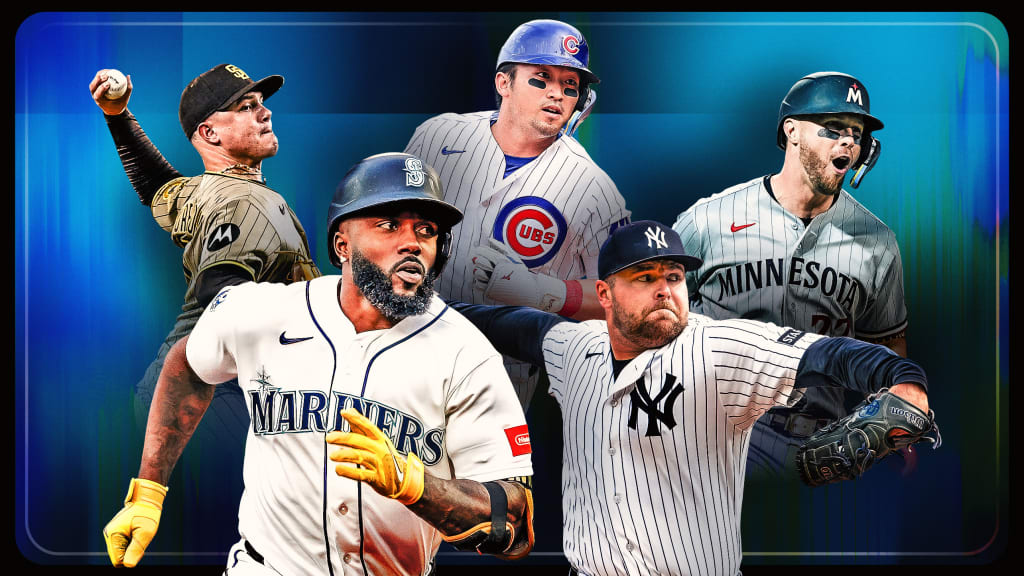
Baseball season has ended. Qualifying offer season is just getting started.
A refresher, for those who haven’t joined us on this journey every year at this time: Each offseason, one of the first orders of business is for teams to decide which impending free agents should be extended a qualifying offer. It’s a one-year deal, worth the average salary of the top 125 best-paid players, and this year, that is expected to be $23.15 million. Teams have until Monday, Nov. 2, at 5 p.m. ET to offer, then players have until Nov. 17 to accept said offer. If they do not, and go elsewhere, then his new signing team loses a Draft pick and his old team gains one, the specifics of which are all spelled out here.
Dating back to 2012, when this system came into existence, we’ve seen 157 QOs given, and just 18 accepted, which is a relatively paltry 11% acceptance rate – though that’s not surprising when you really think about who is most likely to receive one. That's usually the cream of the free-agent crop, the players who have every expectation of signing large, long-term deals.
Last year, though, we saw a record four acceptances, in Trent Grisham, Shota Imanaga, Gleyber Torres and Brandon Woodruff.
Still, we expect fewer qualifying offer than usual this time around, and that really doesn’t have very much to do with the upcoming Collective Bargaining Agreement negotiations. (Any potential change to this process would take place in future years, as this all still falls under the 2022-’26 CBA, which remains in effect until Dec. 1.)
Instead, it’s because this is shaping up to be a relatively weak free-agent class in general, with fewer-than-usual big names who would ordinarily garner a QO, and because several of the big names who are out there are not eligible to get one.
That’s because there are two sets of players who cannot be considered for a QO.
First: Anyone who played for more than one team this year is not eligible, so that excludes Tarik Skubal, Luis Arraez, Casey Mize, Freddy Peralta, Daulton Varsho, Clay Holmes and any other in-season team movers.
Second: Players can only get the QO once in their career, and while we won’t recite all 157 players who have gotten one in the past, the prominent free agents right now who are ineligible due to this stipulation include Michael King, Imanaga, Grisham, Kevin Gausman, Torres, Robbie Ray, Michael Conforto, Nick Martinez and Raisel Iglesias.
All of which means that our usual format in the past – separating players into different tiers based on their likelihood to accept – won’t work. There might not be a single player who, like Kyle Schwarber last year or Juan Soto the year before or Shohei Ohtani the year before that, is an absolute slam-dunk no-doubter to receive and reject.
Which, really, makes it all the more interesting. We’ve identified 15 players who are the most likely to be under consideration. Who will get a qualifying offer – and who will take one?
BATTERS
OF Randy Arozarena, Mariners
No one really noticed this amid Seattle’s massively disappointing 2026, but Arozarena had a career year, posting a 148 OPS+ with 26 homers and steals apiece. That's enough that, by FanGraphs’ reckoning, he was one of the 10 most valuable position players in the Majors.
If not entirely out of nowhere, given that Arozarena has been a useful player for years, it was also an unexpected leap from a hitter who’d generally been repeating the same consistently good year for the last half-decade, uninterrupted.
There are, of course, caveats. Arozarena turns 32 in February. His defense has been considered to be consistently poor for the last four seasons. He managed this excellent season in something of a confounding way, coming as it did around declines in bat speed, sprint speed and hard-hit rate. And again, he'd never had a season quite like this. Still, he's been a good player for a long time.
Given Seattle’s presumed desire to keep a hitter who actually succeeded at pitcher-friendly T-Mobile Park, extending him a QO seems obvious. Given, too, the weak free-agent class, the paucity of right-handed-hitting outfielders, and Arozarena’s track record of success, him declining it in search of one last big score seems obvious, too -- red flags or not.
Prediction: Receives offer / rejects offer.
OF Seiya Suzuki, Cubs
Suzuki and Arozarena, only a few months apart in age, are essentially the exact same player. No, really; look at their numbers over the last four years, and we dare you to tell them apart. They are, looking at WAR among righty outfielders in that time, No. 6 and No. 7, but really tied for sixth behind five of baseball’s biggest stars. Like Arozarena, the consistently good Suzuki is coming off his best season.
That, at least, is where we can find some differences. While Arozarena adds more value on the bases, and Suzuki previously had also been a relatively ineffective defender, we saw Suzuki take a huge step forward defensively this past season, actually getting himself named as a finalist for the Gold Glove. Can teams actually count on that going forward, based on one good year? It’s hard to be certain, though the ‘why’ of it all seems clear enough – he worked to improve his reactions and jumps, and we’ve seen via the Rays that this does seem to be a sustainable way of improving outfield defense.
Maybe Arozarena and Suzuki aren’t such mirror images after all. Except in one final way in which they are: Neither’s taking a one-year deal, not off the seasons they just had.
Prediction: Receives offer / rejects offer.
1B Jake Bauers, Brewers
Now we’re talking. Bauers’ career renaissance from journeyman on the edge of unemployment to “best hitter on baseball’s best team” is an incredible tale, and one that might not have ended with a Milwaukee championship without him. He, along with his teammates, will be legends in Wisconsin forever, but there’s an uncomfortable question that has to be asked. It’s not that anyone begrudges him a raise, not after the year he just had. But will the Brewers be okay with offering a contract nine times more than the $2.7 million he just made?
One would think that after all the moving around he’s done in his career, he’d be pleased to take a massive salary bump to stay in a place where he’s a hero, and that’s the decision Milwaukee has to wrestle with. They did extend the QO a year ago to Woodruff, and didn’t end up getting all that much for it. The real question, then, is whether they think they can simply make the next Bauers, rather than paying a premium for the current one. This actually has the makings of a situation where parties agree to avoid this conundrum by settling on a multi-year deal at a somewhat lower average annual value.
Prediction: Does not receive the offer.
OF Ian Happ, Cubs
Speaking of consistent Cub corner outfielders, Happ keeps on putting up the exact same year, hitting something like 20 homers with around a 115 OPS+ to go with good-enough defense. (Yes, he’s a four-time Gold Glove winner, but the metrics haven’t always backed that up before this year.) You might also consider how much he’s meant to the team over the course of 10 seasons, coming up on a defending champs roster that still included Anthony Rizzo, Kris Bryant and Schwarber, eventually getting himself into the top 20 of games played in the long history of the franchise.
There’s an argument that the Cubs might not want to lose both corner outfielders in one winter. But there were some concerning strikeout issues last year, and they started platooning Happ with trade acquisition Tyrone Taylor to protect him from lefties. It seems highly likely that if given the QO, he’d take it. The Cubs probably won’t want to do that, particularly considering how dire their starting-pitching needs are.
Prediction: Does not receive offer.
C Ryan Jeffers, Twins
It took Jeffers a while to get here, really. In his first three seasons in the league, he was a below-average backup, one with a mere 88 OPS+. It’s been more than a little different since, as he’s posted a 116 OPS+ since 2023, which correlates well with a much better ability to make contact – his 18% strikeout rate in 2026 was half the 37% it was in '21. He’s also well-positioned in this market, because depending on how you feel about Carson Kelly (who is two years older) or Tyler Stephenson (who routinely rates as among baseball’s weakest framers), Jeffers is either “the best catcher available” or “the only starting-caliber catcher available.”
Not, of course, that Jeffers grades out as an excellent backstop, because he usually fares poorly there, and he did miss a big chunk of this past season after breaking the hamate bone in his left hand in mid-May. It won’t matter, though. He’s not even 30 until next June, and he’s a catcher who can hit, in a world where it’s difficult or impossible to find either of those things. There’s no better time to test the market, and that’s exactly what we expect he will do. After choosing not to trade him at the Deadline, the Twins will at least want to get that Draft pick in return if he moves on.
Prediction: Receives offer / rejects offer.
2B Jazz Chisholm, Jr., Yankees
The Chisholm the Yankees had in 2025, the one who went 30-30, would obviously be a player you’d want to retain, either long-term or for even just one more year. But the one we saw in 2026, who declined offensively and was inconsistent defensive, may be a different story
That's especially true given how many moving parts the Yankees have in their lineup, with questions about if and where Anthony Volpe fits, how to keep Luis Garcia Jr. and Ben Rice in the lineup at the same time, and whether to move on from Ryan McMahon at third base.
The Yankees do have other options at second, including Volpe, Jose Caballero, and perhaps Garcia, if they think he can improve on the defense he showed in Washington. Chisholm has said he enjoyed his time in New York and would like to stay. We’re guessing that if he received a QO, he might take it, reasoning that he’d rather be in the market off a better year and without Draft-pick compensation tied to him, and that’s exactly why the Yankees, focusing on other needs, won’t extend him one.
Prediction: Does not receive offer.
2B Brandon Lowe, Pirates
Meanwhile, the exact opposite happened to Lowe in his first (and potentially only) year in Pittsburgh after arriving in an offseason trade from Tampa Bay. Lowe hit 35 homers, his third 30-homer season (and fifth of 20 or more), put up his usual “20% better than league average season” that he does basically every year, but paired it with one of the most incredible defensive turnarounds that we’ve ever seen.
We actually can’t overemphasize that last part enough. In 2025, Lowe was near baseball’s weakest defensive infielder, checking in at -10 Fielding Runs. In 2026, he landed at +12 Fielding Runs, making him the third-best second baseman with the glove, and it’s not just a case of the single-season weirdness that can sometimes happen with defensive metrics; multiple different systems concur here. He credits health and pre-pitch positioning, but whether or not you fully believe he’s elite defensively now isn’t really the point. A year ago, you weren’t even sure he would be a second baseman for much longer. Now, you’re at least comfortable that he can stay there for a few seasons, and that’s good enough.
Lowe, then, is selling a 30-homer bat who can stick in the middle infield, with some chance he’s actually going to continue to be quite good there.
Prediction: Receives offer / rejects offer.
1B Ty France, Padres
Speaking of early-30s journeymen from Southern California who had a shocking breakout in 2026, we have France, who hit exactly as well as Bauers did this year – each being roughly 40 percent above average – except with a pretty major advantage on defense, where he's a Gold Glove finalist for the second straight year.
An elite defender who slugs .500 sounds great, and it was. But France, who had hit poorly in each of the previous two seasons for four different teams, had to settle for a mere Minor League contract last winter, unable to find a guaranteed roster spot and pondering retirement if he didn’t make the Padres roster. Like Bauers, it’s difficult to see the Padres giving him that much of a raise from, in his case, the veteran minimum. Like Bauers, it’s easy to see the well-traveled France wanting to stay in a place where he’s found success, particularly since he was born in San Diego and played for Tony Gwynn at San Diego State. And, like Bauers, it’s pretty easy to see player and team coming together on a multi-year deal that sidesteps this issue entirely.
Prediction: Does not receive the offer.
SS/3B J.P. Crawford, Mariners
Crawford spent parts of eight seasons in Seattle, and there were some definite high points, like the 2023 season that saw him post a 133 OPS+ and garner some downballot MVP support. No Mariner has ever played more games at shortstop. It’s been mostly downhill since then, though, as he’s been basically an exactly average hitter over the last three seasons, which would be OK if not for the fact that defensive metrics routinely rate him as one of baseball’s weakest defensive shortstops.
That’s why, when he said he was willing to move to third base to accommodate Cole Emerson’s arrival this year, it was viewed both as an excellent demonstration of selflessness by a veteran leader as well as an indication that shortstop may no longer be in his short- or long-term future. Given that Crawford is still only 31 and retains excellent plate discipline skills, it’s easy to see a buy-low argument for a number of teams, particularly if they think his unimpressive 2026 was merely about injuries to his shoulder, hand and wrist. That just won’t happen via the qualifying offer, which it’s difficult to see extended here.
Prediction: Does not receive offer.
PITCHERS
SP Trevor Rogers, Orioles
If you know exactly what to expect from Rogers in 2027, you’re a step ahead of us. Rogers had an up-and-down Miami tenure, then posted a 7.11 ERA in four post-trade Baltimore starts in 2024, but then was truly fantastic when healthy in 2025, then had a lousy start in 2026 before a much better finish, and … well, we’re exhausted just typing all that out. Ultimately, he’s about to be 29 and he’s given the Orioles nearly 300 innings of 3.16 ERA ball over the last two seasons.
That’s hard to replace, and so the team extending him the QO seems far more likely than not. For his part, Rogers won't turn 30 until after next season, and he can make a case as the best lefty starter on the market behind Skubal. That’s a recipe for multiple years, and he’ll get it somewhere.
Prediction: Receives offer / rejects offer.
RP Adrián Morejón, Padres
Somehow eight seasons into his career at just 27, and often overshadowed by Mason Miller in the San Diego bullpen, Morejón overcame early-season injury trouble to become one of the most feared relievers in the game over the last three seasons. Owner of the hardest bullpen fastball among lefties (99.4 mph), and with the potential he may yet make a return to the rotation, given his youth, Morejón’s track record should position him nicely on the market this winter – potentially back in San Diego, where he’s expressed an interest in returning.
Perhaps so. But when a hard-throwing pitcher with some history of arm trouble gets to the market at something like the peak of his abilities, he’s not likely to accept a one-year deal. We expect Morejón to seek multiple years, and for the Padres to know that, thus extending the QO, meaning they’ll either get him back for a short commitment or, more likely, get a Draft pick out of it.
Prediction: Receives offer / rejects offer.
SP Matthew Boyd, Cubs
Boyd, 36 in February, is finishing off a two-year, $29 million deal where he was, at times, the top starter in the Cubs rotation. Having turned down his side of a $15 million mutual option, he’s probably looking at his final chance to score a multi-year deal. Boyd was mostly effective in his two years with the Cubs, providing 306 1/3 innings of 3.50 ERA ball, as well as landing twice on the injured list this past year.
Given that the Cubs have essentially an entire rotation to rebuild, they might have interest in bringing Boyd back, and given his age and injury history, he’d probably be thrilled to accept that kind of salary for one year. That’s exactly why the Cubs won’t make the QO, though you could see them working out something else instead.
Prediction: Does not receive offer.
RP David Bednar, Yankees
Less than two years ago, the Pirates demoted Bednar, who’d been an All-Star in 2022 and ‘23, to the Minors to try to reset after a rough 2024. Safe to say, it worked out well; Bednar, who was eventually traded to the Yankees in the summer of 2025, has spent the last two seasons being excellent. Across '25 and ‘26, Bednar has a 2.39 ERA and a 31% strikeout rate. That 2024 now looks like a fluke more than anything, as he’s been reliably good in five of the last six seasons.
Relievers don’t usually merit a QO; only a dozen have gotten one over the years. But losing Bednar would be too big a loss for a Yankee bullpen that needs to add arms, not lose them. This is probably the closest anyone will come to simply saying ‘yes,’ because this would be a sizable raise for Bednar. Maybe he’ll do exactly that. Testing the market seems likelier, though.
Prediction: Receives offer / rejects offer.
SP Mike Soroka, D-Backs
The oft-injured Soroka gave Arizona 116 good innings, but only 34 came in the second half due to, again, the injuries. Arizona may indeed want him back, but they’re not going to double his salary to do it.
Prediction: Does not receive offer.
SP Brady Singer, Reds
We include him mostly because when he was not traded at the Deadline, it led to some question about whether the Reds would try to retain him via the QO – a route they took with Martinez two years ago. If there was a world where that might have been the case, it’s not the one where Singer then posted an 8.39 ERA over his final 10 starts. If the Reds do value the 326 2/3 innings he’s provided over the last two years, they can bring him back far more easily than that.
Prediction: Does not receive offer.
Which leaves us with a projection of seven players getting an offer – and zero accepting one.
- Arozarena
- Suzuki
- Jeffers
- Lowe
- Rogers
- Morejon
- Bednar
If that came to pass, it would be tied with 2023 for the fewest offers extended after a full season on record (there were six after 2020, which we’re setting aside for obvious reasons). It would be the fifth time no one accepts one. It is, for a lot of reasons, a long way away from 2015, when a record 20 qualifying offers were given.