



When ABS (the Automated Ball-Strike Challenge System) came to the Majors in 2026, a big question among the baseball world was something along the lines of, “Well, what if a World Series game, of all things, ends on a challenged pitch?”
Given the two teams that have advanced to the Fall Classic, the better question might be this: What if it doesn’t?
Milwaukee and Tampa Bay, two of baseball’s most analytical clubs, so willing to do nearly anything to find the slightest edge, seem to have settled upon a similar strategy for challenging in the postseason. It can be summed up pretty simply as this: “Save it for the catchers.”
- As hitters, the two teams have taken just four of the 43 overturns available to them, or 9%.
- As fielders, the two teams have taken 21 of the 40 overturns they could have, or 53%.
In nearly identical opportunities, the fielding side of the ball has managed to collect more than five times as many overturns. It’s not just about being right, either, because they’re 57% right as hitters and 63% right as fielders. It’s far more about the willingness to try. The teams together have challenged seven times while batting – and 33 times while fielding.
But we’re overselling the “teams” aspect of this, really. Those four hitting overturns – and all seven challenges overall – have come from Milwaukee. Despite several good opportunities to do so, Tampa Bay’s hitters have not challenged even one time this fall. Not one time.
This hesitancy to tap that helmet can lead to some extremes. Counting the regular season and postseason together, there were 139 batters in 2026 who had at least 25 opportunities to overturn a call, which is to say, “The call was incorrect and the team had at least one challenge remaining.” Of them, 137 batters tapped the helmet at least one time. Only two made it the entire season without a single challenge. They’re both going to play in the World Series.
That’s Milwaukee’s Andrew Vaughn, who let 36 chances go by without a challenge, and Tampa Bay’s Yandy Díaz, who let a stunning 59 go by.
For Díaz, this has been a season-long pursuit. Back in June, he told the Tampa Bay Times why he was choosing not to take advantage of the new opportunities, essentially saying he’d rather focus on hitting than the additional responsibility of challenging. While doing so, he issued a quote you definitely won’t see brought up repeatedly over the next few days.
“I don’t like it,” he said. “When I go to home plate, I need a hit, not a challenge. Maybe in the World Series sometime, but now, [no].”
It is the World Series now. But it is not, according to Rays manager Kevin Cash, a mandate.
“Not by design,” Cash said when asked earlier this week. “If we get the lead after the sixth or seventh inning, we are reminding guys to save them for the catcher, for sure. It's got to be kind of a run-scoring, game-changing at-bat.”
Because ABS is more than just about “being right” -- it's also about “being aggressive” -- the result of all this hesitancy is that none of the 12 playoff teams has accrued less value out of ABS (on the batting side) than the Brewers and Rays. This is a continuation of what we saw in the regular season, when the value leaderboards read: “29) Brewers, 30) Rays.” For however many places you can find these two teams at or near the top of the league together, this is the exact opposite.
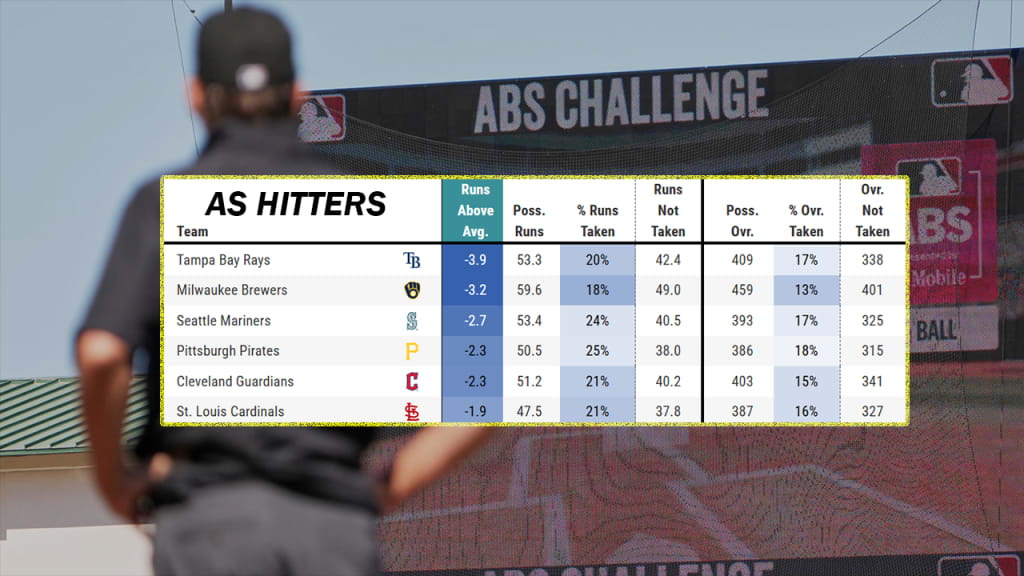
While both teams were tied for 21st in overturn rate in the regular season (46%), Milwaukee was dead last in both percentage of available overturns taken (13%) and in rate of ABS runs attained (18%), with the Rays hovering right around the same range. (The difference in those numbers is that while one overturn is always one overturn, putting it on a run scale includes the context of the game situation – count, inning, runners on, etc. This is basically saying that they were below-average at being right, and also far too conservative at trying, so the end result here is: Value gets left on the table.)
Ironically, no team in baseball had the opportunity to overturn more errant calls than Milwaukee, which had 401 such chances (most) and 60 possible runs of value on those (second-most), which is probably related a little to how many small strike zones they have. They actually earned only 10.7 of those runs – hence the 18%.
For Milwaukee, this roughly aligns with how they approached things all season long, issuing the second-fewest batting challenges as compared to the third-most fielding challenges.
Maybe that’s strategy. Or maybe this is the one thing they’re simply not any good at. It got to the point that some players were simply told they were no longer allowed to question the umpires, notably rookie outfielder Luis Lara, who was wrong on five of his seven challenges, and ultimately attained only 7% of the runs available to him.
“We took him offline,” Murphy said late in the season. “He can’t get any worse. We’ve got a reverse magnet so if his hand goes near his head, it goes away.”
Magnet or not, Lara hasn’t challenged since losing one on Sept. 7. This is essentially exactly what Murphy said would happen way back on the first day of Spring Training.
“I don’t want to put a leash on anyone,” Murphy said in February. “I want all players to feel that freedom. But if a guy does it two or three times and he’s 0-for-3 in situations that aren’t good, then we can take away that privilege.”
It’s not like that gets any easier in the postseason, when everything is magnified. Murphy alluded to that right before the NLDS began.
“Now, everything's different. You don't want them to have that feeling that everything's different," he said. "They're going to feel that it's different. And if you fill their mind with, okay, no ABS, and no ABS after this. It's really hard.”
Tampa Bay's Díaz, meanwhile, has been confronted with a team-high five chances to overturn an errant call in the playoffs, and hasn’t yet done so. That's including this particularly big moment in Game 4 of the ALCS, which occurred on a very important two-strike pitch, with his Rays up 2-1 in the seventh inning, with two on and none out. Not only that, but Díaz's reaction showed he clearly knew the call was mistaken.
It’s true that Cash said, “If we get the lead after the sixth or seventh inning, we are reminding guys to save them for the catcher,” and four of the five could-have-been overturns that Díaz saw fell into that category. But the manager also said, “it's got to be kind of a run-scoring, game-changing at-bat,” and it’s hard to argue this one in Game 3 didn’t count.
Díaz would end up striking out, and Cleveland held on to win.
But none of this is to be taken as, “the two league champions got little value out of this as hitters, so there’s no value to be had.” It’s simply that they seem to prefer to save it for the defensive side of the ball, where the teams are No. 1 (Tampa Bay, 2.4 runs gained) and No. 2 (Milwaukee, 1.1) in ABS challenge value this postseason.
Catchers William Contreras (Brewers) and Liam Hicks (Rays) have been equally outstanding at it in October, with Contreras getting the most overturns (12) and Hicks being responsible for three of the top seven most impactful run value moments of the postseason. That includes this crucial call in ALCS Game 6, when Hicks' challenge turned what would have been a 3-2 count with two runners on into an inning-ending strikeout, a massive change in game state.
Put both sides of the ball together, and the Brewers have been slightly above-average at using ABS this fall, while the Rays have been at the bottom of the pack, largely because of refusing to challenge at all as hitters.
Which is fine, really. The ABS system was meant to rectify only the relatively few calls worth arguing about, not singlehandedly change the way the sport is called, and it did that quite well in its initial season.
But, let's go back to Díaz for a second. “Maybe in the World Series sometime,” he said.
That was four months ago. So: Will he? Would Vaughn? Will any hitter?
We’ve seen, as proven by the Phillies' J.T. Realmuto, that even when a postseason game ends on an overturn, the world keeps on turning. We’ve seen a few times in the regular season, too, that even with a challenge left and nothing to lose, batters have let the game end without a head tap – our favorite example coming in Arizona in July, when Ketel Marte didn’t challenge a high strike, despite how desperately Tim Tawa, the runner on second, was smacking his helmet for it.
We’ve even seen the Brewers themselves let a ninth inning end this way, as Jackson Chourio (ironically, on the same July day as Marte) let a slider go unchallenged to end a rally despite Milwaukee still having two available.
In the first ABS-powered World Series, we’re confident that Hicks and Contreras will do as much with it as they can from behind the plate. We’re most interested, though, in seeing if some of the hitters -- Díaz particularly -- will finally take the plunge. If a World Series game ends because a challenge is called and the pitch is overturned, it won’t make much of a ripple. If one ends because the batter doesn’t tap the helmet, though, well, that’s when things could get spicy.
MLB.com’s Adam McCalvy and Adam Berry contributed to the reporting of this article.