



CHICAGO -- After Cubs center fielder Pete Crow-Armstrong chased down a drive from Royce Lewis deep into the gap to his right -- sending ivy leaves flying off the vines clinging to the Wrigley Field’s famous wall -- Shota Imanaga stood on the mound with his hands on his hips.
Imanaga felt fortunate in that moment in the sixth inning on Sunday afternoon.
“Pete made a great play deep in the outfield,” Imanaga said via his interpreter, Edwin Stanberry. “That pitch was a mistake pitch on me.”
After a 10-1 win for the Cubs in which Imanaga authored a stellar performance, consider that reaction from the pitcher the response of a perfectionist.
Imanaga gave the North Siders seven shutout innings, marking the first time since May 2 that he logged as many zeroes in an outing. The Cubs’ offense provided more than enough support (all 10 runs came within the first four frames), but the left-hander continued on what has been a strong, seven-start streak for a rotation craving consistency.
The Cubs have a couple starting pitchers on the mend -- Jameson Taillon is set to return from the injured list on Monday and Edward Cabrera is on pace for a return in mid-August -- but have weathered injuries all season. With the Aug. 3 Trade Deadline approaching, it is no secret the front office is on the hunt for available options.
Before each of Imanaga’s outings, the words “SHO TIME” flash on the large red marquee that hangs on the ballpark at the corner of Clark and Addison Streets. Having his performance live up to that billing over the final two months would go a long way in helping the Cubs in their quest to strengthen their playoff positioning.
“He’s been good,” Cubs third baseman Alex Bregman said. “I thought he executed all five pitches really well today. That’s huge when he’s got his five-pitch mix working. The splits were good. The spin was good. The heaters were good up. A few sinkers, too, as well. I thought he did a really good job.”
In Sunday’s outing, Imanaga scattered six hits, struck out four and issued only one walk. The lefty limited Minnesota to a 1-for-10 showing with runners on base, including the Crow-Armstrong catch that ended the sixth and stranded a pair of runners.
“He was just on the attack,” Cubs manager Craig Counsell said.
That has been a trend over the past few weeks, too.
Including Imanaga’s performance against the Twins, the lefty has spun a 2.31 ERA with 35 strikeouts against nine walks with five homers allowed in his past seven turns (39 innings). It has been similar to his first nine games, during which Imanaga had a 2.32 ERA with 59 strikeouts and 13 walks in 54 1/3 frames (five homers allowed).
Then, there is the matter of the four starts that fell between those two segments. In that period that ran from May 18-June 4, Imanaga had a 10.80 ERA with 12 homers surrendered in 21 2/3 innings.
What has been the difference since that stretch?
“He’s done a really good job limiting the damage,” Counsell said. “That’s important. Shota is going to give up home runs. That’s the nature of his arsenal. But when they come and how they come, that has to be a part of it. He’s done a really good job of that.”
Looking under the hood, Imanaga has also adjusted his pitch use in this recent run.
Against the Twins, Imanaga featured his signature splitter 36% of the time. That is in his typical range, but this is only the second time this year that he led with that pitch in consecutive starts. Dating back to June 10, his four-seam usage has plummeted nearly each turn. It skyrocketed to 61.1% on that date and has steadily dropped to under 30% (23.5% on July 10 and 28% on Sunday). There was also a three-start stretch in which Imanaga abandoned his sinker before reintroducing it at a noticeably reduced rate a few outings ago.
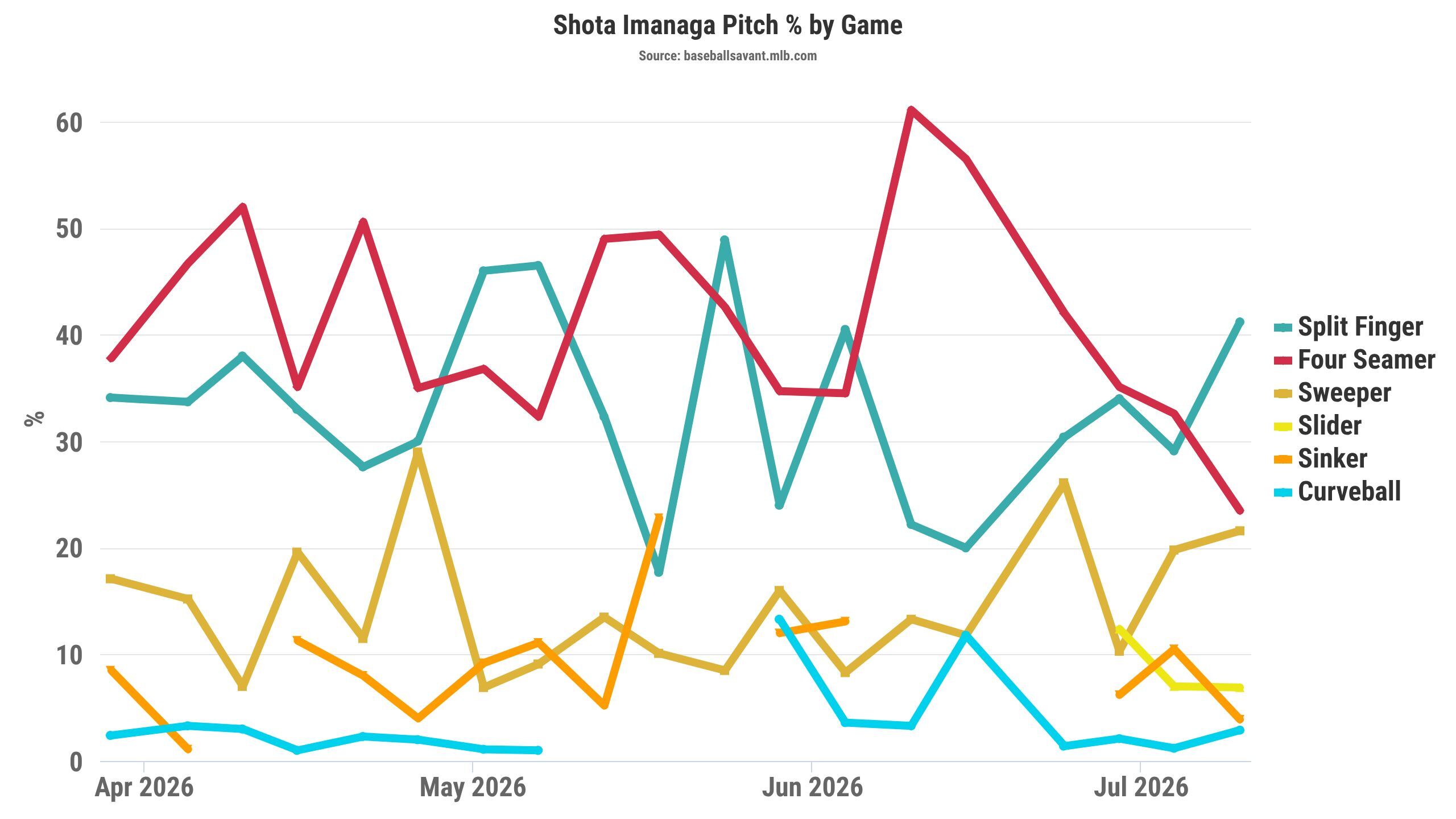
“The pitching coaches are giving me feedback and data,” Imanaga said, “about what I’ve done well, what I’ve done poorly. And it’s just looking at that and working with them and trying to make the good points better, as well as working on what I need to work on with data points that I wasn’t doing as well.
“I’ve felt like I was able to accomplish that. I’m not a complete pitcher yet. I’m not the final product, and I feel like I’m pretty confident that I can get better and better.”