



Tyler Glasnow needed just two starts to remind everyone the sort of weapon he can be for the Dodgers in October.
The L.A. right-hander completed seven innings of one-run ball in a breezy 6-1 victory on Sunday, his second outing since returning from a three-and-a-half month stint on the IL with lower back spasms. Glasnow scattered just two hits. The opposition is now hitting .159 against him this season.
Lowest BA against, SP, 2026
Min. 150 batters faced
- Jacob Misiorowski (MIL): .150
- Tyler Glasnow (LAD): .159
- Shohei Ohtani (LAD): .171
- Brandon Woodruff (MIL): .174
- Dylan Cease (TOR): .176
What's remarkable is that there are no platoon splits here, either. Right-handed batters are hitting .159 against Glasnow; so are left-handed hitters. Their lack of success is the same. That's really been the case for much of Glasnow's 11-year MLB career: Righties are hitting .201 off him, and lefties are only a smidge better, at .210.
Lowest BA allowed to left-handed batters, RHP, 2026
Min. 100 batters faced
- Jacob Misiorowski (MIL): .116
- Gordon Graceffo (STL): .135
- Bryan Baker (TB): .146
- Tyler Glasnow (LAD): .159
- Mason Miller (SD): .160
As much as this era of pitching is defined by velocity, it is also defined by optimization. With vast and ever-expanding pitch mixes, starting pitchers can attack same-sided hitters and opposite-sided hitters differently -- almost as if they are completely different pitchers.
Take Glasnow's rotation mate, Blake Snell. The power lefty carves up left-handed hitters with his slider, which he uses 31% of the time. But against righties, the pitch disappears: He throws it just 2% of the time, leaning instead on a wicked changeup that he does not use against lefties.
Glasnow takes a different approach. At one point in time -- back in 2018 -- he threw four-seam fastballs over 70% of the time to left-handed hitters. But Glasnow is a different pitcher now, and the game has evolved, too. That's not sustainable. This year, for instance, lefties are slugging .500 with an 8.6% swing-and-miss rate against Glasnow's four-seam fastball. So, he's pivoted, using the most balanced pitch mix that he's ever had.
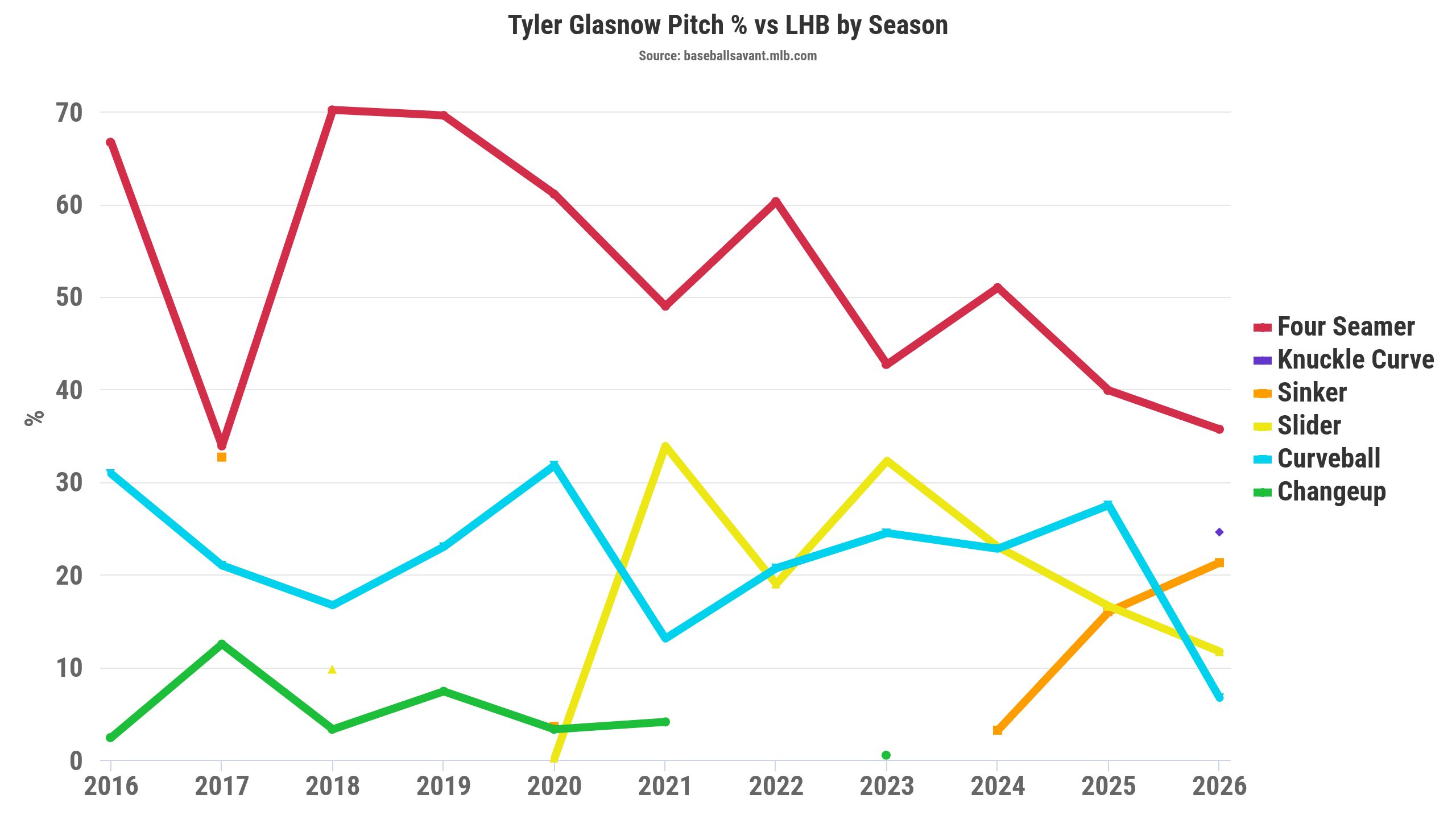
You might notice that orange line, which has ticked up steadily over the past few seasons. That's Glasnow's two-seam fastball, which has quietly become an effective weapon against left-handed hitters. They're hitting just .053 (1-for-19) in at-bats ending on the two-seamer this season.
The two-seamer -- or sinker -- fell out of favor in the late 2010s amid the revolution of high-spin, rising four-seamers. But it has since worked its way back, mainly because pitchers learned how to optimize it. Among other factors, the two-seamer is an effective pitch when thrown inside to same-sided hitters.
But it is not all that common against opposite-sided hitters. Right-handed pitchers use sinkers 22.2% of the time to right-handed hitters, compared to just 11.0% of the time to left-handed hitters.
Glasnow, though, throws it to both.
Glasnow's sinker usage, by handedness
- RHB: 27%
- LHB: 21%
"I think I just feel like I have a lot more room," Glasnow said on Sunday at Comerica Park. "Like I don't really cut off of the two-seam that much, so I think I can use a lot more power into the -- I can kind of throw it to a lefty, and then know it's still going to be in the zone. I have a lot of confidence throwing it to a lefty."
In practice, that looks a lot like this:
On its own, Glasnow's two-seamer has a rather unremarkable profile. It drops 2.8 inches less than comparable sinkers (based on velocity and release point), and has just 10.7 inches of arm-side movement. Only nine qualified pitchers throw sinkers with less horizontal break. The shape is restricted by Glasnow's extreme over-the-top arm angle, which predisposes him to a north-south profile. At 56 degrees, only 10 pitchers have thrown a sinker from a higher slot this season.
This pitch does not really do anything that a "good" two-seamer does, besides having plus velocity (95.8 mph). But it works within the context of Glasnow's arsenal.
As he mentioned, Glasnow does not cut his two-seamer much. That separates it from his four-seamer, which is a heavy cut four-seam. The two pitches look similar out of Glasnow's hand, and when they get to home plate, they are moving differently. To a hitter, it sure looks like Glasnow's two-seamer is running, because it's nothing like his four-seamer.
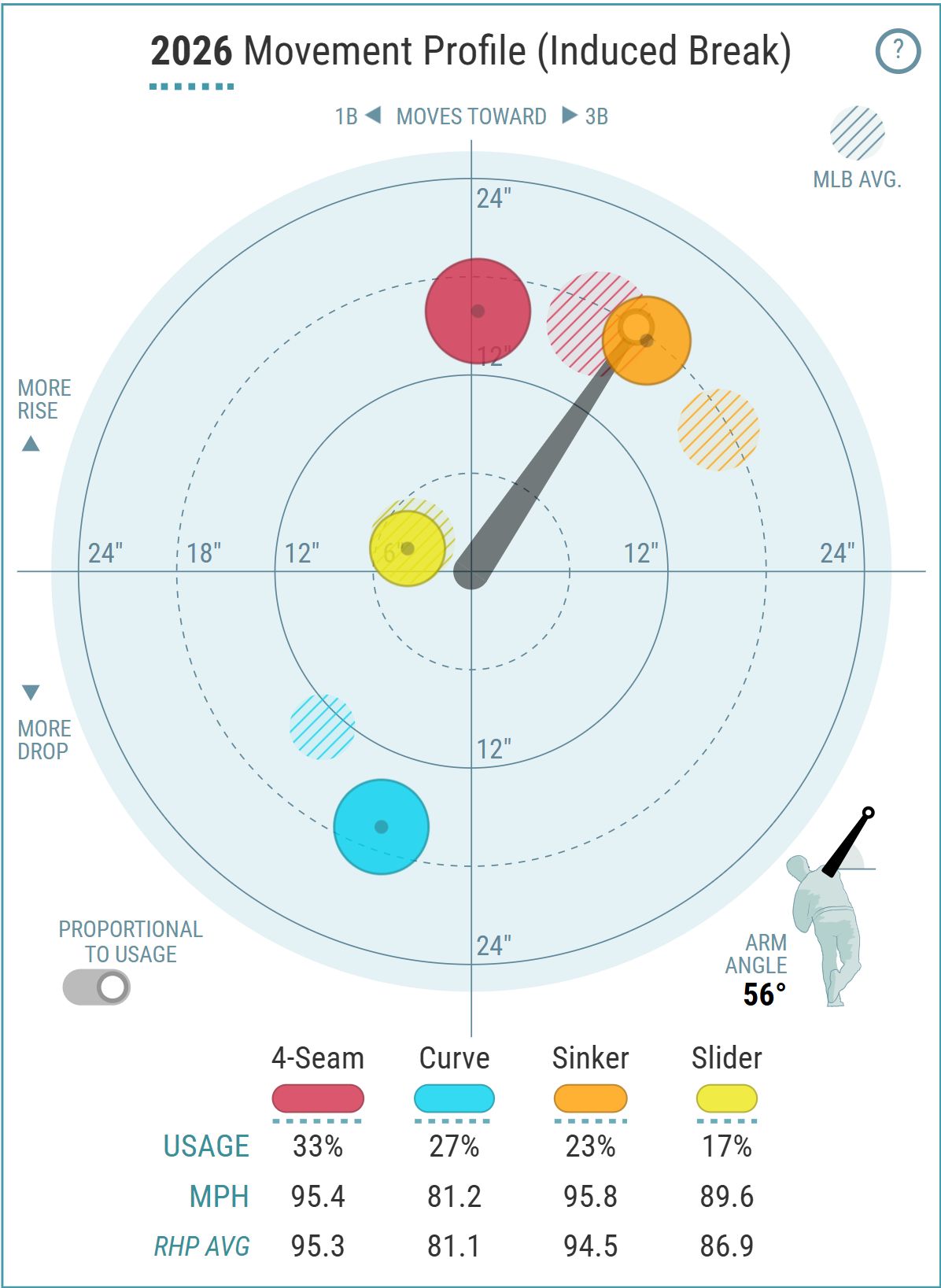
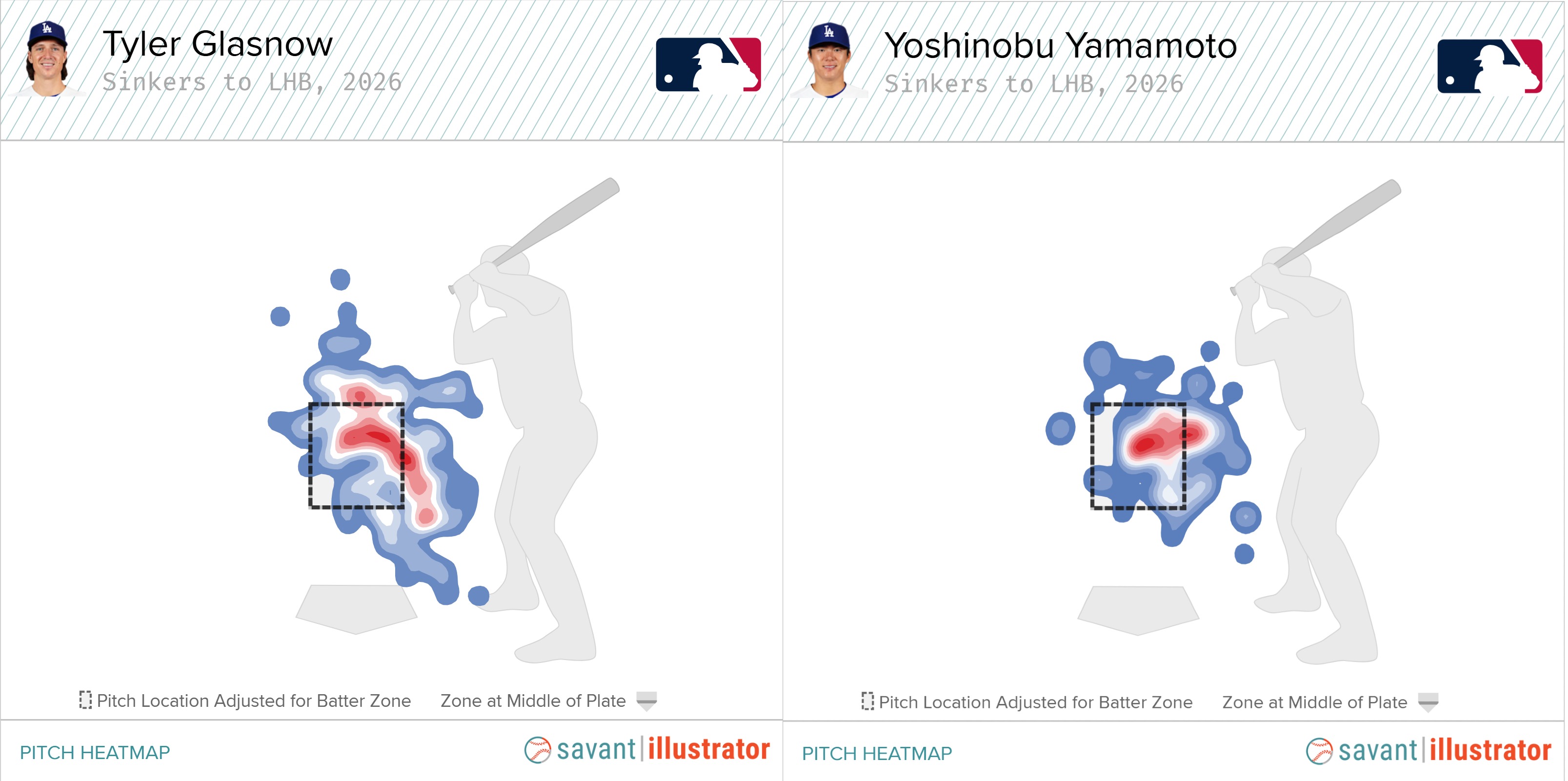
That relationship allows him to play it back over the inner half of the plate. On average, only the Blue Jays' Dylan Cease throws his two-seamer further inside to left-handed hitters than Glasnow (min. 50 pitches).
Glasnow's rotation mate -- Yoshinobu Yamamoto -- is the only other L.A. starting pitcher who features a sinker. As a rotation, the Dodgers throw two-seam fastballs just 6.4% of the time, the second lowest rate in the Majors. While Yamamoto uses the pitch 6% of the time against lefties, he deploys it in the same way as Glasnow. Yamamoto's command is more surgical but, as you'll see below, both pitches have found utility with the comeback sinker inside to lefties.
"I think if I'm able to start at a lefty and then kind of run into the strike zone, I can control it well," Glasnow said. "I'll use that. It kind of opens up the slider, too, backfoot."
Glasnow can change the hitter's eye level with a sinker middle or up followed by a breaking ball down, with both pitches on the same side of the plate. This year, left-handed hitters have a .231/.308 BA/SLG combo against his slider. That was a .269/.615 mark a year ago.
This isn't something he uses all the time. The elevated four-seamer and hammer curveball are still his 1-2 options against lefties. For the most part, Glasnow said, the hitter will tell him when to throw the sinker and when to shy away from it.
"If he's pretty good inside, or like middle, sometimes I'll maybe shy away from it a little bit," Glasnow said.
But, unlike in the past, he has options. That's opened up a world of possibilities, and helped him dominate left-handed hitters even as he evolves in the later stages of his career.
MLB.com's Dodgers beat writer Sonja Chen contributed reporting to this story.