

Wrigley Field Scoreboard: Manual Operation & History
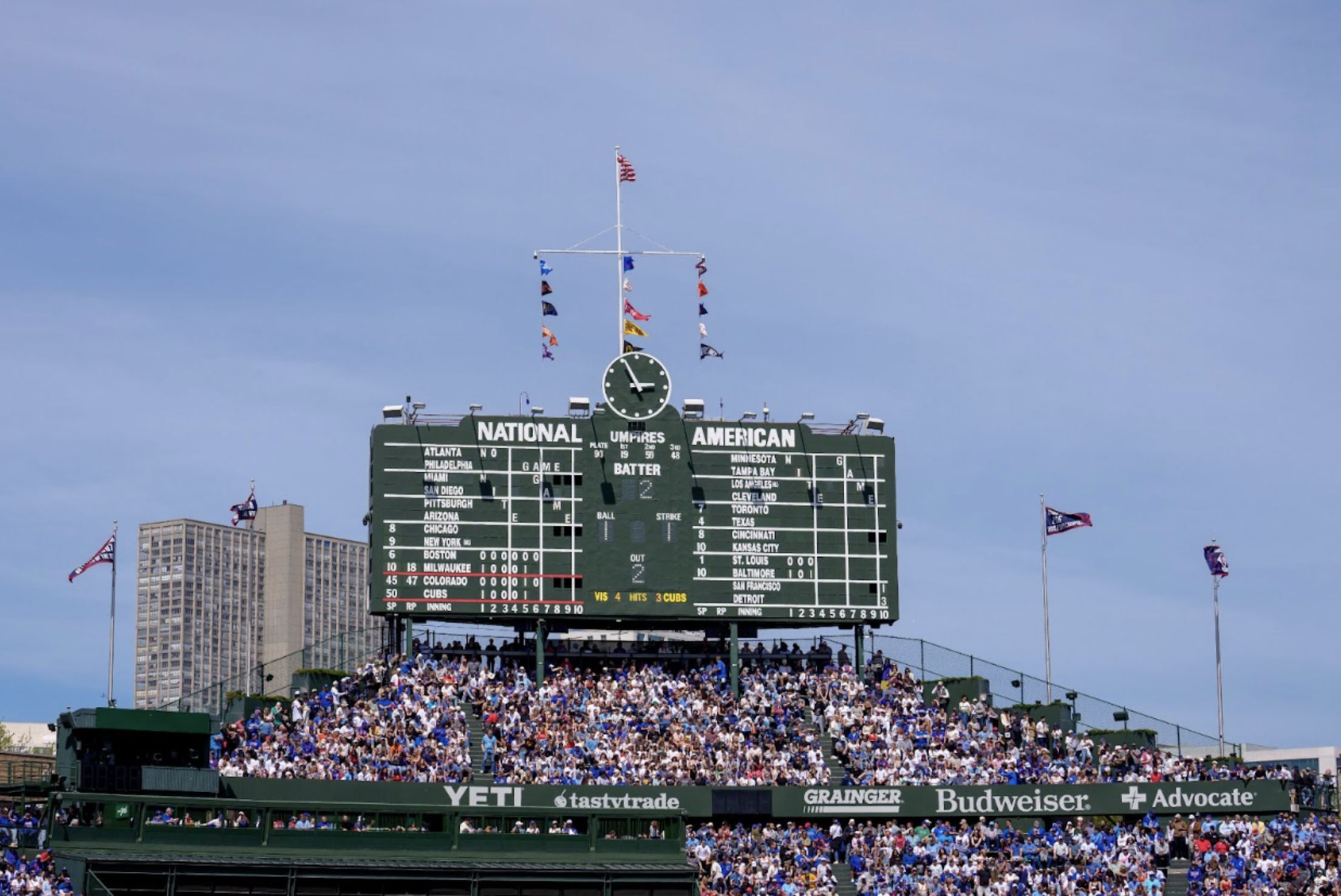
Look up at center field during any Cubs game at Wrigley Field, and you'll see one of baseball's last living relics. While most ballparks flash scores on video boards, the Friendly Confines keeps tradition alive with a manually operated scoreboard standing since 1937.
Only two MLB ballparks still operate vintage manual scoreboards: Wrigley Field and Fenway Park. While technology has transformed baseball, the forest green scoreboard towering 60 feet above center field proves some things are worth preserving.
How the Icon Was Born
1937: Building Something Special
P.K. Wrigley envisioned more than bleacher seats in 1937. P.K. Wrigley commissioned a renovation that included new bleachers, the famous ivy and construction of a baseball landmark.
Architects Holabird & Root, famous for Chicago's skyscraper design, created the 27-foot high, 75-foot wide structure. Originally reddish-brown "seal brown," batters complained about sun reflections. In 1944, the Cubs painted it forest green.
In 1941, the Cubs added the circular clock at the top with dots instead of numerals. As baseball expanded from 16 to 30 teams, the "National" and "American" labels were raised to fit more scores.
When the Bears called Wrigley home from 1921 to 1970, the scoreboard transformed for football.
Inside the Scoreboard
Climbing Into History
Getting inside requires climbing a steep ladder from the bleachers through a trapdoor. Once inside, three levels of platform floors connected by steel staircases spread out. From those floors, three Cubs employees change steel plates for runs scored across as many as 12 games simultaneously.
Two columns are visible from the stands. One lists National League games with the Cubs featured. Another shows American League games including the White Sox. Space limitations mean only 24 of MLB's 30 teams fit at once.
The Work
Each steel plate weighs about five to seven pounds. Team name plates weigh 40 pounds. Altogether, 344 steel plates fill the entire scoreboard.
Workers turn a clip counterclockwise, then punch the rusty steel to pop it out. Some plates sit behind steel beams, making removal trickier. Drop one from 60 feet up, and someone could get hurt.
Yellow numbers show an active inning. When the half-inning ends, workers replace yellow with white. During nine innings, that means at least 18 changes, plus pitching updates for other games.
When Every Game Counts
On busy days when most teams play simultaneously, the crew works constantly. One worker coordinates from the second level with a laptop. Running up three flights, changing plates, running back down becomes the rhythm.
Shouting instructions over crowd noise adds difficulty. "American League, two on the ins" means posting two runs for the visiting team. Ins are visiting, outs are home.
Summer days turn the steel box into an oven. Workers wear gloves to handle sun-baked plates. Cold days mean heavy coats and ski masks. Wind blows paint chips into eyes. No bathroom exists inside, and workers can't leave during games.
The People Behind the Plates
Darryl Wilson started working inside the scoreboard in 1991. As of 2017, he'd spent 26 years watching Cubs history from above center field.
"You see everything," Wilson said. "You see the coaches and players in the dugout, you see some of the players talking to people in the bleachers, you see some things that a lot of people don't see sitting in their seats."
Before Wilson, Art Sagel operated the scoreboard for 14 years starting in the early 1970s. Sagel famously kept a 2-by-4 wedged in the trapdoor to prevent bleacher fans from breaking in.
During the Cubs' 2016 playoff run to their first World Series Championship in 108 years, workers felt the electricity. "You sit up here, you feel this rush of all these people cheering," Wilson said. "You feel like a force. It's electrical."
Why Manual Matters
Only one technological piece exists in the scoreboard for balls, strikes and outs.
Everything else gets done by hand, the same way it was when your great-grandparents watched games at Wrigley Field.
"We're like the history, keeping it real. This is authentic. That's the feel of old-time baseball," Wilson said. "Everything about Wrigley is from the beginning, when baseball just started."
Walking through Wrigley Field on a ballpark tour gives you a glimpse into this history. While you can't climb into the scoreboard, tour guides share stories about the workers who keep this tradition alive.
No batted ball has ever hit the center field scoreboard since it was built in 1937. Bill Nicholson came close in 1948, and Roberto Clemente nearly reached it in 1959. But the scoreboard stands untouched, a symbol of everything that makes Wrigley Field special.
Frequently Asked Questions
When was the Wrigley Field scoreboard built?
Built in 1937 as part of a major renovation commissioned by P.K. Wrigley, the scoreboard was designed by architects Holabird & Root. At 27 feet high and 75 feet wide, it sits 60 feet above the ground as part of improvements that included bleachers and the famous ivy walls.
How many people operate the Wrigley Field scoreboard?
Three Cubs employees work inside during games. One coordinates from the second level while the other two handle different sections. Working across three levels, the crew changes 344 steel plates showing runs for the Cubs game plus as many as 11 other games happening simultaneously.
How much do the scoreboard plates weigh?
Number plates weigh five to seven pounds each. Team name plates weigh approximately 40 pounds. Workers carry these plates up and down steel staircases while changing scores throughout games. On busy days, workers constantly run between floors updating dozens of scores.
Can you visit the Wrigley Field scoreboard?
The scoreboard isn't included on regular tours due to safety restrictions. However, guided stadium tours offer views from the field and bleachers while sharing its history. Tours last 75 to 90 minutes and include the seating bowl, bleachers, press box and dugout.
Why hasn't Wrigley Field replaced the manual scoreboard?
Manual operation preserves a beloved tradition connecting modern fans with baseball's early days. Only two vintage manual scoreboards still operate in MLB, at Wrigley Field and Fenway Park. While the Cubs added a video board in left field, keeping the manual scoreboard maintains the authentic feel that makes Wrigley Field special.
What happened to the scoreboard during football season?
When the Bears played at Wrigley Field from 1921 to 1970, the scoreboard was modified for football. "Batter," "Ball," "Strike" and "Out" changed to "Yards to Go," "Down," "Ball" and "Quarter." Scores posted by quarter instead of inning, and a digital clock appeared. After 1970, the scoreboard returned primarily to baseball use, though it was also modified for soccer from the late 1970s to the mid-1980s.