

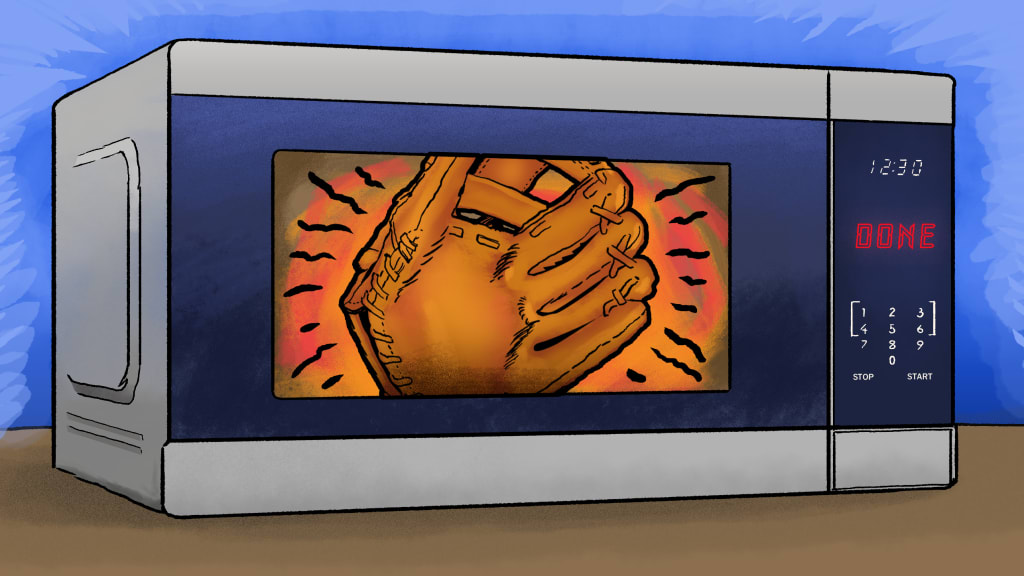
During Spring Training, I came across a sight in the Arizona Diamondbacks clubhouse that made me do a double take: A steamer.
When a player lifted the lid, steam rose into the air, and what came out was not freshly steamed pork buns, but baseball cleats and a glove.
“Wait … a steamed glove?” I asked. “What is this supposed to be?”
The explanation was simple: Steam helps soften leather, especially in Arizona’s dry climate.
Speaking further with players and staff, it became clear that glove care methods vary widely. Some use hot water to soften the leather, others steam it, cool it, even freeze it. Some hammer it with wooden mallets, while others toss it in a clothes dryer. Even with the same equipment, the approach differs from person to person -- each clubhouse carrying its own set of personal philosophies and routines.
During a recent series against the Yankees, I asked Angels infielder Yoán Moncada, who was using a vividly colored glove, how he breaks it in.
Without hesitation, he replied with a completely straight face: “Microwave. Two minutes.”
“Microwave?”
I asked him to repeat it, thinking I had misheard -- honestly, I thought he was joking.
“Two minutes. Not one, not three. Two,” he said firmly.
It sounded like the precision of instant noodles timing, but he insisted it was the result of extensive trial and error -- finding the exact method that produces the feel of leather that works best for him.
On April 4 against the Mariners at home, Angels outfielder Jo Adell -- who made three home-run-robbing catches in the game -- also shared his glove care routine.
“Mostly oil,” he said. “After that, I put it in a case and wrap up by a belt, and keep it in my bag so it holds its shape. It’s kind of a mix of old-school methods with a bit of modern tech.”
He then actually showed me how he does it. Inside his locker sat two tools. In the center of the glove keeper case was a ball slightly smaller than a regulation baseball. The glove is fitted over it and wrapped like a support bandage, holding the shape in place.
It’s not too far removed from the old-school method of oiling a glove with a towel and wrapping a ball inside it to break it in.
When asked about the microwave method, Adell laughed.
“Yeah … that one’s a little risky," Adell said. “I've used this thing called the hydroculator. So, I put [my glove] in, like a little basket that lets the steam out. Basically, you just shut the top and add some steam.”
“Some guys even drive over their gloves in the car," Adell mentioned casually. "I’ve seen that too.”
He said that the more you hear, the more you start to wonder just how many ways there really are to break in a glove.
The Angels' Nolan Schanuel also weighed in on how he handles a new glove as a first baseman.
“I give it to one of our guys, and he breaks it in for us," Schanuel said. "It takes, like, two, three days to soften up the leather and it's good to go.”
Schanuel has never tried the microwave method, but he is familiar with steam-based techniques.
“I used the hot packs, and I put it in the hot pack, which is basically a steamer wrapped up in in a towel and wrapped up with a ball in it, so it loosened it up. It's pretty interesting, right?”
He explained that players often pick up ideas by watching videos or copying teammates, and then tweak things to fit their own preferences.
“I’ve heard of guys pouring hot water on their gloves too," Schanuel said. "Honestly, everyone does it differently. In the end, you just have to find what works for you. Especially with gloves -- that’s the most important thing.”
Conditions across MLB also play a role, from dry Arizona to humid East Coast cities.
“Yeah, I would say it gets, it's super dry during Spring Training in Arizona, so the leather kind of dries out a little bit," Schanuel explained. "But over here, when it's humid in New York, it's the total opposite. It's kind of crazy.”
Rainy games add another layer of maintenance.
“Honestly, water isn’t great for leather,” Schanuel admitted. “But games don’t stop. After that, you just have to dry it properly -- hang it somewhere, let it air out, and make sure it doesn’t get moldy.”
Holding up his glove with a smile, he added, “I’ve been using this one for about a year now. The one before that, I used for three years.”
This glove, he said, will be his trusted companion as it travels with him across the U.S. and Canada throughout the season.
It’s long been said that Alex Rodriguez used to put his glove in the freezer after games. When that story came up, Schanuel laughed.
“I didn't even know that” he said.
Then he added, “I’d say pitchers probably have the craziest methods. I have no idea how they break in their gloves, so they probably use different techniques than we do.”
Which raises the next question -- how exactly do pitchers take care of their gloves? Stay tuned.
Note: If you choose to try any of the glove-care methods mentioned in this article, please do so at your own risk.