



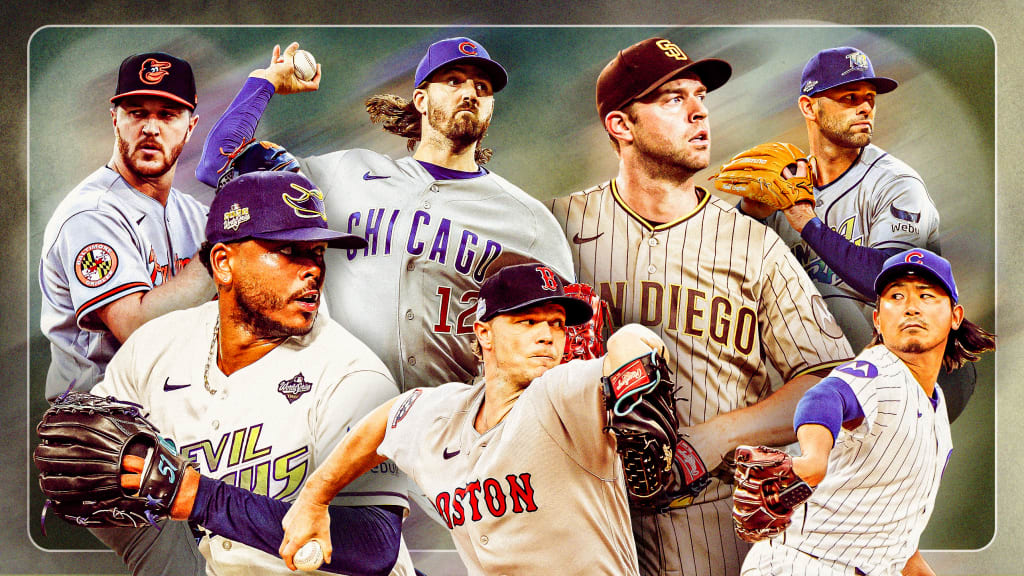
There is no doubt about the top free-agent starting pitcher available this winter: Tarik Skubal, a two-time Cy Young Award winner whose elite stuff remained intact following a remarkably quick return from in-season elbow surgery.
But the identity of the next-best starter is far less clear, adding uncertainty to the most consequential cohort of the free-agent market.
The drop after Skubal is significant, but there should still be value for teams that choose wisely. The question isn't necessarily who was the best pitcher in 2026. It's which starter offers the best combination of near-term performance, durability, upside and age-adjusted risk over a likely multi-year contract.
The Rays exercised their club option for Drew Rasmussen ($20 million) and the Marlins did the same with Sandy Alcantara ($21 million). With those arms off the board, who is the second-best pitcher available?
Let's meet the candidates, organized by archetype.
The established performers
Kevin Gausman (entering age-36 season; 2025-26 fWAR: 7.2).
This is a bet that Gausman is an outlier -- and he might be just that.
Since 2021, only Logan Webb has thrown more innings, and only Webb, Zack Wheeler and Dylan Cease have tallied more pitching fWAR. His four-seam/splitter combination has enabled him to throw at least 170 innings and produce at least 3 fWAR in six consecutive seasons. Gausman is the only pitcher among this group to achieve that.
He's coming off one of his weaker campaigns. His average fastball velocity slipped to 93.9 mph, its lowest level since 2018, and declined from 94.1 mph in the first half to 93.6 mph in the second. But he still posted an above-average 18.3% K-BB rate, which improved to 21.9% with the Cubs in the second half. There's still fuel left in the tank.
Michael King (age-32 season; 2025-26 fWAR: 3.6).
King signed a three-year deal prior to last season, but it included opt-outs after the first two years, and he has done just that after putting questions about his durability largely to rest by logging 185 innings over 32 starts with a 3.21 ERA this past season.
Clearing 180 innings is increasingly rare. Only 13 pitchers reached that threshold, and just eight logged more innings than King.
He's not a one-year wonder, either. King ranks 29th in fWAR since 2023, situated between Rasmussen and Tanner Bibee.
King lacks elite swing-and-miss stuff, but his heavy sinker/sweeper/changeup mix generates weak contact, reflected in a career .281 BABIP. He also owns a 1.86 ERA in 29 postseason innings.
Sonny Gray (age-37 season; 2025-26 fWAR: 7.0).
Gray would be one of the riskier investments, given his age and underlying stuff metrics that were among his weakest since 2018. But he's thrown at least 166 innings and recorded at least 3.4 fWAR in four straight seasons. Few arms can better spin the ball, and he's remained remarkably durable.
The upside plays
Freddy Peralta (age-31 season; 2025-26 fWAR: 5.5).
The question with Peralta is how much of his second-half rebound in Tampa Bay was sustainable change and how much was a product of a small-sample variance and the effects of a strong defense behind him.
Peralta struggled after the Mets acquired him from Milwaukee, but the Rays made meaningful adjustments after acquiring him at the Deadline. He raised his arm angle, regained some lost extension and leaned more on his changeup. MLB.com's Adam Berry documented the mechanical and pitch-mix changes.
The track record and talent are strong. Peralta owns a strong career 19.3% K-BB rate and a fastball that can still reach the upper 90s.
But under the hood, his K-BB% was nearly identical with the Mets and Rays, at 12.7% and 12.8%, respectively, suggesting his overall strikeout-and-walk profile changed little despite the improved results.
His BABIP fell from .313 with New York to .232 with Tampa Bay, likely reflecting some combination of better defense behind him and batted-ball fortune. And while Peralta reduced his walk rate with the Rays, he threw just 40% of his pitches in the strike zone, below the MLB average.
Peralta still offers the ingredients of a high-end starter, but his below-average 97 Stuff+ score and largely unchanged K-BB% leave uncertainty about what a new club would be buying.
Trevor Rogers (age-29 season; 2025-26 fWAR: 7.3).
Rogers' resurgence began with a realization that he needed to get stronger. After an assessment at Driveline, he focused on adding lower-body strength and began to resemble the pitcher who broke out with the Marlins earlier in his career. His velocity and strength improved further in 2026, averaging 93.8 mph with his fastball (best since 2022), building on his remarkable rebound the previous season.
Among likely free-agent starters, only Skubal (11.9 fWAR) has produced more WAR over the past two seasons. Rogers' 1.81 ERA in 2025 was never likely to be sustainable, but his underlying metrics suggest the improvement is real. His expected ERA since the start of 2025 (3.52), minimum 200 innings, is also tops among this group.
While he had hot and cold stretches in 2026, his overall Stuff+ (102), Command+ (107) and Pitching+ (106) all improved, supporting a 4-fWAR season.
One of Rogers' most valuable attributes is his ability to attack hitters with his fastball. The pitch ranked 14th in MLB in run value in 2026, between Skubal and Bryan Baker. Rogers' low arm slot, deception and command help the heater play above its raw velocity. It's an excellent building-block offering to build from.
The alternative candidates
Nick Martinez (age-36 season; 2025-26 fWAR: 4.9).
Martinez lacks an elite strikeout rate, but his minuscule walk rate (3.6%) and ability to limit hard contact (33.1% career Statcast hard-hit rate) help his skills play up. He owns a 3.99 career ERA compared with a 4.25 expected ERA, maximizing run prevention by refusing to beat himself.
His flexibility as both a multi-inning weapon and a stabilizer in the rotation gives managers tactical options. He's also regarded as an elite clubhouse presence.
Shota Imanaga (age-33 season; 2025-26 fWAR: 2.7).
Imanaga rebounded closer to his 2024 rookie form this season with improved velocity.
Imanaga was even better in the second half last year, with a 3.12 ERA and 22% K-BB rate.
His four-seam fastball plays above its velocity readings because of elite vertical break and extension. Hitters misjudge its plane, leading to popups and weak fly balls. He owns a career 1.04 WHIP. Moreover, his splitter is a bat-missing weapon, and his breaking ball was a strikeout weapon in 2025.
Imanaga remains susceptible to home runs, making him more sensitive to his home ballpark environment. Still, he's one of just 11 starting pitchers to post a 19% K-BB rate over at least 450 innings in the past three seasons. The 10 arms with higher rates are Skubal, Chris Sale, Wheeler, Paul Skenes, Logan Gilbert, Joe Ryan, Cease, Gray, Bryan Woo and Cristopher Sánchez.
That's a group loaded with Cy Young winners and frontline starters.
Verdict
Each of these pitchers offers a plausible path to helping a club in the near term. But in making a recommendation for the best arm after Skubal, I'd choose Rogers.
Gausman and King offer more established paths to production. Peralta has the strikeout upside and is likely a popular pick to slot in after Skubal, while Imanaga's strong K-BB% profile makes him an intriguing alternative.
But Rogers offers the most attractive combination of recent performance, age and potential for further development.
His improvement is supported by more than his ERA. His velocity has returned, and his Stuff+, Command+ and Pitching+ metrics all improved. It's generally more difficult to improve a fastball than other pitches, so his four-seamer gives him a foundation to build on should he be able to add or sharpen a secondary offering.
There is still risk in projecting Rogers forward, particularly if his recent gains prove less sustainable than his results suggest. But at 29, he offers more runway than the older alternatives
He might not be the safest choice, but he's the arm I'd bet on to give the best performance after Skubal.