


Before Gavin Williams could walk through his various pitch grips, he needed to find a baseball.
"I can show you better than I can tell you," the Guardians right-hander said before a day game at Yankee Stadium last week.
Lately, Williams has done a whole lot of showing: Each start tends to speak for itself. Williams enters Monday's start against the Yankees at Progressive Field leading the American League in strikeouts (94) and touting a top 10 strikeout rate (29.0%) among qualified starting pitchers. He has become a legitimate top-of-the-rotation arm. Since the 2025 All-Star break, only four starting pitchers have been harder to hit than Williams.
Lowest batting average against, since 2025 All-Star break
Min. 400 batters faced (107 pitchers)
1. Tyler Glasnow (LAD): .168
2. Yoshinobu Yamamoto (LAD): .185
3. Carlos Rodón (NYY): .188
4. Jacob Misiorowski (MIL): .189
5-T. Gavin Williams (CLE): .201
5-T. Nolan McLean (NYM): .201
And while ERA doesn't tell a complete story, it's worth noting that Williams has the fifth-lowest ERA (2.72) among qualified starters in that same span. It's been a sustained run of success for Williams, the organization's first-round Draft pick in 2021.
How did Williams turn a corner? Well, the stuff is better, and he's using his arsenal differently. He's also cut down on walks. In a three-year span from 2023-25 -- starting with his rookie season -- Williams had the third-highest walk rate among qualified starters, trailing only Blake Snell and Edward Cabrera. This year, though, his walk rate is in the 63rd percentile of MLB. Williams and Cam Schlittler are the only two starting pitchers to decrease their walk rate by at least 4.0% from 2025 to 2026.
Fastball usage is a main factor here. Williams is throwing fewer four-seam fastballs than he ever has, especially against right-handed hitters. Instead, he's opting for more sinkers, a pitch that he honed following the 2024 season.
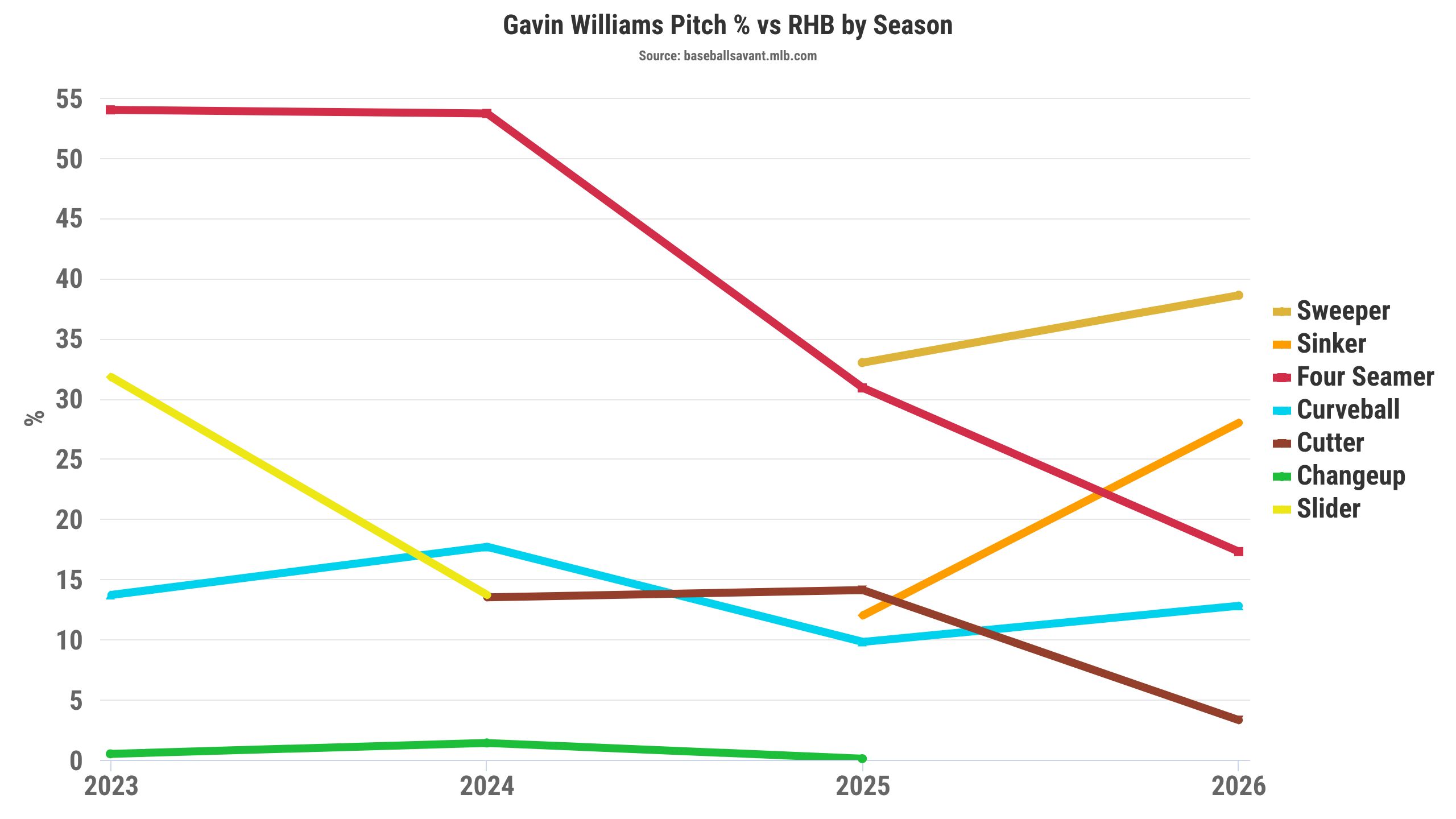
Earlier, when we chose the 2025 All-Star break as our cut-off point, we weren't exactly cherry-picking a random date. In his first start out of the break, Williams twirled an 11-strikeout gem. He also threw 20 sinkers -- at that point, the most in a game in his career. This was new. It's not anymore. Williams has thrown more than 20 sinkers in five different games already this season, bumping his sinker usage to 28% against righties (and cutting his 4-seam usage to 17% in those matchups).
This is a part of a plan.
"I get a little bit too juiced up, so my miss is way worse with the four-seam on the outer half," Williams said. "With the seam-shift that I have on the sinker, I'm able to run it back -- where with the four-seam, I just pull it. It's an auto take every time."
Sure enough, Williams has the fourth-lowest zone rate on his four-seamer in the Majors, among 113 pitchers to throw at least 250 four-seamers this season. You can see in the heatmap below that his misses tend to cluster up and away to right-handed hitters, reflecting his tendency to yank the pitch.
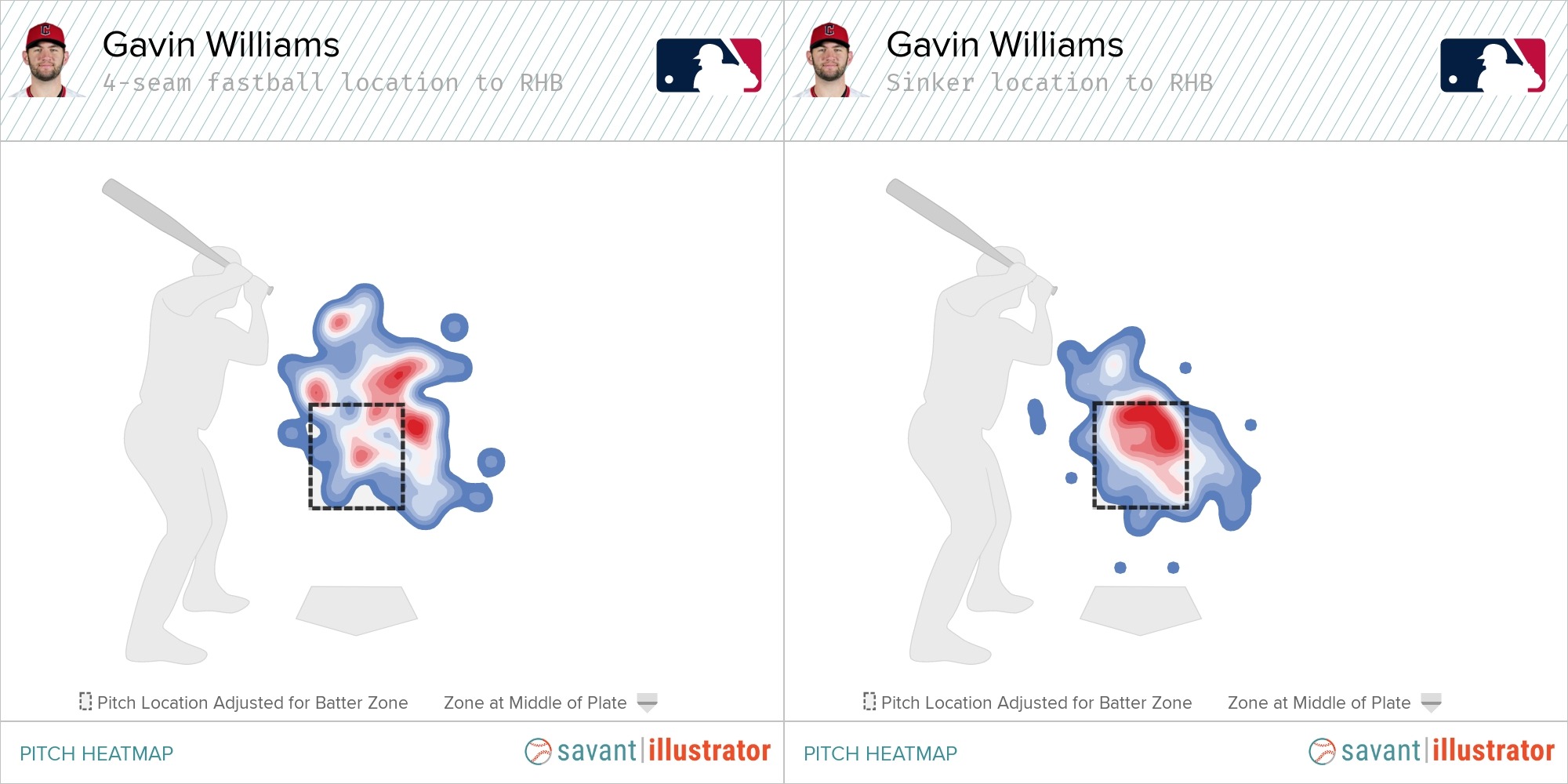
But with the sinker, Williams has the second-highest zone rate, this time among a group of 181 pitchers to throw at least 100 sinkers.
"Mainly, I'm just trying to throw it as a strike," Williams said.
This is rather odd. Williams rarely finds the zone with his four-seamer, but he pounds the zone more than anyone with his sinker. As it turns out, this isn't a magic trick. It has to do with the way that he throws his sinker.
Williams cycled through a number of different grips while learning the two-seamer. He first tried the Kluber, the sinker grip popularized by former Cleveland ace Corey Kluber. It didn't work -- he still had too much backspin, making the pitch look like a four-seamer. From there, he worked his way up the seams. Eventually, he settled on a grip that rests the crease of his fingers on the seams, with his pointer finger off to the side of the MLB logo. The thumb sits on another seam below.
With this grip, Williams can harness the effects of seam-shifted wake, a phenomenon in which the seams of the ball can catch pockets of air to cause late, unexpected movement on the way to the plate. Practically, that means Williams can still yank his sinker and have the baseball land in the zone, because the seam-shift effects will steer it back toward the plate.
"Sometimes, I'm trying to go in with it," Williams explained. "I get so juiced up, so I pull it a little bit. But it still comes back."
That leads us to the other oddity here. Williams doesn't use his sinker like most pitchers do. Sinkers are back in style again, after a brief lull in which they fell out of favor as pitchers embraced premium velocity, elevated fastballs, and high-spin breakers. Eventually, though, the sinker re-emerged as a valuable pitch, particularly inside to same-sided hitters. When used this way, sinkers can get in on a barrel and generate weak contact.
But that's not what Williams does. He has the fourth-highest rate of sinkers on the outer third of the strike zone in right-on-right matchups. Only six pitchers (min. 100 sinkers) have a lower usage on the inner third -- meaning that Williams hardly ever comes in, eschewing convention.
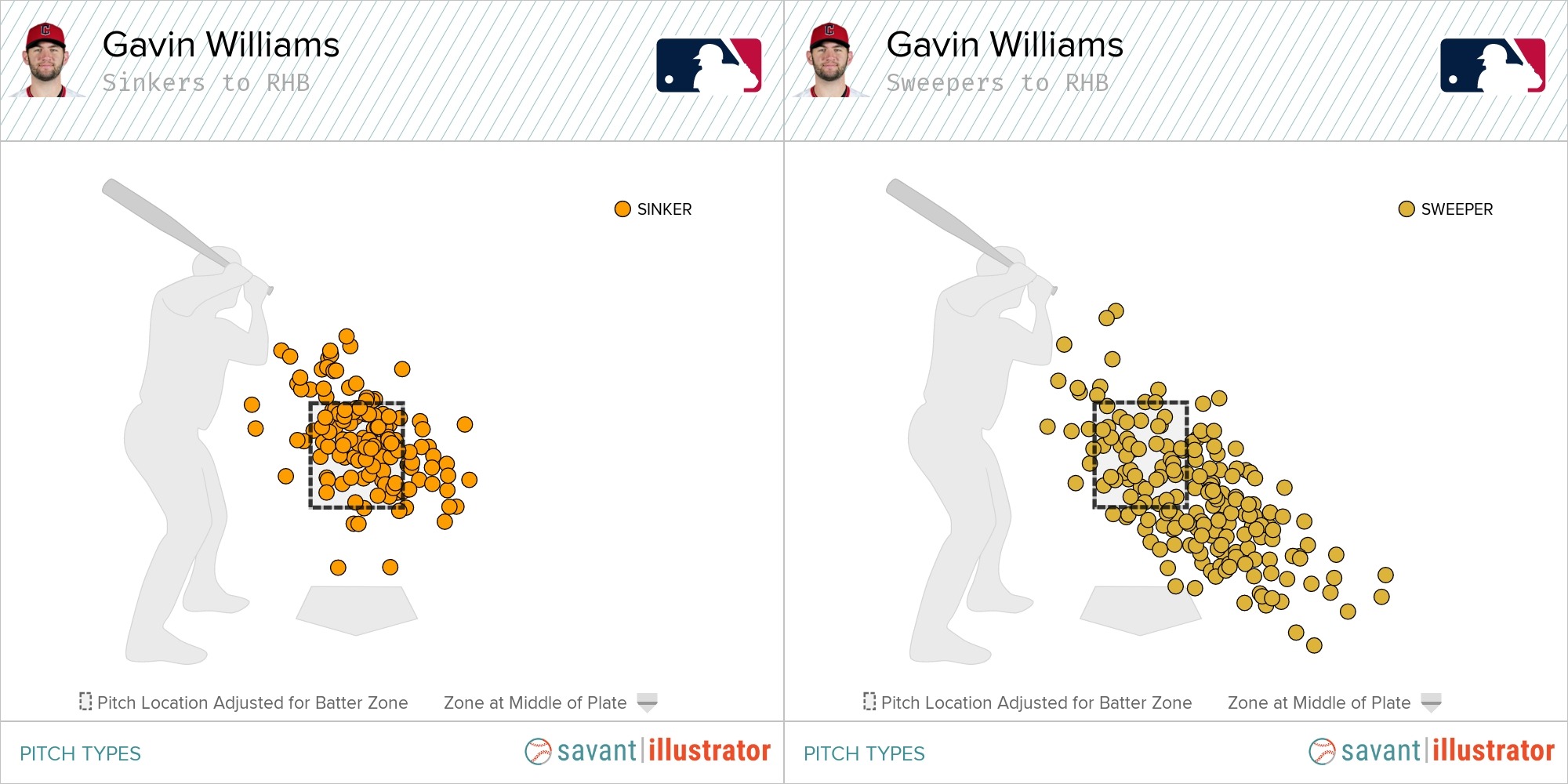
At the same time that he added a sinker, Williams also developed a sweeper. He spiked his slider grip to create a breaking ball with more horizontal movement -- at that point, his slider looked a lot like his cutter -- giving him a distinct sweeper shape.
The sinker/sweeper combo is a common one. Take Mets rookie Nolan McLean, for example. He pours his sinker inside on righties, then counters with a bendy sweeper that breaks away off the plate. In doing so, he covers the entire width of the plate. It's a nightmare for hitters.
Williams uses the pairing differently. He'll throw sweepers off the plate and then come back with a sinker -- which looks like an easy take, only for late movement to pour it back over the plate. Or, he'll start with a sinker on the outer half and then follow up with sweepers off the plate, causing the batter to chase.
"It plays off the sweeper, especially on the outer half," Williams said. "Sometimes the sweeper is three, four inches off the plate, and then I can throw the sinker off the same plane and I'll go backdoor and it just freezes him."
When Williams uses his sinker against righties in putaway counts -- anything with two strikes -- he gets a strikeout 43.5% of the time. It's his best putaway pitch. That's unusual, too, but it's because of the way the sinker interacts with the rest of his arsenal. He's gotten 10 strikeouts in 17 at-bats that end with a two-strike sinker. The sweeper, meanwhile, generates the third-highest swing-and-miss rate of any qualified sweeper in the Majors. Hitters have to respect both pitches.
This also shows how pitch development is always an ongoing process. There is so much hoopla when a pitcher first breaks out a new pitch. That excitement often fades as time passes and the novelty wears off. And yet, Year 2 of a new pitch is often more important -- and sometimes, more challenging -- than Year 1.
"Year 1, it's on the report, but teams aren't looking for it because you don't throw it as much," Williams said. "Then you finally use it in a game, you bump the usage and the hitters don't know what to do with it. It helps out that way. Then, Year 2, the usage has been there, and they know it can come at any point. They're looking for it. It's easier for the hitter to pick up."
That's where doing something different is beneficial -- as it often is in pitching. Williams uses his sinker in a unique way. It works for him. And it's part of the reason why he's been so good.