


The 2025 Rockies lost 119 games and were outscored by a Modern Era-record 424 runs. It was legitimately one of the weakest seasons in baseball history, and they're universally projected for another last-place season, potentially their fourth in a row losing 100 or more -- a feat the sport hasn't seen since the expansion Washington Senators did it in their first four years of existence in the 1960s.
After all: You’re coming from a pretty dark place when you could improve by 15 wins in one season and still lose 104 games.
But something really is different this year, even if the results on the scoreboard may not immediately reflect it. For the first time since 1999, the club went outside the organization to find a new lead baseball executive, adding Paul DePodesta to be the team’s president of baseball operations and hiring Josh Byrnes away from the Dodgers to be general manager. DePodesta brought several former Mets front office colleagues with him, and a number of external additions to the pitching staff followed, from new Major League pitching coach Alon Leichman down through the organization. The new hitting coach, Brett Pill, just spent six years in the Dodgers system.
If the roster looks largely the same, the front office, coaches, and general outlook very much do not.
It is, in some ways, reminiscent of the Orioles from a half-decade ago, when Mike Elias’ new front office came in and realized they had to rebuild the organization internally before worrying that much about the Major League roster. That led to a 54-108 record in their first year before the fruits of the rebuild slowly began to emerge.
Part of what’s ailed the Rockies is the difficulty of how to reliably succeed at the elevation of Coors Field, obviously. Part of it is sharing a division with the Dodgers. Those things haven’t changed. But part of it, too, is that the team has popularly been believed to be too insular, too behind the times, and not quite in step with the endlessly modernizing way the sport is played. The good news there is that some of those things – strategies, mostly – can be fixed quickly.
It might not immediately lead to a massive increase in victories, because there’s lots of work to be done. But there are also quick-fix things you can see, too. So let’s try to figure out what that looks like: What might we see this year that shows that the Rockies are making real, actionable changes to catch up to the rest of the sport? How will you know this is working if the standings show another triple-digit loss season?
“There [are] some funky, wacky ideas that have been thrown around in these conversations from the pitching side,” longtime Colorado starter Kyle Freeland told the Denver Post earlier this spring. “But you know what? It’s also extremely refreshing to hear those kinds of ideas and those thought processes, because it creates excitement inside the clubhouse to go out and try those and see if they work.”
We agree. Let’s see if we can identify some of those funky, wacky things. It might take years to change the roster over. It won’t take but a minute to make some different in-game choices to catch up with the rest of the sport. If you see some of this happening in 2026, you know that things are trending in the right direction.
1) Fewer bad four-seamers. Fewer four-seamers at all, actually.
Last year, the Rockies allowed a wild line of .323/.414/.555 against four-seam fastballs. (Joe DiMaggio, for his career, hit .325/.398/.579, just to make one comparison.) That comes out to a wild minus-166 runs' worth of run value, which was three times as bad as the next-worst team, as well as by far the weakest mark of the pitch tracking era, back to 2008.
We’re not ignoring the realities of pitching at elevation, yet Rockies pitchers' four-seamers were also twice as weak as anyone else’s just on the road, too. It was a Coors problem, but not only a Coors problem. There are only two ways to fix that, really.
- You can throw fewer four-seamers, which is likely to happen. Only one team had a higher four-seam rate last year, and no team threw more over the past decade.
- You can throw better four-seamers. No team had weaker four-seam shapes and quality, per FanGraphs’ Stuff+ metric. At a time when Induced Vertical Break (IVB) has become a key term -- that's essentially rise, which everyone wants -- the Rockies threw by far the most fastballs in the Majors within the worst range of IVB (12 to 14 inches). These "dead zone" four-seamers got crushed: a .468 opponent SLG and -182 runs of value.
It’s a little more complicated than this – for the sake of simplicity, we’re not right now delving into arm angles, approach angles, and release height, which are also factors – but you get the point. While, again, Coors does suppress that kind of movement, no team threw more on the road, too, and even away from home, Colorado’s no-rise fastballs got lit up.
There’s a location factor, too. Part of the issue is that when the Rockies threw a pitch at or near the bottom edge of the zone, no team in baseball was more likely to have that pitch be a four-seam fastball, and it’s been a very long time since “keep the ball down” was an in-vogue pitching strategy.
“I think it’s very predictable what the Rockies would do in the past,” assistant pitching coach Gabe Ribas, hired this winter from Detroit, told the Athletic. “It’s no secret that it was heavy fastball usage, particularly down to glove side. We’re going to open it up more to look a little bit more like what the league looks like.”
Down and to the glove side? For righty pitchers, when throwing down and to the glove side, no team was more likely to have that pitch be a four-seamer, just as Ribas noted. “Don’t do that” is an easy fix – and they won’t.
What to watch for in 2026: Fewer four-seamers, thrown less often down to the glove side, and likely cutting down on heaters from pitchers who don’t have either elite velocity or interesting movement. “Be weird,” basically.
2) Fewer bad-platoon sinkers.
A generation ago, the sinker was in vogue, usually as a ground ball-inducing pitch. Then it disappeared, superseded by the trendy high-spin four-seamer thrown high. Over the last few seasons, it’s come back as a big-value pitch, but with a big caveat – it’s different now. Today’s sinkers, compared to a decade ago, are thrown harder, with more arm-side movement than actual sink, and most importantly, only to same-handed batters.
We can’t stress that part enough. Much of the regained value simply came from realizing that sinkers (or two-seamers) were a bad value proposition to opposite-handed hitters, but you could do well with them as a platoon-positive pitch.
You can guess where this is going, already. Over the last three years, no team had a higher rate of righty sinkers going to lefty batters than Colorado (46%, well above the 32% average). No team had a lower rate of righty pitchers attacking righty hitters with a sinker. It’s the same for lowest rate of lefty-on-lefty sinkers, too. Colorado just hasn’t been using this pitch optimally. Those sinkers got splattered with a .511 SLG, the highest in the game.
The old-school sinker, pitching to contact in hopes of a grounder, doesn’t really work at Coors. The newer-school two-seamer, running in on the hands of same-sided hitters, can.
What to watch for in 2026: Better platoon choices in sinker usage. At the very extreme risk of caring at all about Spring Training platoon splits, they’re doing this at a league-average rate so far in 2026.
3) More pitch types.
“If you have more pitches, you have more weapons to go to when you’re facing Shohei Ohtani,” Leichman said to MLB.com’s Thomas Harding. “If you have three pitches, everything is pretty easy for him. If you have more pitches, he needs to make more decisions. The more decisions a hitter has to make, the tougher.”
It didn’t escape our notice what the three veteran starting pitchers the Rockies added this winter all had in common.
- Michael Lorenzen: 7 pitch types
- Tomoyuki Sugano: 6 pitch types
- Jose Quintana: 5 pitch types
If last year’s trend was “the Year of the Pitch Mix,” of pitchers adding more and nastier offerings, then the Rockies mostly didn’t. Looking at pitchers who threw 10 or more innings in the bigs, just 24% of Colorado’s pitchers threw four or more meaningfully distinct pitch types – the second-lowest rate in the Majors.
Throwing fewer four-seamers and more of anything else is really a slam dunk, if only because of the three new veterans and the way they pitch. But it’s not just them. There have been endless reports of returning Rockies with new pitches in camp, such as Antonio Senzatela (sinker, sweeper), Chase Dollander (sweeper), Seth Halvorsen (sinker, splitter) and Tanner Gordon (sinker).
“After last season, I was determined to change around some things, add a couple things to my repertoire,” said Senzatela, and not a moment too late – he’s been doing the same thing, over and over, annually, to worsening results, never changing.
For years, pitchers have left Colorado and marveled at what they’d lacked – here’s Yency Almonte after going to the Dodgers, and Jeff Hoffman finding success in Philadelphia and Toronto. But this spring, Colorado pitchers are seemingly much more pleased about their support.
"They did a deep dive on my pitches," Dollander told the Denver Post. "I mean a deep dive. It was crazy. I was like, 'Holy Moly!"
Holy Moly indeed. It's part of what's been missing.
What to watch for in 2026: Fewer four-seamers, more varied repertoires. This is almost guaranteed.
4) Don’t be afraid of breaking balls – especially more bullet sliders.
If you’re not throwing four-seamers, you’ve got to replace them with something, right? This has long been the issue; since pitchers don’t feel like their curves will break as much at Coors, they throw them less. They fill that gap with more fastballs and … well, that hasn’t ended well.
The effects of elevation really do hurt breakers -- some of them, at least. For example, look what reliever Jimmy Herget said about throwing his sideways sweeper last year, after a road trip.
“Coming from San Francisco,” he said to Renee Dechert, “I was throwing sweepers at 20 inches. [At Coors], I average probably about 12 to 14.” The numbers back him up: 13.8 inches of break on that pitch at home, and 17.2 inches of break on the road. It’s a huge deal.
But the solution isn’t “never throw breaking balls.” While certain types of breakers do suffer, remember that pitchers like Germán Márquez and Jon Gray did have recent success at Coors, and they weren’t throwing 100% fastballs. In general, you want pitches that rely less on spin-based movement (like big breakers, or high-rising four-seamers), which means you can still get by with splitters or more gyro-y bullet-type breaking balls, preferably thrown hard – the kind of spin which both isn’t as affected by elevation and, therefore, shouldn’t have such extreme behavior differences home/road, like Herget’s sweeper.
For example: From 2017-19, some of Gray’s best years with the team, his slider was worth +36 runs, a top-eight mark in the game. In 2018, Márquez’s best year, his slider was +12, tied for 13th-best. Going back a few years before, reliever Boone Logan had a top-25 slider between 2014-16.
It can be done. Now, take a look at a handy Baseball Savant pitch movement profile chart, and you can see that their sliders (yellow) were mostly in the gyro zone, that middle-middle of the chart where spin-inefficient pitches live -- the kind somewhat less likely to be affected by the elevation.
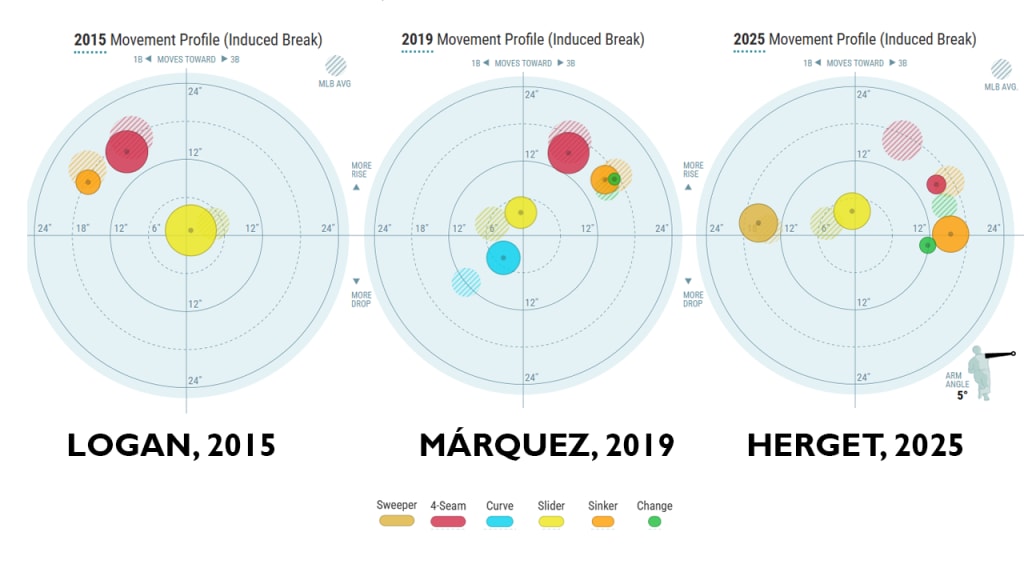
As Herget added, “[at Coors] I just have to rely more on that harder breaking ball versus the slower one.”
What to watch for in 2026: Fewer big breakers, more gyro sliders/cutters. Let Jaden Hill cook.
5) Challenge the strike zone, pitchers.
It’s easy when they flat-out tell you what to look for:
“The main thing for all our pitchers is to get into the strike zone early in the count,” Rockies manager Warren Schaeffer said. “We need to fill up the strike zone on the pitching side. We need to attack the zone early. Strike one is huge.”
That was something they very much did not do last year.
Only one team, the similarly unsuccessful White Sox, had a lower rate of hitting the zone or its edges on a 0-0 count. No pitching staff fell into a 1-0 count more often. Only one team, again the White Sox, threw more pitches behind in the count at any point in the plate appearance. It goes on, and on, and on. Because of strategy choices or lack of confidence that they could beat a hitter in the zone, Rockies pitchers were regularly ending up behind in the count – a truly bad place to be.
This may not be fully solvable immediately, because you do understand why pitchers who call Coors home might feel uncomfortable filling up the zone. It’ll take time to acquire or grow more talent on the mound. But count leverage is huge, and any improvement is improvement.
What to watch for in 2026: Something closer to a league-average level of being behind in the count and first-pitch strikes.
6) A stronger approach from the lineup.
“Strike out less” isn’t exactly a revolutionary baseball strategy. We are quite certain the previous regime wanted this as well. But it didn’t happen. Only the Angels struck out more often than the Rockies, and no team struck out more often on the road. In fact, only one team has ever struck out more often on the road than the 2025 Rockies did: the 2024 Rockies.
That’s obviously more than a little about the effects of transitioning from elevation to sea level, the long-noted “Coors Field Hangover,” which won’t be solvable in 2026 and may not be ever. But just like Rockies pitchers, the team's hitters were constantly behind in the count -- more often than any other team, in fact. If you think this doesn’t matter, realize that the teams that were behind in the count the least were the Dodgers, Yankees and Blue Jays.
What can change quickly here? Some roster changes should help, for one. The two biggest whiffers on last year’s team, Michael Toglia (39% strikeout rate) and Ryan McMahon (32%) have moved on, as well as reserve outfielder Yanquiel Fernández (30%). In their place, the team has imported Willi Castro (24%) and Jake McCarthy (18%), the latter having been one of the best in the game at in-zone contact over the last three years. Potential first baseman Troy Johnston had an 18% rate with Miami’s Triple-A team – which is exactly the Triple-A strikeout rate his main competition, Blaine Crim and TJ Rumfield, had in 2025 as well.
Because of that, when we ran the 2026 ZiPS projections against what happened in 2025, only one team, Tampa Bay, is projected to lower its strikeout rate more. It’ll still be a lot. It just doesn’t have to be so much.
What to watch for in 2026: Being merely in the bottom 10 in strikeouts and falling behind in the count.
There are, to be sure, more areas for a 119-loss team to target for immediate improvement, whether it's creating more varied looks from their pitching staff (like the Blue Jays did this winter) or improving MLB's bottom-ranked baserunning value, or becoming more adept at using the ABS challenge system. (At Triple-A last year, Colorado hitters were the weakest.)
Not all of that can be fixed in 2026. Most of it won’t be. But for the first time in a very long time, the feeling is a little different. The small things can be improved upon quickly. The Rockies might just start looking a lot like much of the rest of the game.
"We’re three years in a row of losing 100 games,” said Freeland, one of the few remaining veterans of the 2017-18 playoff teams. “Might as well try some new, fresh things.”