


These are not your older sibling’s Colorado Rockies. Heck, these are not your Rockies, either.
Colorado carries a 13-16 record into Tuesday’s series opener against the Reds, on the heels of a surgical three-game sweep of the Mets. Last year, the Rockies did not win their 13th game until mid June, when they improved to 13-55.
This success is not an accident. These are encouraging early returns for an organization that carried out a facelift in the offseason. Following three consecutive 100-loss seasons -- including a 119-loss campaign in 2025 -- Colorado overhauled its front office, conducting an outside search for someone to lead its baseball operations department. The club landed on Paul DePodesta of Moneyball fame.
Sweeping changes occurred in the pitching department. The Rockies hired Alon Leichman as the club’s Major League pitching coach, Gabe Ribas as the assistant pitching coach and Matt Daniels as the organization’s director of pitching. The trio inherited a rotation that pitched to a 6.65 ERA in 2025, the highest of any starting staff since ERA became an official statistic in 1913. As a whole, the Rockies finished last among all 30 clubs in ERA, FIP, and strikeout rate in each of the last three seasons.
There was plenty of work to do, which makes what is happening now -- even in a 29-game sample -- particularly notable.
Rockies pitching, MLB ranks
Through play on April 26
- 2023-2025: 5.22 ERA (30th), 5.14 FIP (30th), 1.96 K/BB ratio (30th)
- 2026: 4.07 ERA (T-15th), 4.44 FIP (20th), 2.46 K/BB ratio (13th)
The team’s 4.07 ERA through 29 games is the lowest ERA by a Rockies pitching staff in a 29-game span since 2021.
“The organization has been incredible,” said 12-year veteran Michael Lorenzen, one of three free-agent starting pitchers to sign with the club this past offseason. “I don’t know what it was like before, but, just watching from afar, it seemed like there was a lot of low-hanging fruit. If you made some simple changes, there’d be better results instantly. I feel like we’ve seen that.”
A lot of this, as Lorenzen accurately pointed out, was low-hanging fruit. In March, MLB.com’s Mike Petriello noted some of the changes that Colorado could make to simply catch up with the rest of the sport (and maybe even crack the riddle of Coors Field). For a few years now, teams have diversified pitch mixes, thrown fewer fastballs, and embraced the idea of platoon-based pitch types. These are staples of modern pitching. Led by Leichman -- one of the most innovative minds in the game who is also calling pitches from the dugout -- the Rockies are catching up.
“We’re going to try different things,” said All-Star catcher Hunter Goodman, who has been in the organization since he was drafted in 2021.
That they have.
The most overt change you’ll notice is the abundance of pitch types. In Spring Training, Leichman told MLB.com’s Thomas Harding that, if you have more pitch types, “you have more weapons to go to when you’re facing Shohei Ohtani.” But this is not limited to simply facing Ohtani.
“When I talked to Alon in the offseason, he wanted to expand my arsenal,” said right-hander Tanner Gordon, who added a curveball and a sinker to his three-pitch mix. “He wanted to expand everyone’s arsenal.”
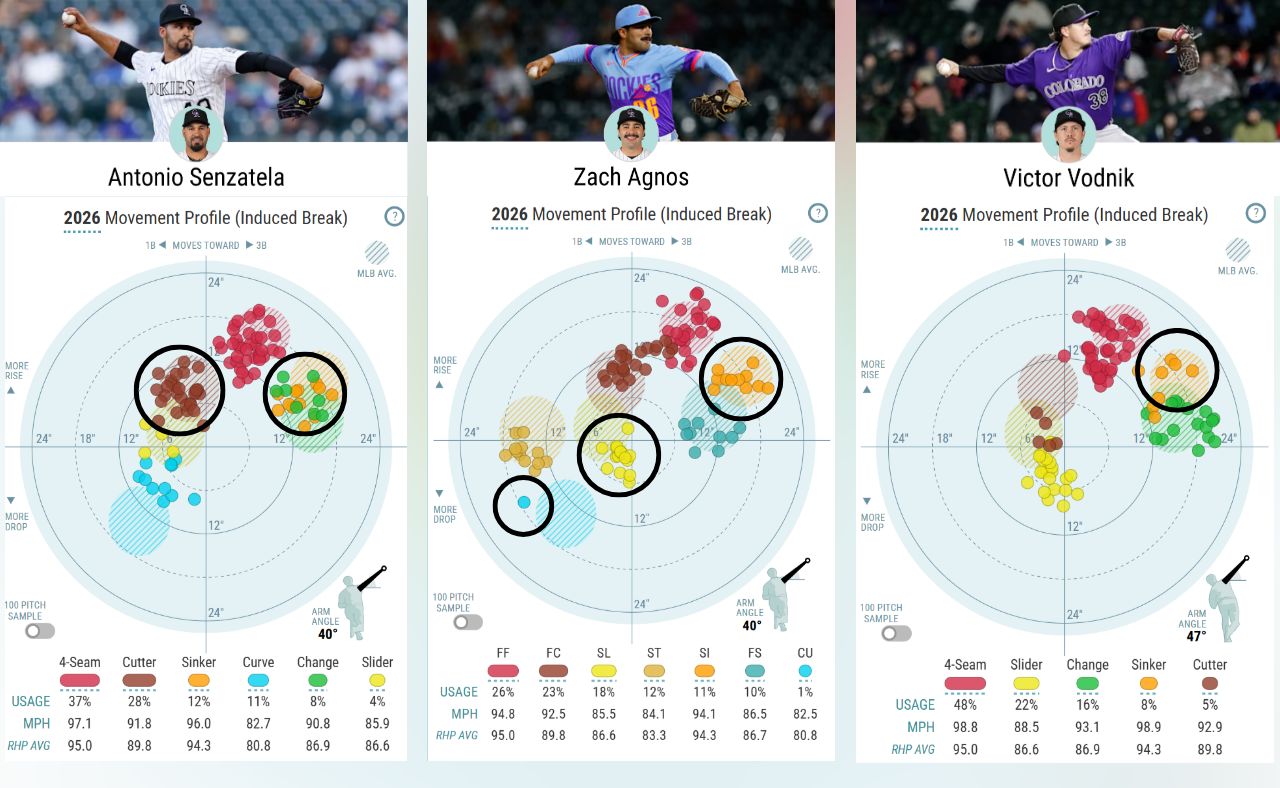
Of the seven relievers on the Rockies active roster, six have debuted a new pitch in the regular season (of note, we are defining a new pitch as anything thrown no more than 1% of the time last season). Three have added multiple pitches. Toss in Chase Dollander -- a first-round pick in 2023 who has pitched as both a starter and a reliever this year -- and Colorado’s current staff has combined to add a whopping 12 new pitches from last season.
“They’re very open-minded, down to explore different things,” said Victor Vodnik, who added a sinker to his four-pitch repertoire. “You never know. They show you a grip, maybe you have a super nasty sweeper that you didn’t know you had.”
This experimentation may sound a bit like the wild west, but it’s not. After they were hired, Leichman, Ribas and Daniels arranged phone calls with each pitcher. The new brain trust wanted to get to know their players as people, that way they could build the sort of relationships that are paramount to success. Only then could they make recommendations. And they came prepared, too.
“They did their research,” Gordon said. “They knew a lot about the guys. They took what they knew and then they added their own little touch.”
Vodnik, for example, leans on a four-seam/slider combo. The new brass did not want to steer him away from his strengths. But they wanted him to experiment with different pitches and different grips to round out his arsenal. So, Vodnik toyed with a sweeper and a sinker in the offseason. Together, they cycled through different sweeper grips before ultimately scrapping the pitch because it didn’t feel natural for Vodnik to throw a sweeper from his arm slot, which is more straight over the top. The sinker stuck, but as a complementary piece: He throws it just 8% of the time, something to sprinkle in and give hitters a different look from his four-seamer.
“I’m open to better ideas to make me a better pitcher,” Vodnik said. “And these guys, they have no ego. They want to see us succeed and they want us to get better. You talk to them, we don’t agree on certain things, but we’ll come to a conclusion and work on it together.”
In the rotation, the Rockies added Lorenzen (seven different pitch types), Tomoyuki Sugano (seven), and Jose Quintana (five). The unit has a markedly different feel from last season, when five of the nine pitchers to make at least seven starts threw four distinct pitch types or fewer.
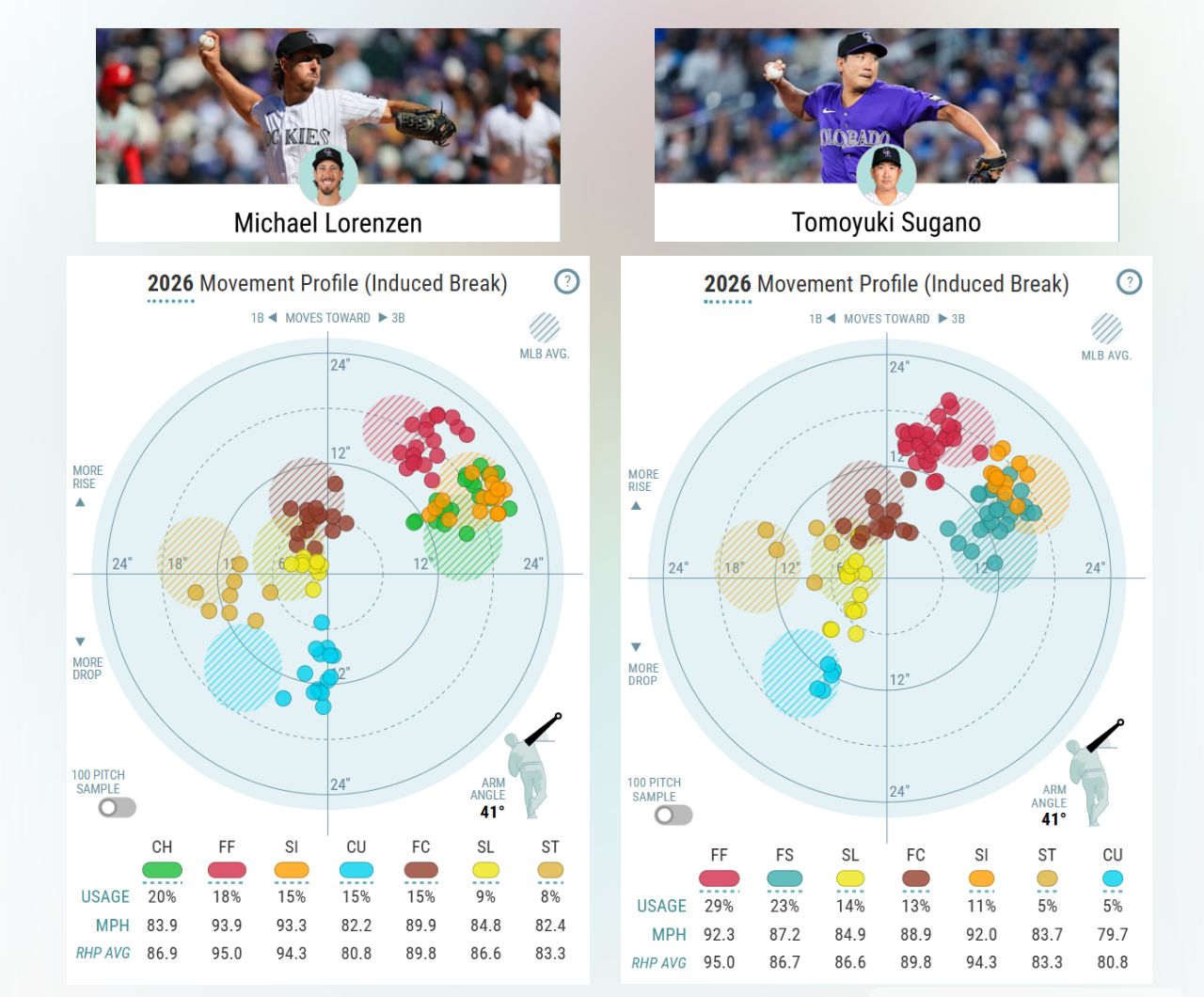
When he moved to the bullpen in his second year in the Majors with the Reds in 2016, the organization advised Lorenzen to stop throwing so many different pitches. The game has since taken a hard turn the other way.
“It’s always made sense to me: Why wouldn’t I throw all of these pitches if I could?” Lorenzen said. “The best way to get guys out in the strike zone is by being unpredictable and having better stuff. If the slider is your best pitch, and you’re still out there throwing the fastball down and away, using that philosophy, you’re just not setting yourself up for success.”
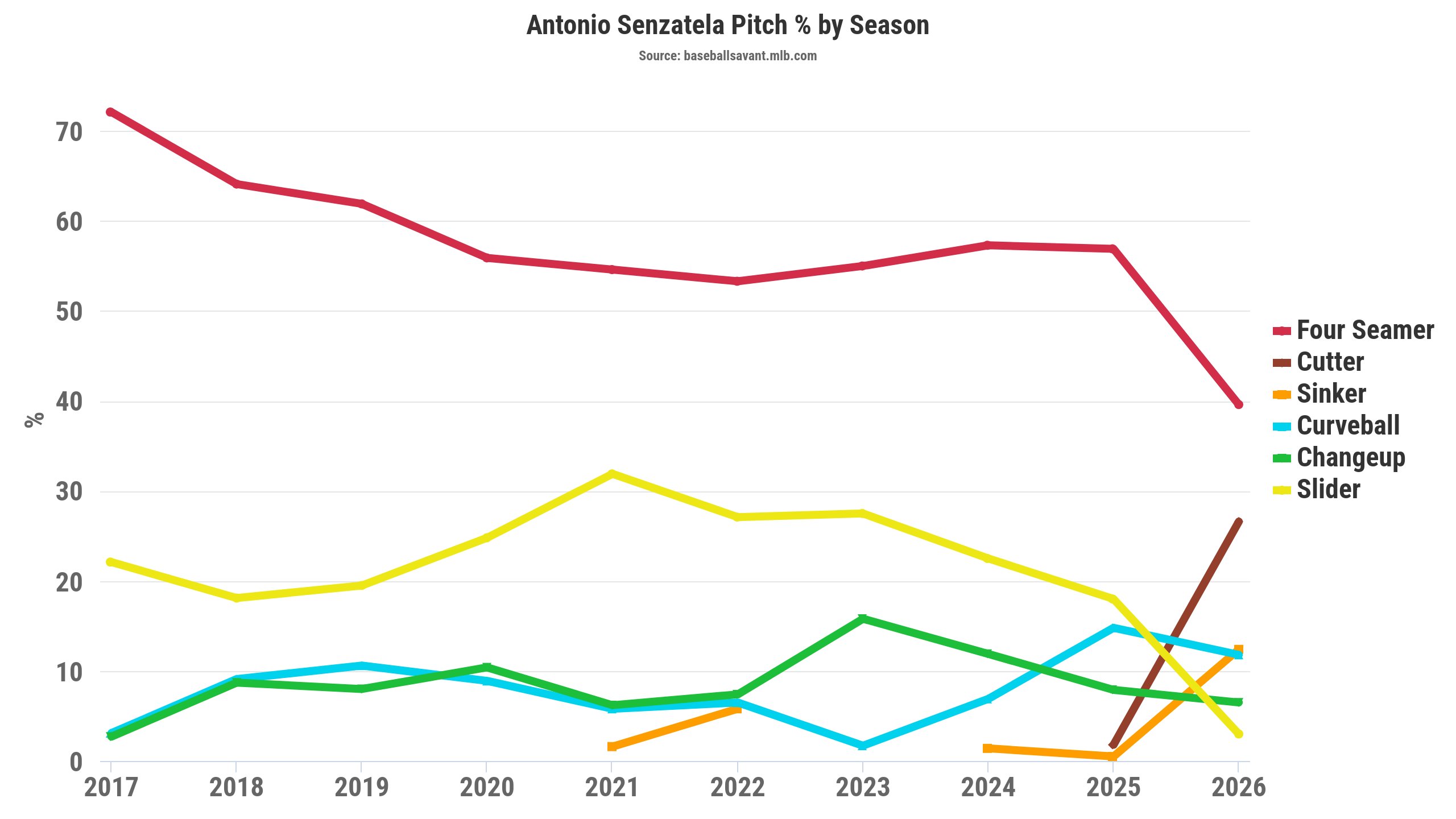
Among other benefits, large pitch mixes also allow for better usage decisions. After years of relying excessively on four-seam fastballs, the Rockies have pivoted: Their 29.1% four-seam usage rate is ninth lowest in the Majors and down from 40.9% a year ago. The poster boy here is Antonio Senzatela, a reliever-turned-starter who threw his four-seamer 57% of the time last season, more often than all but 13 qualified pitchers. Senzatela is using his four-seamer just 37% of the time in 2026, relying on other fastball shapes -- a cutter (28%) and a sinker (12%) -- that he did not have in his arsenal a year ago.
Similarly, Colorado is weaponizing platoon-based pitches, like the sinker, whose comeback is in part because of its ability to stymie same-sided hitters. Last season, Rockies right-handers threw sinkers just 9.0% of the time to right-handed hitters, the lowest usage rate in the Majors. They’ve doubled that this year, up to 18.1%, thanks to the likes of Dollander, who is throwing sinkers a quarter of the time to righties.
All of this allows pitchers to come into the strike zone with confidence, which is something that multiple Rockies players emphasized. This is something that every organization -- and certainly every new regime -- tends to preach. But the results are telling. The league-wide walk rate is up to 9.6%; that’s a 1.2% bump from last year and would be the highest figure since 2000. Only six teams have decreased their walk rate from 2025 to 2026, and the Rockies are one of them.
“It’s been a good start,” said Lorenzen, who threw seven innings of one-run ball in his last start on Friday. “The first phase right now is seeing -- based on being a supinator, a pronator, what your slot is -- let’s see if we can give you this grip and you don’t even think about it, just let it rip. Let’s see what the ball does. That’s where we’re at. Phase Two is going to be more of -- guys are going to lose a shape and we’re going to have to build it back. Then figure out, ‘Hey, it’s a great shape on the Trackman, but the hitters are telling us that it’s not great at all.’ That’s another phase. It’s going to be never-ending, but the initial phase has been really good.”
It is a big deal that the Rockies, after years of lagging behind everyone else, are at this point.
“They broadened my understanding of pitching,” Gordon said.
“There’s a philosophy here,” added right-hander Seth Halvorsen.
There may have been one before, too. But the new philosophy is finally up to speed, and we’re already seeing the changes in full effect.