


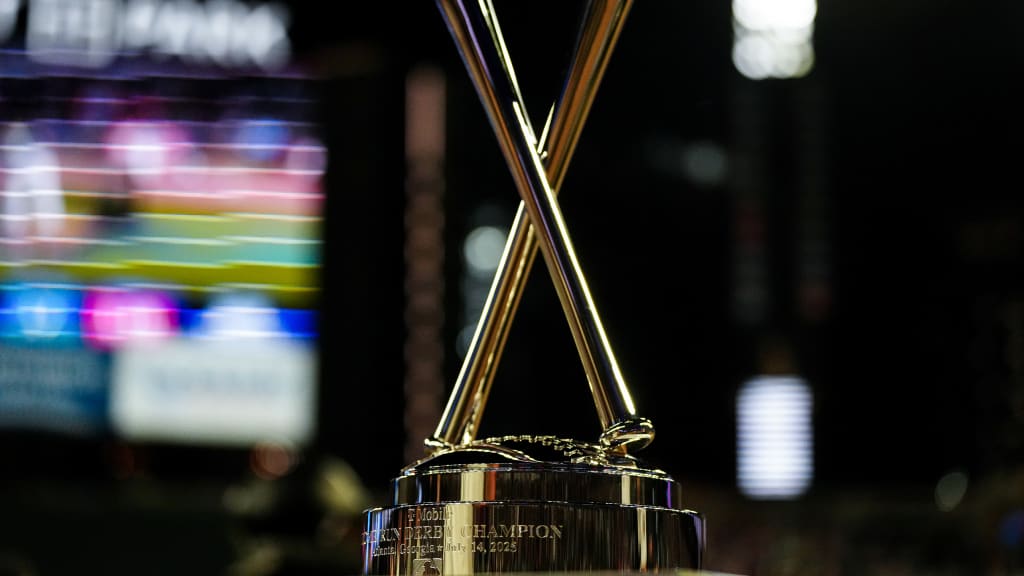
MLB’s T-Mobile Home Run Derby is going off the clock, and that’s going to have big implications for this annual, dinger-driven event.
Let us not cry for the clock. For a time (pun intended), it breathed new life into the Derby. It walked so that the pitch clock could run (on time… pun intended again). In its decade of Derby life, the clock made every second count (yet another pun intended).
But the Derby, unlike baseball itself, is unbound by precedent, agnostic to tradition, untethered to dogma. It is baseball’s open-source exhibition, free to be tinkered with from year to year.
The latest tinkering announced Thursday calls for the Derby, which will take place July 13 at Philadelphia’s Citizens Bank Park and will be streamed on Netflix, to be oriented around swings, not seconds:
- Participants will get 20 swings in Round 1, 15 in Round 2 and 15 in the final round.
- If you homer on your last swing in any round, you keep going until you don’t homer.
- There is no bonus round.
- There is no bracket in the first round.
Let’s look at the ways this untimed endeavor will alter the Derby.
1) Swing efficiency now matters more than stamina
The Derby is physically demanding, doubly so with the clock. While the race against time was fun for fans, it was asking a lot of the athletes involved to take max-effort, violent swings every few seconds for three or four minutes straight, trying to beat the buzzer.
The fatigue often caught up with even the best dinger deliverers as the rounds went on, and it threatened to mess with mechanics.
This new format removes that rush and conceivably should reward pure power and precision more than cardio finesse.
2) Selectivity is essential (again)
Though some pitches were still taken, the clock generally encouraged participants to swing at just about anything and everything, regardless of location, because every opportunity within those precious few minutes was of the utmost import.
Now we’re back to rewarding a batter’s ability to make disciplined decisions.
3) But it’s selectivity without the slog
The chief criticism of the Derby before the clock was that it felt interminable. It was outs-based, meaning your round ended when you ran out of outs. So a dialed-in hitter could take 30, 40, 50 swings. It led to some epic performances (witness Josh Hamilton at Yankee Stadium in 2008) but it also led to some hitters tiring themselves out prematurely (also witness Josh Hamilton at Yankee Stadium in 2008).
Add in hitters waiting for juuuust the right pitch, and some rounds felt longer than nine-inning games.
Now, we’ve got a clearer cutoff. You get your 15 or 20 swings. Do what you want with them, but don’t keep us there all night!
4) We’ll be able to actually appreciate the homers again
As fun as the clock was, it also induced whiplash. Balls were flying out of the yard at such a frantic pace that you could barely keep up with the homer count or landing spot. You could not fully appreciate what these guys were doing at the plate, because there was always another one landing past the wall (hopefully not on your head).
5) No more freebie bonus balls
Under the previous format, every hitter was afforded three extra outs at the end of their timed round. It was their chance to reset and slow down a little, but it also added time to the event.
6) There’s less math (and confusion)
Previously, hitters could add another out to their bonus period by hitting a homer measured at least 425 feet. It could be hard for fans to keep up with what was going on and why the round was continuing.
Now, the only time the Statcast-calculated distance will matter is if it’s required to break a tie to see who advances out of the first round. (A swing-off will settle ties in the subsequent rounds.)
7) Derby pitchers don’t matter as much
The clock put A LOT of pressure on the pitcher. Lose any rhythm with a few bad pitches in a row, and you actively ate away at a hitter’s clock.
We’ve seen some pretty cool batter-pitcher stories in the Derby, heartwarming stuff like fathers pitching to their sons. But when you get right down to it, we’re here to see premier hitters perform at the peak of their powers, not to evaluate the merits of some old friend or family member lobbing BP fastballs.
8) Momentum matters more than before
Your round can no longer end on a home run. Buzzer beaters could be a buzzkill if a guy was just starting to heat up.
Now, if a batter launches a homer on his last swing of a round, he gets to keep going for as long as that blast bender lasts. That has the potential to really swing round results.
9) Past Derby records seem safe
Vladimir Guerrero Jr. shot to the top of the Derby annals with 91 total homers in 2019. Julio Rodríguez set a single-round record with 41 in the first round in 2023. (That neither actually won the Derby in the year in question tells you the pitfalls of the clock format.)
Even accounting for the possibility of a sustained run after a homer on the final allotted swing, its seems like it will be nearly impossible to best either of those marks under this format.
The trade-off to no longer witnessing record totals is that we’ll have more refreshed participants in the finals, when players should be in a better physical position to perform at their best against each other, and hopefully see a more consistent barrage of tape-measure blasts.
That seems like a worthwhile trade, and likely a fan-friendly one.