



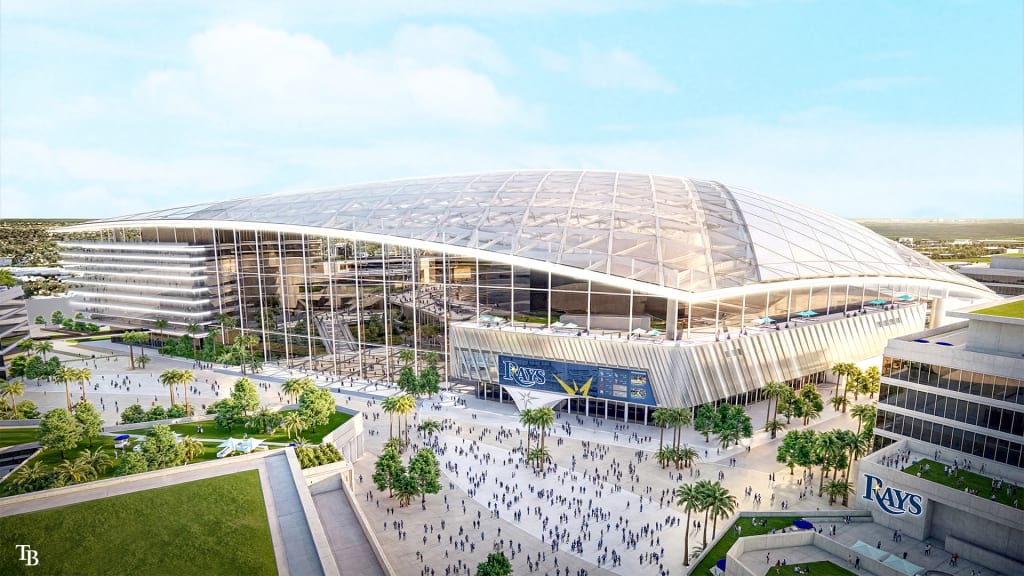
ST. PETERSBURG -- The Rays have proposed a timeline and a funding plan for their planned ballpark on the site of Hillsborough College’s Dale Mabry campus in Tampa, according to a memorandum of understanding released on Thursday.
The memorandum of understanding (MOU) provides further detail regarding the Rays’ vision for the proposed project, specifically the ballpark they view as their “forever home” and their hope to open in time for the 2029 season.
According to the MOU, all the involved parties -- including the team, the City of Tampa and Hillsborough County, among others -- must complete and approve the final agreements by June 1 in order for the ballpark to be open by March 2029.
The ballpark is projected to cost approximately $2.3 billion. The Rays have offered to pay $1.235 billion, more than half of that figure, plus all design and construction cost overruns. They are asking for a $1.065 billion public contribution, with $750 million coming from the county and $251 million from the city.
“We are grateful for the collaborative efforts of Hillsborough County, the City of Tampa and the Tampa Sports Authority, as we work together toward a shared vision for the Rays’ Forever Home in Tampa Bay,” Rays CEO Ken Babby said in a statement. “This Memorandum of Understanding marks an important step forward and reflects a responsible public-private partnership that can be achieved through open communication and a commitment to getting this right for the community.
“We look forward to continuing these conversations with the County, City, TSA, Hillsborough College and the community, as we refine the plan and move the process ahead.”
The new ballpark’s lease would be for 35 years, with options to extend it up to 15 additional years in five three-year periods. The club would manage, operate and maintain the stadium, cover all insurance and repairs and commit to a non-relocation agreement with the county and the city.
According to an overview of the MOU, the public funding would come from a variety of city and county sources but not general taxpayer dollars or new taxes: Hillsborough County’s Tourist Development Tax, the Community Investment Tax (“provided the allocation does not impact committed police, fire and emergency management projects”) and Drew Park Community Redevelopment Area (CRA) tax increment revenue bonds.
Hillsborough County Commissioner Ken Hagan told local sports talk radio station WDAE on Monday that the “goal” was for the county to vote on the ballpark proposal on May 6 before the Tampa City Council votes on May 7. The Hillsborough Board of County Commissioners is scheduled to discuss the Rays’ future during a workshop on April 16.
The City Council, County Commissioners and CRA Board will have to approve the final project agreements for the ballpark project to move forward. MLB must also approve the stadium itself and all project agreements.
While the Rays are pitching the ballpark project as a public-private partnership, the team has previously said the surrounding mixed-use development will be “100 percent privately financed.”
The Rays’ use agreement with the City of St. Petersburg to play at Tropicana Field is set to expire after the 2028 season. In February, MLB Commissioner Rob Manfred and Florida governor Ron DeSantis spoke in support of the Rays’ proposal.
The team has spent two decades searching for a long-term home in the Tampa Bay area, and the new ownership group led by managing partner Patrick Zalupski made it clear upon purchasing the team from former principal owner Stuart Sternberg that building a new ballpark at the center of a mixed-use development -- like The Battery in Atlanta -- was their top priority.
The Rays moved quickly to identify Hillsborough College’s Dale Mabry campus, across the street from Raymond James Stadium and adjacent to the Yankees’ George M. Steinbrenner Field, as their preferred location.
In January, the Hillsborough College District Board of Trustees voted unanimously to approve a non-binding MOU with the Rays to pursue a partnership to redevelop the roughly 113-acre campus. The mixed-use development around the proposed ballpark would also include a redesigned campus for Hillsborough College, which would remain operational while relocating to a facility on campus during construction.