



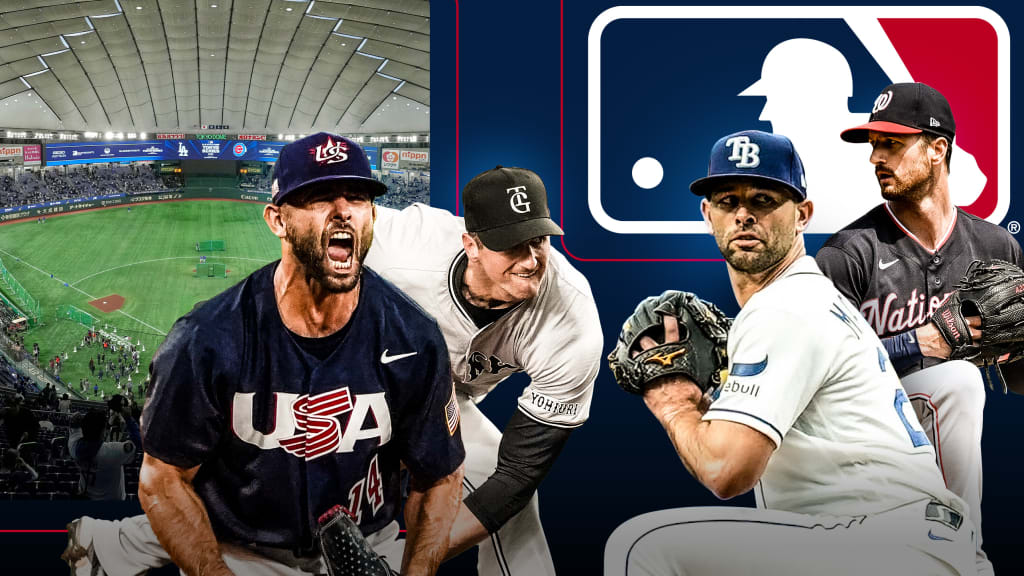
Nick Martinez and Foster Griffin have been two of the better pitchers – and pitching stories – to begin this young season.
Martinez owns a 2.29 ERA through his first 12 starts for the Rays, including gems like his April 22 outing against the Reds when he threw a season-high eight innings and allowed just one run. Griffin is 6-2 with a 3.76 ERA, helping the Nationals to a surprising start in his first year with the club. On April 26 against the White Sox, he was stellar over seven scoreless innings, allowing two hits and two walks while striking out eight.
They are different pitchers, better pitchers, than they were before they crossed the Pacific to reinvent themselves. They are also part of a growing, profitable trend in pro ball.
North American expat pitchers once viewed Nippon Professional Baseball in Japan and the Korea Baseball Organization in South Korea as a last paycheck, a career graveyard. More and more, the path has become a developmental springboard to revitalize careers.
Colby Lewis was something of a trailblazer. Before he signed with the Hiroshima Carp ahead of the 2008 season, a North American pitcher in Japan rarely returned to the Majors except as a middle reliever. Lewis re-engineered his pitch mix, led the Central League in strikeouts twice and proved a career could be revived there.
Nolan Ryan scouted video of him in the 2009-10 offseason, and the Rangers signed him. Lewis delivered 401 1/3 innings and 6.9 fWAR in his first two seasons back, winning a combined 26 games and making three World Series starts for Texas teams that won back-to-back AL pennants.
Ryan Vogelsong followed. He became a World Series hero and 2011 All-Star with the Giants after three seasons in Japan. Miles Mikolas, Merrill Kelly, Chris Flexen and Erick Fedde later returned and each posted at least one 3-fWAR season as Major League starters.
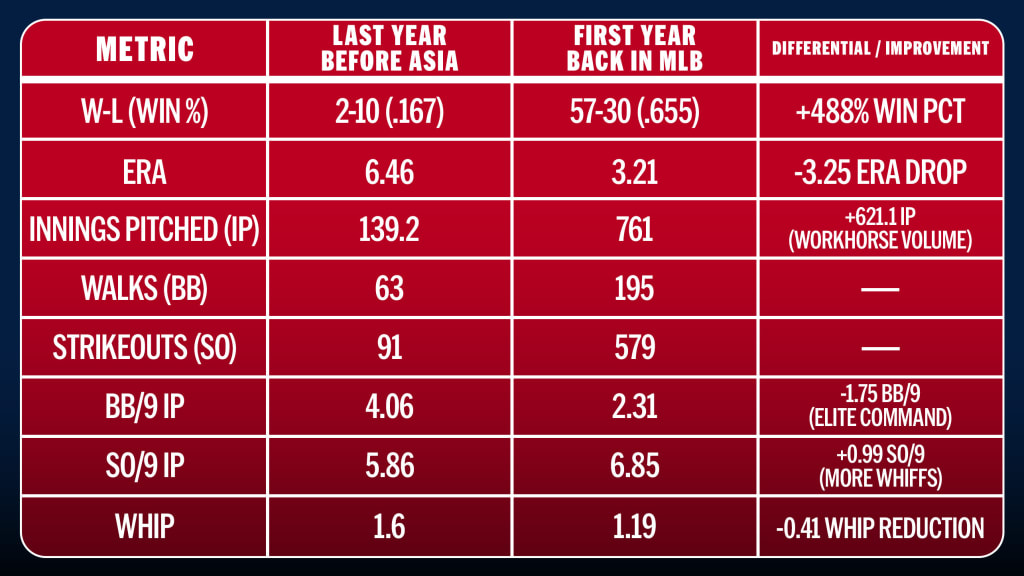
Consider that this group cut its ERA by 3.25 runs, added 621 innings, and improved their combined winning percentage by 488% in comparing their last year in the Majors before departing to their first year back.
Martinez and Griffin are two of the more recent success stories. I wanted to learn how the experience shaped them and helped them reinvent themselves.
Why they left
Martinez was non-tendered after posting mid-5 ERAs with the Rangers in 2016 and ’17. He was looking for a place to experiment and boost his stock.
Griffin, a former Royals first-rounder, spent most of his time in the Kansas City bullpen before Tommy John surgery derailed him further in August 2020. Had he stayed stateside, he figured he was destined for Quad-A shuttle duty as a reliever. He still wanted to start.
"I feel like I really just got a second chance," Griffin said. "I was a pretty typical 4A player. If I would have stayed here, I would have gone into that DFA limbo, here and there, bouncing around from team to team. … That's kind of where I felt like I was at, so it was kind of a no-brainer for me to take a chance."
Both pitchers saw Japan not as a last resort but as a calculated risk for a real role and room to grow.
The opportunity and environment
Martinez was drawn by the volume of work he would be allotted, and that NPB is viewed as a step above Triple-A.
"They only get a certain number of foreign players on the active roster," he said. "When an Asian team signs you, you’re gonna have an opportunity to perform and to play. You’re gonna be relied on by the team. And you’re given the opportunity to improve your game."
One AL front-office executive put it this way: "The consistency and reliability of a role in Asia – instead of the up-and-down, DFA, and being moved to the bullpen if you struggle as a starter – is a thing. They can sort of regroup over time with one club."
Griffin was intrigued by the in-game workload.
Pitch counts more regularly exceeded 100, and he pitched just once a week, giving him a chance to learn how to navigate lineups not just a second but often a third time through. He averaged 6.05 innings per outing in his first year with the Yomiuri Giants.
But it was hardly a low-stakes environment.
Teams want to win. Stadiums are packed and loud. Fans knew who he was and waited for him at subway stops seeking autographs near the Giants ballpark in Tokyo, and at the road train station platforms (teams travel by high-speed rail in Japan).
"It’s almost more like a kind of playoff-level vibe, especially on the road," Griffin said. "They’ll have the entire stadium full, and we only have like a little strip of our fans (in a section). If you go look at pictures online of Koshien Stadium in Osaka … it’s a place to get extremely loud. It’s pretty fun."
Griffin and Martinez had their families with them so there was little loneliness in foreign culture. But other players who make the journey face more isolation.
Consider former outfielder Eric Thames, who used the power of boredom in Changwon, South Korea, to change his career.
"The language barrier was really tough," Thames said several years ago. "For me, it was a lot of time by myself. I didn’t speak any [Korean]. All the other American [players] had families and stuff, so they are with their kids. So I’m just online reading stuff, and I’m bored, and I’m pissed because I’m 0-for-15. ‘Let’s figure out what’s going on here.’ So I started looking up videos."
He would try to mimic Barry Bonds' swing in his quiet apartment, even how Bonds took pitches. He would go through "a million articles a day" on hitting on the bus, in the clubhouse and elsewhere, he said.
While he wasn't a pitcher, he returned to the Brewers as a very different player (31 homers, 125 wRC+) in 2017.
The reinvention
Martinez’s reinvention actually began in the States.
After his first season with the Nippon-Ham Fighters in 2018, he still wasn’t turning heads.
He went to Driveline in the Seattle area hoping to improve his curveball. He had begun to dive into analytics and knew his curveball spin efficiency was poor. But he learned something else at the facility.
"We did the biomechanical assessment. I saw that I had awful mechanics," he said. "I was able to repeat it, but I was leaving some in the tank."
He addressed his mechanics in 2020, an uneven season disrupted by COVID (4.62 ERA). His fastball velocity rose in Japan – 93.4 mph in his first year back in the Majors in 2022, up from 92.5 in 2017. He improved his curveball and learned a new pitch by accident.
"Japan is the best place to learn a splitter, right?" he said.
After tinkering with grips and struggling to throw a traditional splitter, he discovered his middle and ring fingers produced better separation.
"I threw one in the bullpen, and the movement went all the way right. And it was just like, bang, that was it," he recalled.
He perfected the split-change in the offseason.
With the Fukuoka SoftBank Hawks in 2021, he broke out: 1.60 ERA over 140 2/3 innings, K-BB% jumping from 7.6% to 18.1%. That earned him a four-year, $25.5-million deal with the Padres.
"In 2021, (the split-change) became a major weapon for me and opened up all my pitches," Martinez said. "That’s where I kind of hit my stride, and I was able to carry that to this season."
Griffin dove into analytics during his Tommy John recovery, learning how to employ Trackman data. He tweaked his sweeper and expanded his arsenal, adding a sinker and splitter to navigate lineups deeper and combat Japanese hitters. He now boasts seven pitches.
"The reason for expanding the arsenal was for swing and miss," Griffin explained. "I think for the most part here in the States, we have a lot of guess hitters. Over there, it’s hard to get swing and miss. I had to get a bunch of different pitch shapes in order to induce that."
After a strong three-year run with the Giants (2.57 ERA, NPB All-Star), he signed with the Nationals this winter.
Chicago White Sox pitching director Brian Bannister, who has worked with several returners like Fedde, sees a pattern.
"I think the primary reason pitchers are coming back with more success is they finally take a chance on pitching in a different style or adding a new pitch that they were hesitant to experiment with while [in MLB]," Bannister said. "Lower-spin pitchers that switch to more of an east-west style or pitchers that add a splitter are two examples of beneficial arsenal changes that have resulted in higher production ceilings when they return."
The Return (Proof the detour works)
Since returning, Martinez has pitched five seasons for three teams, covering 595 1/3 innings with a 36-31 record and 3.51 ERA. Griffin, on a one-year, $5.5-million deal, looks like a steal.
They returned with wider arsenals, sharper command, the experience of pitching deeper into games and greater mental resilience.
"I feel like I just grew as a person over there," Griffin said.
As more success stories pile up, teams have grown comfortable investing in these pitchers.
"Given the quality of data we have today, and the track records from some successful returners, teams are more open to paying guys," said one assistant GM. "We had an amazing projection on Mikolas when he was coming back … but our bid was probably only 25 percent of what our model would have recommended. We built in a huge margin of safety because we were afraid of the bust factor. …
"When you look at more recent signings, teams seem much more willing to bid the full amount."
The far side of the world is no longer a graveyard for careers. It is a place to grow.