



Mason Miller, Jacob Misiorowski and Josh Hader have a whole lot in common.
We can start with the fact that they are three of the best pitchers in baseball, elite flamethrowers whose names are synonymous with this era of unprecedented power pitching.
Lowest expected ERA, 2026
Min. 50 balls in play (555 pitchers)
1) Mason Miller (SD): 1.52
2) Josh Hader (HOU): 1.73
3) Brandyn Garcia (AZ): 2.05
4-T) Jacob Misiorowski (MIL): 2.10
4-T) Bradgley Rodriguez (SD): 2.10
4-T. Blake Snell (LAD): 2.10
4-T. Drew Sommers (DET): 2.10
All three pitchers are also known for an elite individual pitch. Misiorowski's four-seam fastball averages 100.6 mph and bullies hitters like few other heaters ever have before. It's the second-fastest pitch in the Majors behind Miller's four-seamer, which averages a cool 101.5 mph. Hader doesn't throw quite as hard, but his rising sinker is a true one-of-one pitch. All three are uniquely nasty.
There is one more characteristic that tethers these three dominant hurlers. They each have a changeup stowed away in their back pocket.
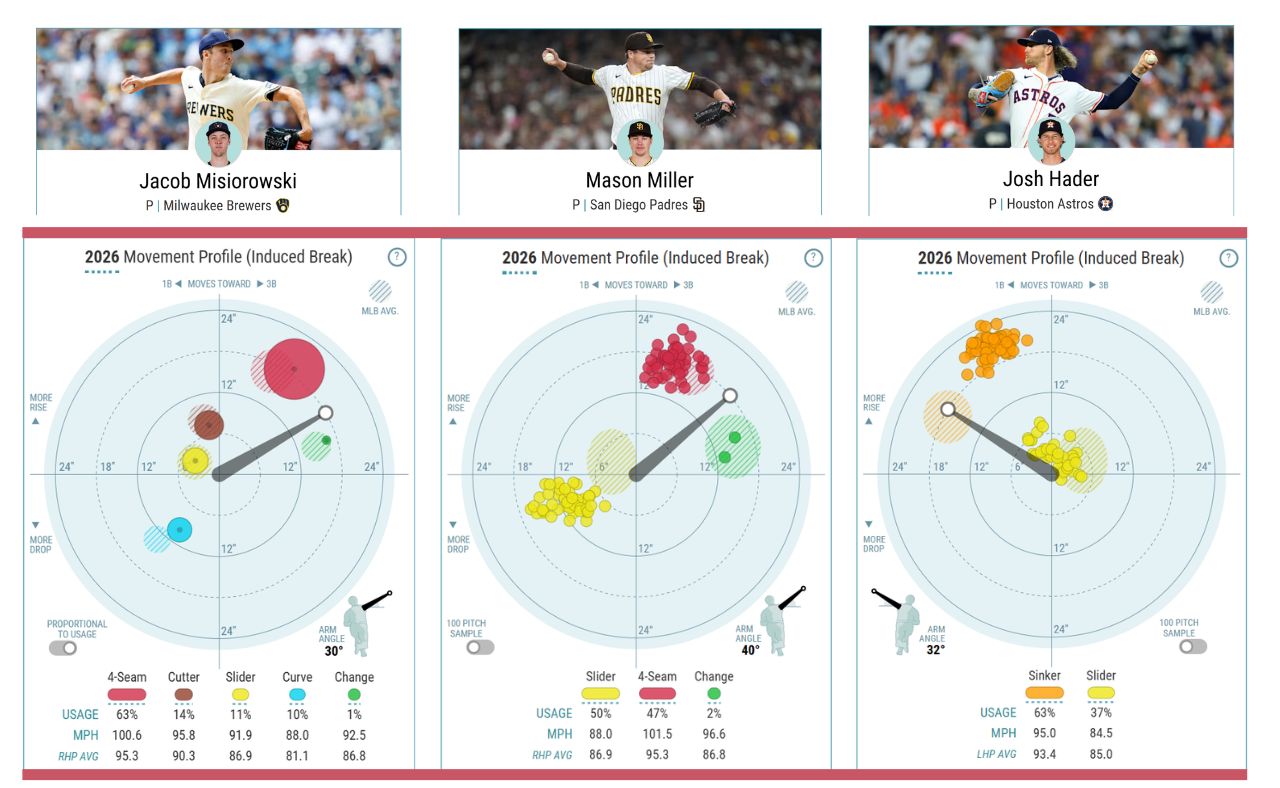
You won't see these changeups often. Misiorowski (28) and Miller (22) have combined to throw just 50 all season. Hader, who threw 37 changeups in 2025, is yet to use the pitch this year. But each pitcher is toying with the offering in between outings. They fiddle with it while playing catch, sprinkle it into bullpens, and tinker with its shape.
What's the point of all this? Why are three of baseball's most dominant pitchers, each equipped with truly elite individual weapons, bothering with another pitch?
"It's in there, you might see it," Misiorowski chuckled last month while standing outside the visitor's dugout at Citi Field. "It's one of those deals where you gotta keep it in the back of a guy's mind. It's the one-percent pitch. You can basically eliminate it, but if it comes out, well, here it is. Good luck."
You don't have to squint to see the utility of the "one-percent pitch" -- and, in Misiorowski's case, he throws his changeup exactly 1% of the time. Look at where we are in the baseball calendar, barreling toward October. Postseason baseball is a uniquely intimate environment. The Miz might pitch three times in a best-of-seven series, which would mean facing the same hitters eight or nine times in a week-and-a-half span. Hader and Miller could square off against the same hitters on consecutive days, or appear four times in a given series. These sort of situations rarely happen in the regular season and, even if they do, the stakes are not as high.
In these moments, wouldn't it be nice to throw the hitter for a loop?
"It gives players a different look when you face them multiple times," Hader said in late August at Citi Field.
That sounds logical enough. But here is the other part of all this: Is it even possible to go weeks without throwing a certain pitch in a game setting and then deploy it effectively in a postseason game? And if it's possible, is it a good idea?
That's the quandary that Miller is wrestling with in the heat of the pennant race.
"I'd love to tell you that I'm going to start throwing it 20% [of the time]," Miller said in mid-August inside the visitor's clubhouse at Citi Field. "But my other two pitches, the fastball and slider, are really good. The game is usually on the line, so I'm not trying to get beat on my third pitch. But I'd love to throw it more."
Miller is trying to get there. He used a changeup sparingly in his first three years in the Majors, struggling to find a movement profile that worked for him. Last offseason, he scrolled past a video demonstrating Tarik Skubal's unique changeup grip and decided to try it for himself. The two pitchers were teammates for Team USA at the World Baseball Classic in March. Miller picked Skubal's brain a bit, and the left-hander told him he needed to throw his changeup slower.
"I'm like, 'I'm trying,'" said Miller, whose new changeup averages 96.6 mph.
On Aug. 25, Miller threw a 98.2 mph changeup to the Pirates' Oneil Cruz. It was the hardest changeup on record in the pitch-tracking era (since 2008), but that's not necessarily a good thing. The pitch wound up looking like a slow fastball -- at least by Miller's standards -- and Cruz belted it for a home run.
This is all still a work in progress. Cruz has a 49% whiff rate against changeups this season, which is one of the highest swing-and-miss rates against changeups by any Major League hitter. Miller had a logical attack plan; it just didn't work out.
"It makes sense to [throw it] to some guys," Miller said. "I also have to show myself that I can throw it for a strike and use it competitively, which I really haven't been able to do. ... Just picking my spots when I have an opportunity to attack a guy that has a weakness with it where it makes sense, versus doing a guy a favor throwing something right in the middle of the plate."
He has not thrown a changeup in a game since giving up the home run to Cruz.
Miller's experiment is similar to the one that Edwin Díaz tried last season. The Dodgers' closer, then with the Mets, told the New York Post that he wanted to make hitters think more. But without a better movement profile, Díaz said, he would stick with his traditional fastball/slider combo. They were good enough on their own. After giving up a hit on the first changeup that he threw last June, Díaz put the pitch on the shelf.
That thought process resonates with Hader, whose unicorn sinker and tight gyro slider make for a dominant 1-2 punch.
"I just think the way my fastball and slider are playing right now, they've been in a really good spot," Hader said. "Overall, if it ain't broke, don't fix it. That's kind of where I'm at right now."
Still, there's an understanding that things could break at any time. They did last season, when Hader struggled to keep right-handed hitters in the ballpark. So, he began incorporating a changeup into his arsenal to keep righties off balance and mess with their timing.
This year, right-handed hitters are batting .080 with three extra-base hits against Hader. There is no need for the changeup. But things could change. That's why a pitch that may never see daylight in 2026 is a constant in Hader's daily routine.
"You're always throwing it," he said. "You're throwing it in catch play. You're throwing it in warmups."
The same goes for Misiorowski, who last threw a changeup in a game on June 19.
“I’ve been playing with it all year,” Misiorowski said. “I’ll have a week where, ‘OK, if I get a spot, I’ll throw it.’ But then the spot doesn’t arise and there goes another week where I haven’t thrown it. I keep playing with it and I have a bad week, then a bad week turns into two weeks, and all of a sudden I haven’t thrown that pitch in a month.
“It’s like, ‘Eh, should we just stick with what’s working?”
So far, he has. That is an undeniable luxury. Misiorowski can throw his fastball 63% of the time and still have the lowest batting average against among qualified starting pitchers. We are not talking about normal pitchers here, and that matters, too. Most guys can't afford to do this.
Miller, Misiorowski and Hader can. So they are proceeding along the tightrope, simultaneously aware that their stuff is truly elite and that October brings about a new set of challenges. They have all pitched in the postseason before. They know that when the margins are tightest, a wrinkle could make the difference. So, why not have it ready to go?
“Hopefully, I'm able to have a really successful career and I never need it,” Miller said. “It’s more of just, at some point, I might need a third pitch.”