



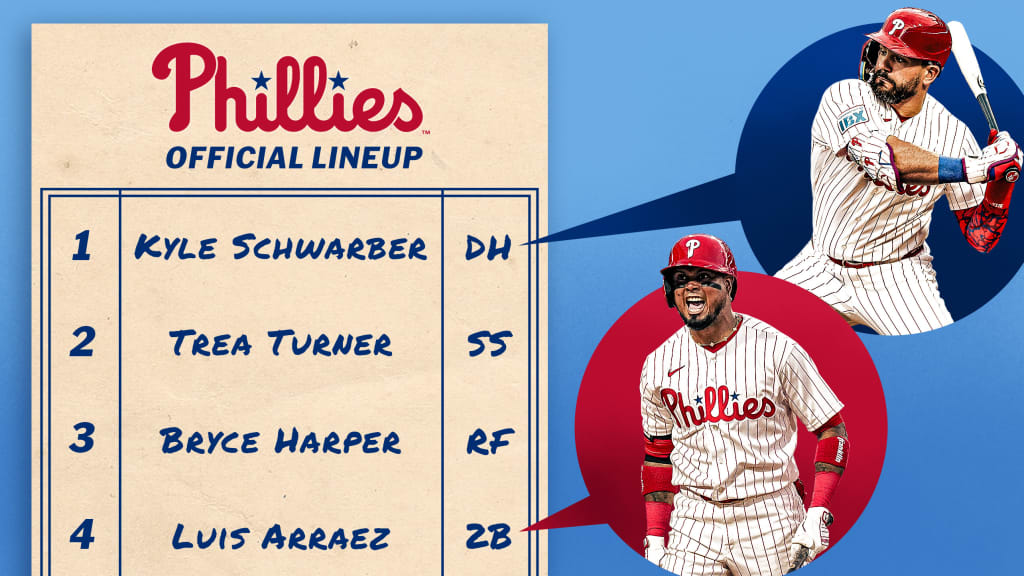
When the Phillies traded for Luis Arraez at the Deadline, most of the discussion was understandably about how he’d fit into their defensive lineup. All of the moving parts required infielders Bryson Stott, Alec Bohm and Bryce Harper to each move to new positions -- along with the more recent development of designated hitter Kyle Schwarber having to find his rarely used first-base mitt.
That alone is a tricky situation that has many questions left to be answered. But maybe, it turns out, there’s a far more interesting lineup configuration to consider. It’s how Don Mattingly has changed the hitting side around.
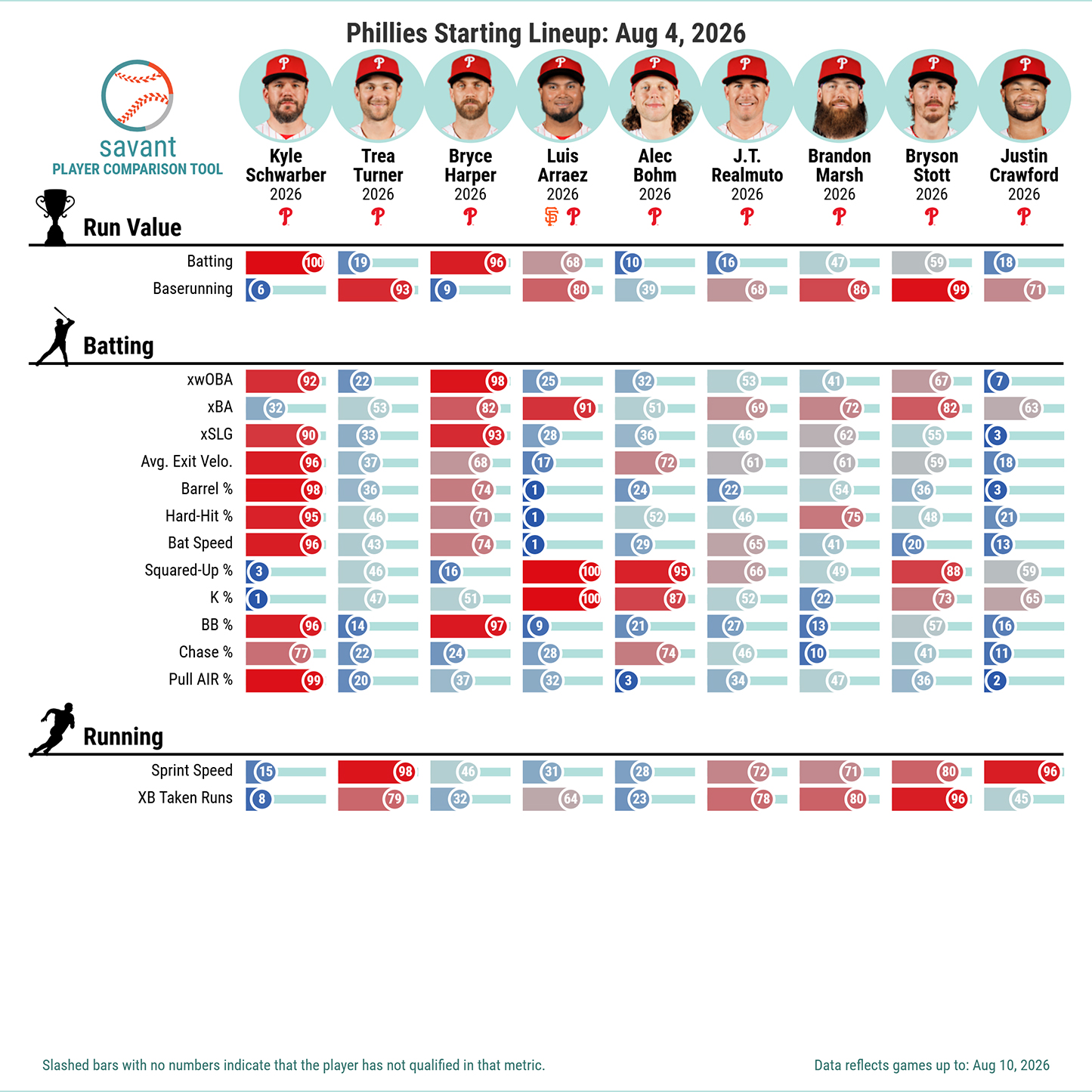
In each game since the trade, the Phillies have led off with Schwarber, one of the best sluggers of his generation. He’s also one of the slowest players in the game, and one who very possibly might set the all-time record for most strikeouts in a season this year.
Also, in each game since the trade, Arraez has hit cleanup. For all of the obvious contact-lord skills he brings, this is a hitter who swings baseball’s second-slowest bat and has the weakest hard-hit rate in the National League. Cleanup, famously the domain of Lou Gehrig (who literally wore No. 4 because of it), Willie McCovey, Frank Robinson, Joe DiMaggio and many other of the game’s most famous and feared mashers, now occupied by a mostly power-free contact-hitting middle infielder.
Put another way, Philadelphia's leadoff man might end up with more homers this year alone (Schwarber has 35) than their cleanup hitter has in his entire career (Arraez has 41, in parts of eight seasons).
My, how the game has changed. It looks weird. It feels weird, to be honest. But it also, improbably, makes a considerably great deal of sense. It is where Arraez probably always should have been, because in many ways he was always miscast as a top-of-the-order hitter due to those contact skills.
It’s going to get a little mathy, and we apologize for that, but if you think that these decisions aren’t essentially made on math, well …
“Over the years, they’ve run these lineup optimizers and things like that. And it’s really you just want your best nine in the game. The order that they hit, it basically showed it doesn’t change the number of runs scored. Maybe a point-something over the season. So, in general, I’m not worried about that.”
… realize that quote isn’t from a back-office team analyst or spreadsheet-lover. It’s from Mattingly himself, a six-time All-Star, 1985 AL MVP, current Philadelphia interim manager, and not someone whose name ever appeared in “Moneyball.” It’s just how these things work.
Why it makes sense for Schwarber to lead off
Because he’s your best hitter, and now you’ll get your best hitter to the plate as many times as possible, roughly 18 times more than if he were in the No. 2 spot, and 36 more than the No. 3 spot, and so on, over the course of a season.
There are other arguments we’ll not get into here about having your best hitter batting second, so there’s at least a chance for a runner on, but we’ll skim past that for now, because this isn’t primarily about Schwarber. Best hitter, hitting more.
OK, that part was easy, good talk. Let’s get more complicated.
Why you’d put a power-free hitter like Arraez at cleanup (the simple answer)
For all of the angst every fanbase feels about batting average with runners in scoring position (or RISP), an outcome that is vital to winning games and yet almost never a repeatable skill more than it is randomness, there’s no one better at it than Arraez …
Highest average with RISP, 2021-2026, min. 350 PA
- .348 Arraez
- .340 Freddie Freeman
- .328 Xavier Edwards
- .327 Aaron Judge
- .326 Bo Bichette
- .325 Bobby Witt, Jr.
… and if that’s true, then you’d rather have him hitting with, say, runners in scoring position.
Which, more than anyone else in baseball, he has not. Go back to 2019, the start of Arraez’s career, and find every batter who has stepped to the plate at least 1,000 times. (There are nearly 450 of them.) Sort them by lowest rate of plate appearances coming with runners in scoring position and … well, would you look at that.
Lowest % of PA with runners in scoring position, 2019-2026, min. 1,000 PA
- 19.6% Arraez
- 19.7% Edouard Julien
- 19.9% Ronald Acuña Jr.
- 20.1% Tim Anderson
- 20.2% Shohei Ohtani
- 20.2% Jung Hoo Lee
If you value Arraez’s ability to move runners along and/or in, then his previous teams have not put him in position to do that, instead viewing him as someone who gets on base, even though his general refusal to take a walk mutes some of the on-base skill a high batting average provides.
Note, also, that batting average doesn't account for a sacrifice fly, a tool Arraez used to drive in a 10th-inning game-tying run against Toronto on Saturday. This year, Arraez has 10 sac flies, second-most in the Majors behind Ozzie Albies' 11.
That’s why it’s always felt a little odd that Arraez has spent approximately three-quarters of his career plate appearances hitting first or second, presumably because that’s where a contact-hitting middle infielder ‘should’ hit. In so many ways, he's not the typical anything.
Why you’d put a power-free hitter like Arraez at cleanup (the complicated answer)
Because his entire skillset is about having runners on base to drive in. It’s not, contrary to popular belief, the contact by itself that makes him valuable. It’s the contact at the times when it’s actually important to have that contact made – which isn’t always.
That’s because a single with the bases empty is better than not having that single, but still requires the hitters behind you to do some work to drive you home. That’s with no outs; with one out, it’s less useful; with two outs, it doesn’t gain you that much at all.
That’s based on this kind of math, using the Statcast Game Strategy Explorer, which lets you find the run expectancy of every situation (i.e., what happens in various counts, outs, and base states), comparing what you’ve gained before and after the plate appearances.
For example, with the bases loaded and one out, a team, on average, scores +1.63 runs. With the bases empty and one out, a team, on average, scores +0.26 runs. That’s just putting numbers to what you already know; more runners plus fewer outs equals more success.
With the bases empty and no outs, the value add in a single is +.396 worth of run expectancy. (That, if you’re interested, is derived from the difference between the +.494 run expectancy of a no outs, bases-empty situation against the +.890 run expectancy of a no outs, runner-on-first situation.) Don’t overthink the decimals here; you can think of it as “you’ve just added four-tenths of a run if you single with the bases empty and no one on.”
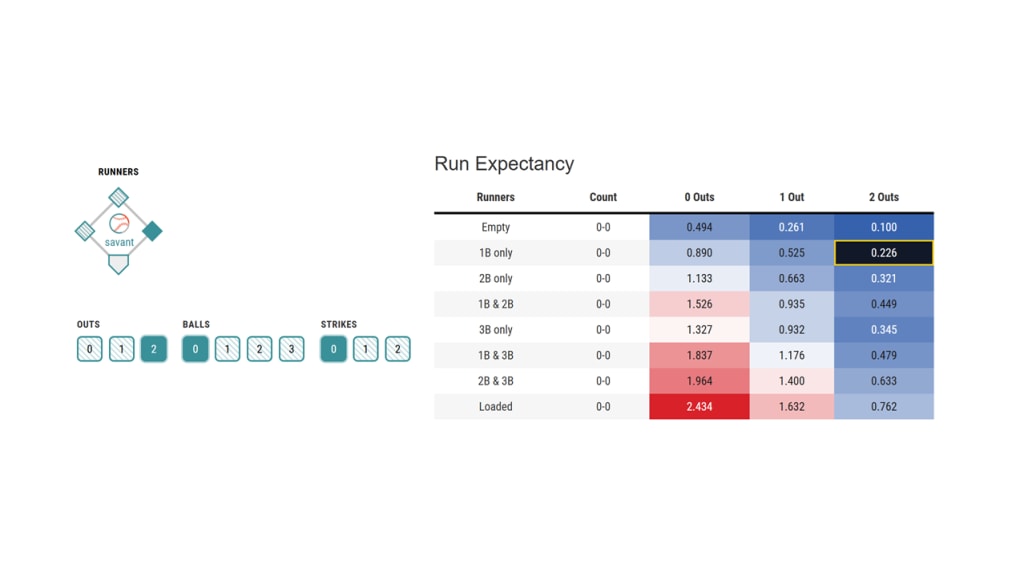
With bases empty and one out, that drops to adding +.264, or about a quarter of a run; with the bases empty and two outs, that single drops to adding +.126 of a run, or a bit more than one-tenth of a run, which is another way of saying it’s a long way from there to actually scoring a run.
This all sums to “a bases-empty single with two outs is fine, but not more than fine,” yet a single with a runner on third gets you +.881 (because you’ve scored a run while making the ensuing situation somewhat worse), or about seven times as valuable as that single with the bases empty.
Plus, that’s only if you get the single. With runners on, putting the ball in play might at least move the runner over, whether you get a hit or not, while a strikeout certainly will not. (Set aside the potential downfall of the double play for now.) With the bases empty, that’s not quite true. The strikeout and the groundout carry the same value, which is to say, zero.
(Hey, we said there’d be math.)
Now, you might reasonably argue: OK, fine, not leadoff. But why cleanup, the domain of sluggers? Why not second or third?
Not second, because Bryce Harper is a future Hall of Famer having a reasonably normal Bryce Harper year; he’s a better overall offensive performer than Arraez is, and so he should hit in the spot that’s now become synonymous for where your best hitter lives, because you want him to hit more often than Arraez does. (Arraez also hit second most of last year for San Diego. Only the punchless Guardians had fewer runs driven in from the two-spot than the Padres did.)
(Could you make the argument to swap Harper and Schwarber at the top? Sure, probably. Would it make a great deal of difference? Probably not, so far as the math goes, and besides, Schwarber has an established history of being truly excellent at leading off. It’s probably not worth the trouble to change.)
Not third either, not here, for two reasons. For one thing, no spot in the order is more likely to hit with two outs and no runners on, which gets us back to the original problem: Arraez hitting with two outs and no one on is a waste of his skills. But also, it’s because of the composition of his new Phillies teammates. Schwarber hits lefty, as does Harper, as does Arraez, and when Mattingly says “I wanted to split the lefties up a little bit, as much as I can, instead of having three of them together,” thus placing the right-handed Trea Turner at three, it’s hard to argue that.
Ultimately, it doesn’t matter that much. The top four of the Phillies lineup are the four guys you’d expect. Justin Crawford is the weakest regular, and so he’s at the bottom. The five-through-eight spots are interchangeable based on pitcher handedness (Brandon Marsh higher against righties, lower against lefties), and who’s in that day’s Phillies lineup (catcher higher with J.T. Realmuto, lower with Garrett Stubbs), and to some extent, who’s running hot (as Stott very much is right now).
It may look weird to have Arraez hitting in the prototypical power spot, and surely for most of baseball history it wouldn’t even have been a consideration. He’s not the standard four-hole hitter. But nor was he the best fit at the top, either, no matter how much contact he makes. The takeaway here is simple: He shouldn’t be the guy who gets on base ahead of your best hitters. He should be the guy driving in the best hitters who already got on base.
None of this, again, matters that much. Lineup order never does. It also makes a whole lot more sense than you might think.