



Fastball Freddy is bringing the heat in October.
Freddy Peralta’s four-seam fastball -- which he is throwing 67.1% of the time this postseason -- is averaging 96.9 mph through four playoff appearances.
That may not seem all that fast in an era of baseball defined by triple-digit heat. But consider this: In the regular season, Peralta averaged just 94.3 mph with his four-seamer.
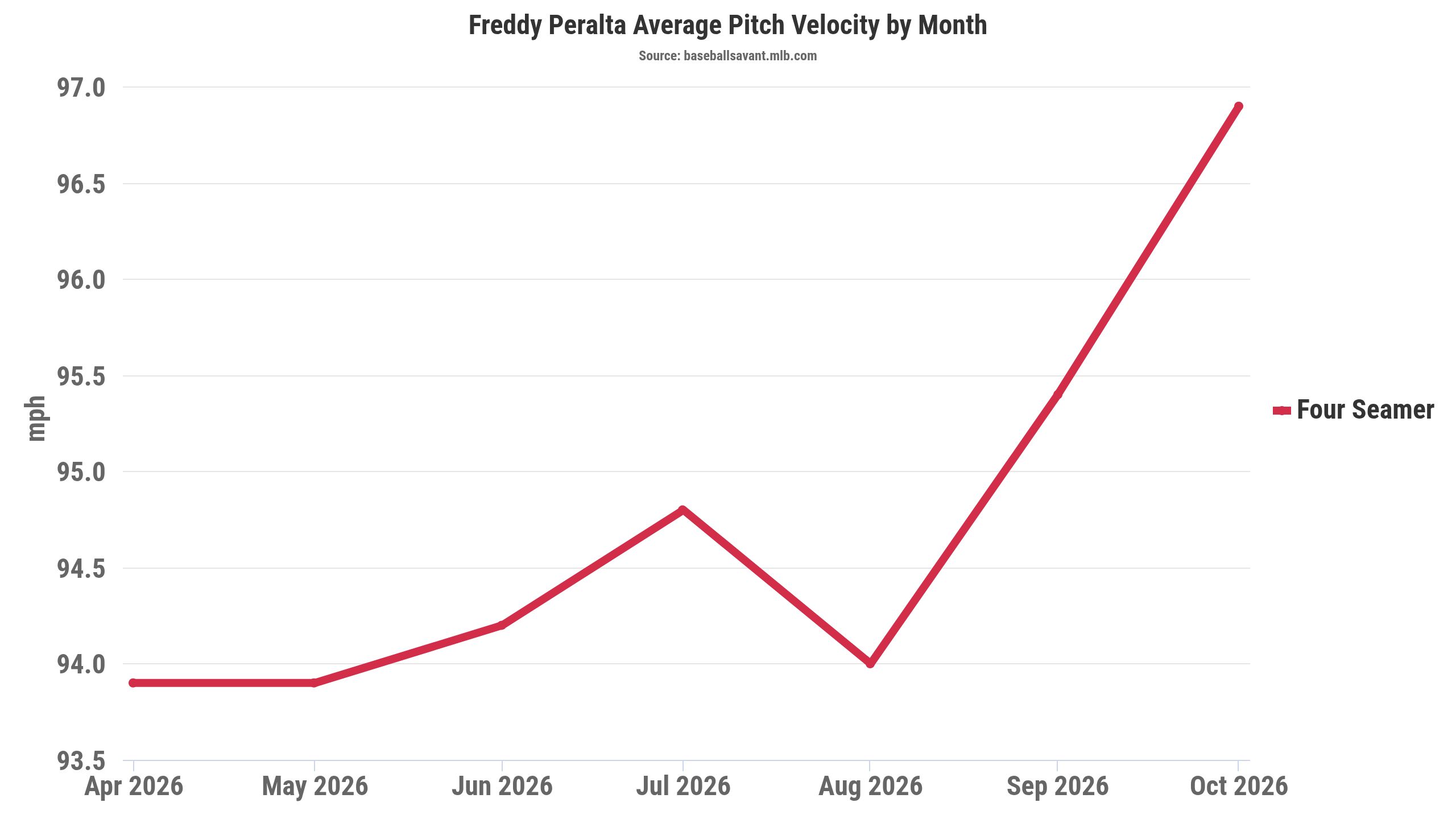
That is a comically absurd spike. Among a slew of other reasons, it is why the Rays will entrust a rejuvenated Peralta with the ball for Game 3 of the World Series on Monday night as the Fall Classic shifts to St. Petersburg.
Peralta is experiencing the second-largest velo bump by an individual pitcher from the regular season to the postseason in the pitch-tracking era (since 2008). Among pitchers to throw at least 75 four-seam fastballs in a single postseason, only one player has improved their average four-seam fastball velo by a larger amount from the regular season. That would be the Dodgers’ Roki Sasaki, whose four-seamer sat nearly three full ticks faster in the 2025 postseason than it did during his up-and-down rookie year.
There’s only been a handful of instances under tracking where a pitcher has improved their four-seam fastball velocity by more than 2.0 mph from the regular season to the postseason. Here is the company that Peralta finds himself in.
Largest increase in average four-seam fastball velocity, regular season to postseason (since 2008)
Min. 75 fastballs thrown in the postseason
- +2.8 mph // 2025 Roki Sasaki
- +2.6 mph // 2026 Freddy Peralta
- +2.3 mph // 2014 Kevin Gausman
- +2.2 mph // 2023 José Leclerc
- +2.2 mph // 2019 Tanner Rainey
- +2.1 mph // 2008 Ryan Madson
- +2.0 mph // 2009 Jered Weaver
- +2.0 mph // 2008 Jon Lester
Even in that group, Peralta stands out. His velo surge has come as a traditional starting pitcher. Peralta threw six four-seamers in a three-batter relief cameo in Game 4 of the ALCS, averaging 97.5 mph. If you remove those pitches from the sample, Peralta's average fastball velocity this postseason is still 96.9 mph -- or, still a +2.6 mph increase.
Sasaki's velo soared last October in part because he ironed out his mechanics, and also because he pitched out of the bullpen, which allowed him to let his fastball fly. Gausman, a starter with the Orioles in 2014, became a reliever for the playoffs. Weaver made four appearances in the '09 playoffs with the Angels, and two came out of the bullpen. Meanwhile, Leclerc, Rainey and Madson were all traditional relievers.
That makes Lester the best -- and, really, only -- comparison here. The southpaw made four starts for the Red Sox in the 2008 postseason -- including two against the Rays in the ALCS -- and saw his fastball velo climb from 93.1 mph to 95.1 mph.
It is normal for fastball velocity to rise in October. It has happened every year of the pitch-tracking era.
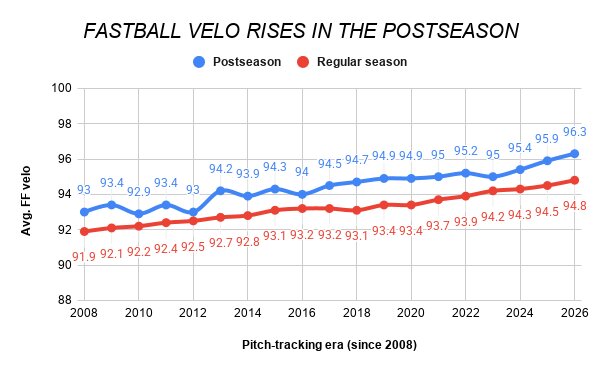
It is happening again in 2026. So far this postseason, the average four-seam fastball is thrown at 96.3 mph. That’s the fastest in a single postseason under tracking and nearly a full tick faster than the 2024 postseason, just to show how drastically velo is rising. In the regular season, the average four-seamer was just 94.8 mph.
Where does that uptick come from? There are a combination of factors at play, from the fact that starters have quicker leashes to the rampant use of relief pitchers. Adrenaline is most certainly involved here, too; Peralta has credited adrenaline for his velo bump after each of his three postseason starts.
But it certainly feels like there is more to this. Peralta has thrown more four-seam fastballs than anyone this postseason. He is not slowing down. He is letting it rip.
Peralta threw 33 pitches at 97.0+ mph in Game 6 of the ALCS against the Guardians. That series featured five of the fastest pitches of his career, paced by a 99.4 mph heater to Jo Adell. Peralta has thrown at least 20 pitches at 97.0+ mph in all three of his postseason starts. Before this month, his single-game career high was 18 pitches at 97.0+ mph.
Only one of Peralta's 173 four-seam fastballs has clocked in at 94.3 mph or slower. All 172 other fastballs have been faster than his average fastball velo in the regular season.
So much has been made of the way the Rays unlocked the best version of Peralta after acquiring him from the Mets at the Trade Deadline. They prioritized comfort when ditching his hands-over-head windup. Pitching coach Kyle Snyder and bullpen coach Jorge Moncada helped Peralta speed up his delivery and regain some of his elite extension, which makes his fastball play up. Tampa Bay instructed him to deploy his changeup more often, too, par for the course for an organization that throws more changeups than anyone else.
Much like those tweaks, the velo uptick did not happen overnight. Through three starts with the Rays, Peralta's fastball velo averaged just 93.8 mph.
There were signs in September that things might be trending the right way. On Sept. 19, Peralta threw 58 four-seam fastballs against the Red Sox and averaged 96.4 mph on the radar gun. That was his fastest average fastball velocity in a single game since 2019. His next time out, against the Phillies, Peralta sat at 96.2 mph with his fastball. Something clicked. He has not looked back.
The velo is not everything. Location is just as important, and Peralta is pounding his fastball at the top rail. But in October, velocity is king. And Peralta has gone where he never has before in search of the crown.