


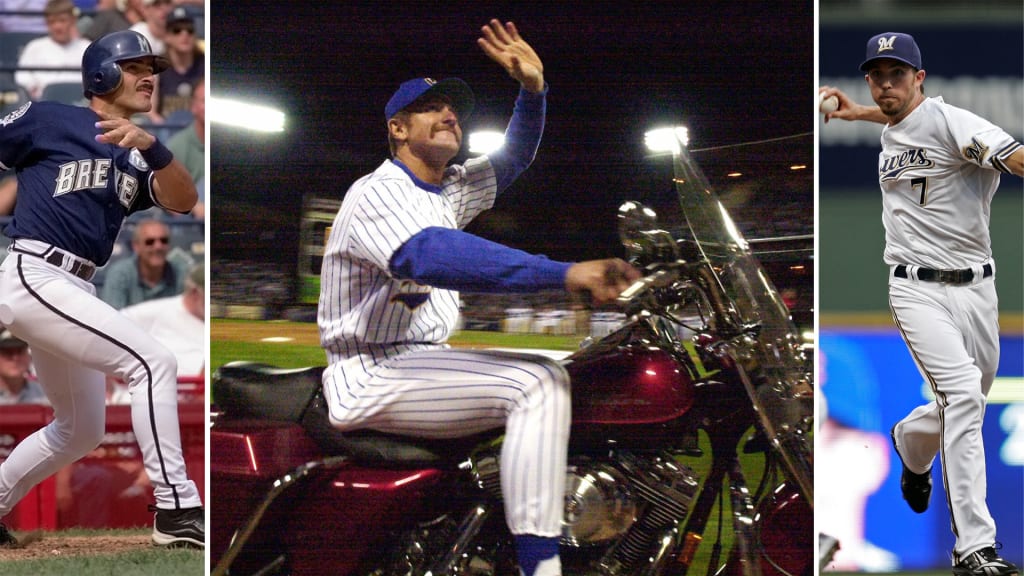
No one loves a good debate quite like baseball fans, and with that in mind, we asked each of our beat reporters to rank the top five players by position in the history of their franchise, based on their career while playing for that club. These rankings are for fun and debate purposes only, and are updated through the end of the 2025 season.
Here is Adam McCalvy’s ranking of the top 5 shortstops in Brewers history.
1. Robin Yount, 1974-92
Key fact: Brewers' all-time leader in games, runs, hits, extra-base hits, RBIs and walks
“In 1973,” Brewers founder Bud Selig said, “Jim Wilson was our general manager, Jim Baumer was our scouting director. Both were scouts, which is what I was looking for because I didn’t like how our drafting was going. From Wilson and Baumer, I started hearing about players. One was Richard Shubert, a left-handed pitcher from New York. And then you had this kid from Woodland Hills, Calif.”
His name was Robin Yount.
Wilson knew pitching. He pitched 12 years in the Majors and came with the Boston Braves to Milwaukee for 1953 and '54. He was an All-Star in '54 and pitched the first no-hitter at County Stadium, working opposite the Phillies' future Hall of Famer in Robin Roberts. Baumer was an infielder who’d reached the big leagues with the White Sox in '49 at 18 years of age. That turned out to be a remarkable coincidence.
The men battled furiously, Selig said. In the end, it was the scouting director’s call, and Baumer chose Yount, a thrill-seeking, mechanically inclined and remarkably athletic shortstop who would be in the big leagues less than a year later at 18 years of age. It took Yount a few years to gain a foothold, but once he did he blossomed into a two-time American League MVP Award winner who topped 3,000 hits over 20 seasons in a Brewers uniform and made it to the Hall of Fame in 1999. A shoulder injury forced Yount to center field in '85, but as a shortstop, he tallied 1,650 of his 3,142 career hits and cemented himself as the best player in Brewers history.
“No baggage,” is how teammate Jim Gantner described Yount. “Extraordinary talent,” said fellow Hall of Famer Ted Simmons. “A great teacher,” said Paul Molitor.
“He had fun all the time,” Cecil Cooper said. “He was serious, but he wasn’t serious, you know what I mean? I think that’s part of how he got the name, ‘The Kid.’ That’s what he was.”
2. Willy Adames, 2021-24
Key fact: His 32 homers in 2024 are a record for a Brewers shortstop
“[Adames] and Robin are probably the two greatest shortstops to play here, and a cherished part of our history,” Brewers owner Mark Attanasio said as Adames’ tenure came to a close in 2024. “We’re appreciative of everything he has done here.”
The numbers support putting Adames in that exclusive company. His 15.6 FanGraphs WAR ranks second in Brewers history for a primary shortstop, trailing only Yount (66.5) and just ahead of former All-Star J.J. Hardy (11.0). Adames arrived in Milwaukee via a trade with the Rays in May 2021 when the Brewers needed a jolt of energy, and he delivered an .886 OPS in 99 regular-season games down the stretch that year, one of the reasons the team ran away with the NL Central title. During a Brewers tenure that spanned four seasons, Adames hit 107 home runs, posted a 113 OPS+ and was a mainstay at the most important position on the infield. Adames hit 31 home runs in 2022 to break Yount’s club record for a shortstop, then set a new mark with 32 homers in 2024 before departing via free agency.
3. Jose Valentin, 1992-99
Key fact: 249 career homers ranked 12th among Puerto Rico-born players as of 2025
It’s an infamous trade from the Brewers’ perspective, the deal that sent a disgruntled Gary Sheffield to the San Diego Padres at the end of 1992 Spring Training for Valentin, Ricky Bones and Matt Mieske. Sheffield led the National League the very next season with a .330 average to go with 33 home runs and 100 RBIs, and he turned into one of the most feared hitters of his generation. But the Padres knew they were giving up a good, young player as well.
“We heard about the trade,” said Tony Gwynn, as quoted in the Milwaukee Journal,” and we said, ‘Please don’t let it be Valentin.’”
Only Yount played more games at shortstop for the Brewers than Valentin, who played eight years in Milwaukee and was a productive switch-hitter and solid shortstop, part of a double-play combo with energetic second baseman Fernando Vina. Valentin’s best year in a Brewers uniform was '96, when he hit 24 home runs with 95 RBIs. He went on to play 16 years in the big leagues, including a five-year stint with the White Sox during which Valentin averaged 27 homers. He finished with 249 career home runs, two shy of Yount.
4. J.J. Hardy, 2005-09
Key fact: Had the same OPS as a shortstop with the Brewers (.753) as Yount
Hardy had professional sports in his blood. His mother was once the nation’s second-ranked amateur golfer behind World Golf Hall of Famer Nancy Lopez. His father played tennis for two years on the ATP Tour and reached as high as No. 270 in the world. Hardy and his brother, Logan, who is 17 months older, played every sport but football. This was a competitive family, especially at the ping-pong table.
“That all started with my dad just working my brother and I,” Hardy said. “I mean, grabbing a brick [as a ping-pong paddle] and beating us with a brick. He’d get a frying pan and [defeat] us with a frying pan. … So we said, ‘Screw this, let’s practice.’”
Hardy applied that competitive spirit to baseball, and after grinding through an unsuccessful rookie season with the Brewers in 2005 and an injury-shortened '06, he broke through as an NL All-Star in '07, his first of back-to-back seasons with 20-plus home runs.
5. Bill Hall, 2002-09
Key fact: Only Brewers shortstop other than Yount and Adames to slug better than .500 in a season at the position
Hall played all over for the Brewers, but he was at his best as the Brewers’ shortstop in 2006, when he logged an .899 OPS with 35 home runs and 85 RBIs, earning himself a contract extension. The Brewers moved him to center field the following season and to third base the year after that, and Hall’s production suffered. Still, he is one of only 28 players in franchise history to produce more than 10 fWAR in a Brewers uniform through the end of 2025, and one of 21 to slug 100 home runs.
What's more, Hall holds a symbolic place in Brewers history as the first of the young hitters drafted and developed by the team -- Hall was a sixth-round pick in 1998 -- as the club returned to competitiveness in the mid-2000s. Last year, Hall returned to Miller Park to officially retire as a Brewer.
Honorable mention
**Mark Loretta, 1995-2002**
Key fact: Was 1993 Big Ten player of the year at Northwestern before the Brewers drafted him in the seventh round.
There’s a case here for any number of players, but Loretta’s longevity (he played parts of eight seasons in Milwaukee) earns him the nod despite the difficulty of assigning him a single position. His first Major League start was at shortstop in September 1995, when Loretta homered against the Tigers for his first big league hit, and he went on a post a productive .289/.355/.385 slash line in a Brewers uniform before (deep breath) ... going to Houston in a 2002 trade involving Keith Ginter, who helped the Brewers get Nelson Cruz from the A’s in '04, who helped the Brewers get Francisco Cordero from the Rangers in '06, whose departure helped the Brewers draft Jake Odorizzi as a compensatory pick in '07, who was traded to the Royals in a prospect package for Zack Greinke in '10, who was traded to the Angels in '12 for Jean Segura, who was traded to the D-backs in '16 for a package including Isan Díaz, who was one of the players traded to the Marlins in January '18 for Christian Yelich.
Besides that trade tree, Loretta was an important player for the Brewers. He was chosen to deliver memorable lines while representing the players at both the closing of County Stadium in 2000 (“Oh, will it be sweet across the street,” he said) and at the opening of Miller Park in '01 (“Well, we’re home.”)
“Oh, will it be sweet across the street,” he said at the opening of Miller Park in '01.