




The road to World Series glory can be paved in a myriad of ways.
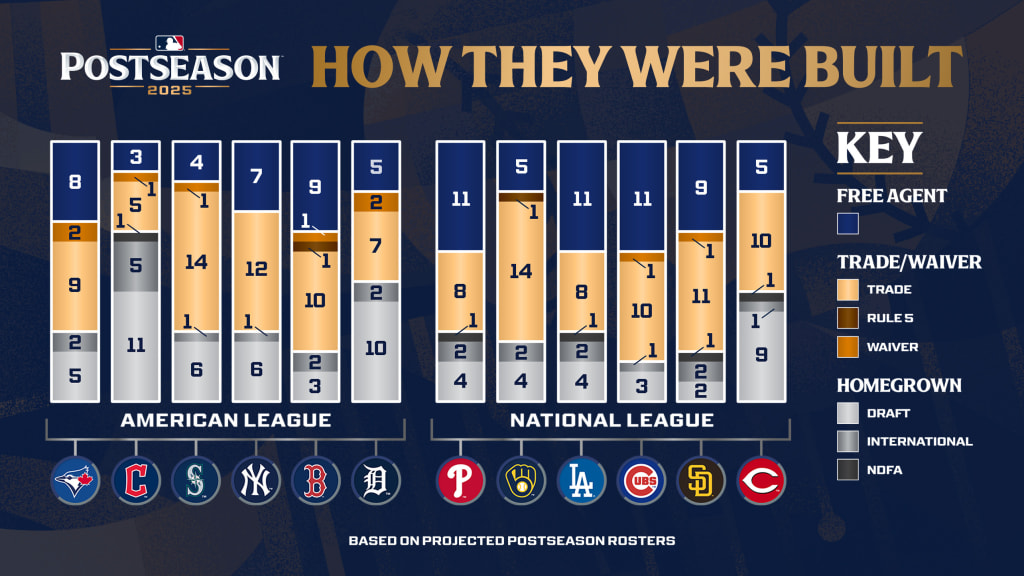
Each of the 12 teams hoping to be the last ones standing in this year’s postseason have been constructed in very different ways. There are the super-homegrown squads, like the Guardians and Tigers, leading the way with 17 and 12 signed and developed players (the Reds are third with 11). The flip side of that coin is where the Cubs (four), Padres (five) and Red Sox (five) live.
More from MLB Pipeline:
• Top 100 prospects | Stats | Video | Podcast | Complete coverage
The Brewers and the Mariners used the trade market more than any other team, with 14 acquisitions each, though they’re not alone. They are two of five teams sporting double-digit trade pickups on their roster. There are three teams with 10 or more free agent acquisitions as well in the Phillies, Cubs and Dodgers, all with 11.
Below is a detailed breakdown of how the 12 clubs were built headed into the 2025 Major League Baseball postseason. If a player was acquired by a team and then re-signed without going to another team, he is listed according to how he was originally acquired. All other players are sorted based on how they were most recently added to their current squads.
AMERICAN LEAGUE
BLUE JAYS (48.2 WAR, T-4th among 12 teams)
Homegrown: 7 (13.1 WAR)
• Draft: 5 (6.3 WAR)
• International: 2 (6.8 WAR)
Free agents: 8 (19.1 WAR)
Trades: 9 (12.8 WAR)
Waivers: 2 (3.2 WAR)
Vladimir Guerrero Jr. and Bo Bichette have carried the homegrown torch since they both debuted in the Majors in 2019, and that remains true of both infielders, especially given Bichette’s nice bounceback summer after his 2024 struggles. But this year’s AL East title – Toronto’s first since 2015 – was just as much defined by free-agent additions. George Springer moved to a primary DH role in his age-35 season and finished with 32 homers and a 4.8 bWAR, both highs since he joined the Jays for the 2021 season. Ernie Clement, who signed a Minor League deal in March 2023 after being cut by the A’s, proved to be an extremely valuable defensive wizard on the dirt, while 2022 addition Kevin Gausman continued to anchor the starting rotation. Guerrero and catcher Alejandro Kirk may be the only two international signees here, but they represent a strong core; only the Red Sox have a higher collective WAR among international amateur adds.
GUARDIANS (23.1 WAR, 12th among 12 teams)
Homegrown: 17 (16.9 WAR)
• Draft: 11 (12.5 WAR)
• NDFA 1 (0.9 WAR)
• International: 5 (3.5 WAR)
Free agents: 3 (1.9 WAR)
Trades: 5 (3.5 WAR)
Waivers: 1 (0.8 WAR)
No playoff team has close to as many homegrown players as the Guardians, whose 17 are five more than anyone else and more than double the average of eight per club. Cleveland signed and developed its four best players: very likely future Hall of Famer José Ramírez (a $50,000 steal from the Dominican Republic in 2009), 2021 first-round pick Gavin Williams, a pair of savvy selections from 2018 in Steven Kwan (fifth round) and Daniel Schneemann (33rd). (33rd). Chase DeLauter, the Guardians' No. 2 prospect and a 2022 first-rounder, would be making his MLB debut if called upon. Reliever Kolby Allard is the most notable of their postseason-low three free-agent signings, while their two best trade acquisitions (Joey Cantillo, Gabriel Arias) came in the same August 2020 Mike Clevinger deal with the Padres.
MARINERS (48.2 WAR, T-4th among 12 teams)
Homegrown: 7 (20.3 WAR)
• Draft: 6 (13.5 WAR)
• International: 1 (6.8 WAR)
Free agents: 4 (-0.1 WAR)
Trades: 14 (26.6 WAR)
Waivers: 1 (1.4 WAR)
Mariners president of baseball operations Jerry Dipoto has a reputation for not shying away from the trade market, and the makeup of this postseason roster certainly cements it. The M’s are tied with the most trade acquisitions of any playoff team and they are second in WAR accrued by those players, a group led by outfielder Randy Arozarena. There are obviously some hugely impactful homegrown players, starting with MVP candidate Cal Raleigh from the Draft and Julio Rodríguez from the international market. Most of the rotation comes from the Draft, with former sixth-round pick Bryan Woo leading the way if healthy.
YANKEES (50.7 WAR, third among 12 teams)
Homegrown: 7 (16.7 WAR)
• Draft: 6 (16.2 WAR)
• International: 1 (0.5 WAR)
Free agents: 5 (12.2 WAR)
Trades: 13 (21.5 WAR)
Waivers: 1 (0.3 WAR)
The Yankees rank third among postseason clubs in terms of Draft production, thanks largely to Aaron Judge but also getting contributions from fellow first-rounders Anthony Volpe and Austin Wells as well as late-round steals Ben Rice (12th round, 2021) and Cam Schlittler (seventh, 2022). By contrast, New York has gotten less out of the international market than any of the teams, with Jasson Domínguez their only representative and yet to live up to his $5.1 million bonus and considerable hype. Surprisingly, the Yankees are tied for the third-fewest free agents with just five, a group that includes their two best starting pitchers in Carlos Rodón and Max Fried. Their 13 trade acquisitions rank third in the playoffs, highlighted by Cody Bellinger, Jazz Chisholm Jr. and Trent Grisham. José Caballero, David Bednar and Ryan McMahon were key midseason pickups.
RED SOX (44.2 WAR, seventh among 12 teams)
Homegrown: 5 (12.1 WAR)
• Draft: 3 (4.9 WAR)
• International: 2 (7.2 WAR)
Free agents: 9 (12.5 WAR)
Trades: 10 (15.2 WAR)
Rule 5 pick: 1 (2.4 WAR)
Waivers: 1 (2.0 WAR)
Though the Red Sox feature just five homegrown products, tied for the second-fewest among playoff teams, that group includes cornerstones Ceddanne Rafaela, Jarren Duran and Brayan Bello. That contingent would be more significant if Roman Anthony, Triston Casas and Marcelo Mayer hadn't sustained season-ending injuries and Rafael Devers hadn't been jettisoned. Boston has compensated with trades (Garrett Crochet, Wilyer Abreu, Carlos Narváez) and free-agent signings (Trevor Story, Alex Bregman, Aroldis Chapman), not to mention the best Rule 5 pick (Garrett Whitlock) and waiver claim (Romy Gonzalez) in the postseason.
TIGERS (33.2 WAR, 11th among 12 teams)
Homegrown: 12 (22.6 WAR)
• Draft: 10 (21.2 WAR)
• International: 2 (1.4 WAR)
Free agents: 5 (6.5 WAR)
Trades: 7 (2.8 WAR)
Waivers: 2 (1.3 WAR)
The Tigers’ 22.6 collective WAR among drafted players is the highest in this year’s postseason crop, and of course, it’s 2018 ninth-rounder Tarik Skubal (6.6) leading the way again on his way to a likely second AL Cy Young Award. First-rounders Casey Mize (2018), Riley Greene (2019) and Spencer Torkelson (2020) have also formed part of the key core in Detroit, and don’t sleep on the contributions of 2020 second-rounder Dillon Dingler as an impressive two-way backstop. Javier Báez’s All-Star appearance aside, the Tigers haven’t found the same success on the free-agent side but deserve credit for strengthening second base with the addition of Gleyber Torres on a one-year, $15 million deal last offseason.
NATIONAL LEAGUE
PHILLIES (52.4 WAR, 1st among 12 teams)
Homegrown: 7 (9.0 WAR)
• Draft: 4 (4.0 WAR)
• International: 2 (5.0 WAR)
Free agents: 11 (15.8 WAR)
Trades: 8 (27.6 WAR)
Much like Jerry Dipoto with the Mariners, Dave Dombrowski is a president of baseball operations who likes to wheel and deal. As a result, the Phillies are tied for the most free agents on a roster, with Trea Turner, Bryce Harper and Kyle Schwarber the huge names on the list. They also boast the highest WAR amassed by trade acquisitions, a total greatly helped by Cristopher Sánchez, whose 8.0 WAR is second among all players in the postseason, trailing only Aaron Judge. On the homegrown front, lefty Ranger Suárez leads the way while Bryson Stott is the top original draftee on the roster.
BREWERS (47.1 WAR, 6th among 12 teams)
Homegrown: 6 (15.9 WAR)
• Draft: 4 (11.0 WAR)
• International: 2 (4.9 WAR)
Free agents: 5 (5.5 WAR)
Trades: 14 (23.6 WAR)
Rule 5: 1 (2.1 WAR)
Milwaukee has one of the strongest farm systems in the game right now, but its Major League success in 2025 derives much of its origins from outside the organization. The 14 players acquired by trade is tied with the Mariners for most in this year’s playoff group with Freddy Peralta (5.5 WAR), William Contreras (3.9) and Christian Yelich (3.1) leading the way. Right-handed starter Quinn Priester (3.0) turned out to be one of the trades of the season too after he was acquired from the Red Sox while in Triple-A back in April, and Caleb Durbin (2.9) slid into the third-base job after moving from the Yankees last offseason. That isn’t to say there isn’t still much homegrown help here. Brice Turang (5.5), the club’s first-rounder in 2018, has been the club’s MVP with his newfound power, 2021 15th overall pick Sal Frelick (3.0) can be an offensive catalyst and Abner Uribe (2.7) could be a scary right-handed weapon out of the bullpen, perfect for October. The best move of all? Arguably getting Rookie of the Year candidate Isaac Collins in the Minor League phase of the 2022 Rule 5 Draft.
DODGERS (46.5 WAR, seventh among 12 teams)
Homegrown: 8 (11.2 WAR)
• Draft: 5 (5.6 WAR)
• NDFA: 1 (1.3 WAR)
• International: 2 (4.3 WAR)
Free agents: 11 (23.2 WAR)
Trades: 8 (12 WAR)
While the Dodgers have a productive player-development pipeline, they also have MLB's highest payroll and will try to defend their 2024 World Series championship with a club largely built on free-agent signings. They're tied for the most free agents (11) and have gotten more production out of them than any postseason club, led by Shohei Ohtani, Yoshinobu Yamamoto and Freddie Freeman, who signed deals worth a combined $1,187,000,000 ($948 million after accounting for Ohtani's deferrals). They also grabbed Max Muncy with a Minor League deal as a free agent in 2018, a move that continues to pay dividends. Los Angeles also has acquired pieces via trade (Mookie Betts, Tyler Glasnow), the international market (Andy Pages) and the Draft (Will Smith, Emmet Sheehan).
CUBS (51.4 WAR, second among 12 teams)
Homegrown: 4 (13.7 WAR)
• Draft: 3 (13.2 WAR)
• International: 1 (0.5 WAR)
Free agents: 11 (19.5 WAR)
Trades: 10 (18.1 WAR)
The Cubs are returning to the postseason for the first time since 2020 thanks largely to trades and free agents. They astutely dealt for Pete Crow-Armstrong and Michael Busch when both were prospects and also picked up Kyle Tucker in a blockbuster move last offseason. Their two biggest free-agent signees on the roster -- Dansby Swanson at $177 million, Seiya Suzuki at $85 million -- have paid off, as have lesser contracts for Carson Kelly, Matthew Boyd and Shota Imanaga. Chicago only has three draftees on its roster, but first-rounders Nico Hoerner, Ian Happ and Matt Shaw all bolster a deep lineup. Another first-rounder, Cade Horton, was one of baseball's best pitchers in the second half as a rookie, but he's sidelined with a rib fracture.
PADRES (43.1 WAR, 8th among 12 teams)
Homegrown: 5 (6.4 WAR)
• Draft: 2 (2.4 WAR)
• NDFA: 1 (1.2 WAR)
• International: 2 (2.8 WAR)
Free agents: 9 (14.3 WAR)
Trades: 11 (21.2 WAR)
Waivers: 1 (1.2 WAR)
Prepare to be shocked: In a season in which the Padres traded the No. 3 overall prospect at the Deadline, their five homegrown players are tied for the second-lowest among this year’s postseason participants: 2021 first-rounder Jackson Merrill, 2017 second-rounder Luis Campusano, international signees Adrian Morejon and Bradgley Rodriguez and nondrafted free agent David Morgan. Their collective 6.4 WAR, coming mostly from Merrill and Morejon, is equal to the Dodgers’ total for lowest among homegrown groups this postseason. To be fair, San Diego probably deserves credit for doing the bulk of developing Fernando Tatis Jr. (5.9 WAR) after acquiring him from the White Sox very early in his career, but rules are rules here. Their two biggest performers beyond him – Nick Pivetta (5.3) and Manny Machado (4.1) – were both big-time free-agent signings in 2025 and 2019 respectively (with an 11-year extension for the latter in 2023).
REDS (39.3 WAR, 10th among 12 teams)
Homegrown: 11 (26.1 WAR)
• Draft: 9 (20.2 WAR)
• NDFA: 1 (2.3 WAR)
• International: 1 (3.6 WAR)
Free agents: 5 (6.1 WAR)
Trades: 10 (7.1 WAR)
The Reds are the most homegrown playoff team in the National League, trailing the Guardians and Tigers in numbers, though Cincy leads all postseason rosters in WAR accrued by this group. The starting rotation core comes solely from the Draft, with Andrew Abbott, Hunter Greene and Nick Lodolo accounting for the bulk of that 20.2 WAR from draftees. The Reds’ lone international signee, Elly De La Cruz, is capable of taking over any series. The organization did make some trades at the Deadline to bolster this roster, with Ke’Bryan Hayes and Zack Littell the most notable acquisitions.