



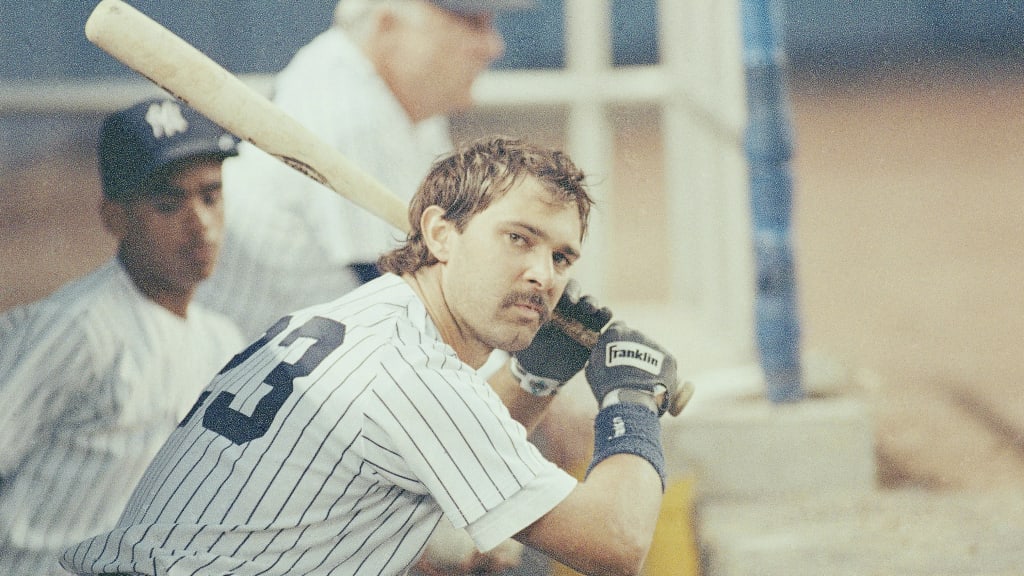
Don Mattingly had received two direct -- albeit confusing -- orders from team brass before reaching the breaking point. Clad in a blue polo shirt, the first baseman was walking toward the dugout when he heard the raspy shouts of an older man.
“Mattingly! I thought I told you to trim those sideburns,” the man shouted. “Go home! You’re off the team -- for good!”
That exchange took place in “Homer at the Bat,” an episode of The Simpsons that originally aired on Feb. 20, 1992. Mattingly’s response to C. Montgomery Burns, the owner of the Springfield Nuclear Power Plant and its softball roster stocked with ringers, remains comedic gold: “Fine. Still like him better than Steinbrenner.”
Even then, the Yankees’ facial grooming policy had become mainstream enough to be lampooned by an animated television sitcom.
Though that changed in the spring of 2025, when managing general partner Hal Steinbrenner announced the team would permit uniformed personnel to sport “well-maintained” beards, it remains a compelling chapter in franchise history.
As the legend goes, its roots grew in 1973, when principal owner George M. Steinbrenner observed his team on the first-base line for Opening Day against the Cleveland Indians.
Steinbrenner was not yet “The Boss,” so new in the role that he could not identify the players by their faces. Instead, he focused upon their hair -- unkempt mustaches, mutton chops and shaggy locks. He scowled, scribbling uniform numbers on a scrap of paper that was urgently dispatched to manager Ralph Houk. Tell these men to get a haircut, Steinbrenner commanded.
Sparky Lyle, Thurman Munson, Bobby Murcer, Fritz Peterson and Roy White all made Steinbrenner’s list that day. Though there would be waves of rebellion over the years that followed (Munson’s 1976 Topps baseball card shows the catcher sporting a full beard, and Goose Gossage’s distinctive Fu Manchu stemmed from an order to shave), the appearance policy was largely abided.
“All players, coaches and male executives are forbidden to display any facial hair other than mustaches [except for religious reasons], and scalp hair may not be grown below the collar,” read a passage in the team’s player manual. “Long sideburns and mutton chops are not specifically banned.”
The policy was strongly influenced by Steinbrenner’s military background; he attended Culver Military Academy in Indiana and served as a second lieutenant in the United States Air Force. When Oscar Gamble arrived for his first spring with the team in 1976, the veteran outfielder had no uniform hanging in his locker. Gamble was told that one would be provided when he trimmed his 10-inch Afro.
“I have nothing against long hair per se,” Steinbrenner told The New York Times in 1978, “but I’m trying to instill a certain sense of order and discipline in the ballclub, because I think discipline is important in an athlete. The players can joke about it, as long as they do it. If they don’t do it, we’ll try to find a way to accommodate them somewhere else. I want to develop pride in the players as Yankees. If we can get them to feel that way and think that way, fine. If they can’t, we’ll get rid of them.”
In August 1991 -- one month after Mattingly recorded his lines for the third-season Simpsons episode -- manager Stump Merrill benched and fined his star first baseman over a refusal to trim his mullet, prompting Mattingly to fume that he was “overwhelmed by the pettiness of it.” While Mattingly and the Yankees resolved their differences, he briefly sported a goatee during his final season in '95.
From Jason Giambi to Johnny Damon to Clint Frazier and Gerrit Cole, the policy remained intact for decades following Mattingly’s final at-bat, an expected requirement that accompanies collecting a Yankees paycheck.
“That's the way it is,” Cole said. “If you're a Yankee, you shave. That's what's up."
George Steinbrenner passed away in 2010, and enforcement of the code was largely handled by Jennifer Steinbrenner Swindal, the club’s vice-chairperson. Hal Steinbrenner’s decision to adjust the policy came after comments from relief pitcher Devin Williams, who expressed reluctance to shave a beard he had maintained for several years.
“Winning was the most important thing to my father,” Steinbrenner said. “If somebody came and told him that they were very sure this could affect us getting the players we want to get … I think he might be a little more apt to do the change than people think, because it was about winning.”