



The White Sox are one of the best turnaround stories in baseball through the first quarter of the season. In fact, they could be one of the greatest improvement cases of all time.
Through play on Tuesday, they are enjoying the third-best win percentage improvement in the Majors (+.152). But widen the scope to include the 2024 season, and if the White Sox maintain this level of play, it would rank as the fourth-best such improvement on record (+.268).
They would trail only the following three teams – two of them from the Dead Ball Era – over a two-year period:
- 1902-1904 New York Giants (+.340)
- 2021-2023 Baltimore Orioles (+.303)
- 1912-14 Boston Braves (+.274)
The White Sox would make the postseason if the season ended today, this after opening the year with 1.2% playoff chances according to FanGraphs’ odds. The Sox are two games above .500 and just two games behind the Guardians for the AL Central lead.
Yes, there are a lot of ifs here. It's still early. But multiple seasons of improvement would suggest this growth is less a fluke and more an upward trend.
How real is it? Let's take a look.
The incredible, early-season bettering of expectations is fueled by offensive improvement. The White Sox are enjoying the fourth-greatest improvement in raw run production.
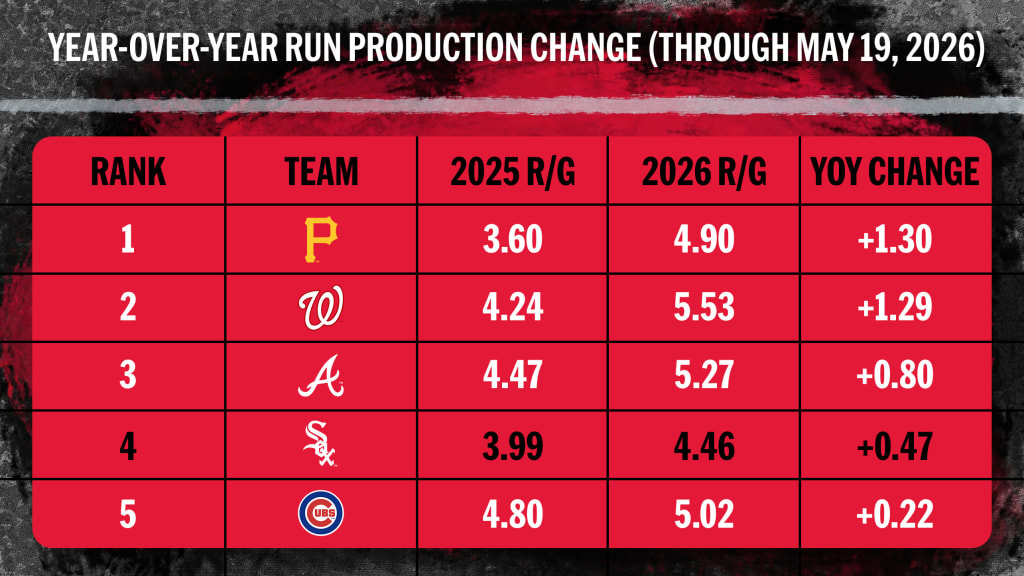
Even more impressive is that the Sox are also enjoying the greatest year-over-year gain in wRC+, a metric that adjusts for ballpark and run-scoring environments.
The Sox improved from an 88 wRC+ mark last season, or 12 percent below league average (ranking 27th in MLB), to a 104 mark this season, which ranks tied for eighth with the Cardinals.
The club's pitching performance is neutral year over year after major strides last season, though young arms like Noah Schultz possess major promise, while Davis Martin is enjoying a huge breakout performance at age 29. So, the big question is whether this 16 percent improvement in wRC+, this major rise in run production, is for real.
The White Sox are specifically being powered by slugging gains. Their 32-point slugging percentage improvement (from .373 to .405) ranks as third best in the Majors. Their 67 home runs are tied with the Braves for second in baseball, trailing only the Yankees (73).
The power growth is likely very real. For starters, it's driven by underlying skills growth. That's real, not fluky.
Per Statcast, the White Sox rank fourth in the Majors in their percentage of fly balls and line drives that are pulled (38.1%). And they rank seventh in their overall percentage of batted balls that are pulled in the air (20.1%). Pulled air balls are the most valuable type of batted ball.
Those figures mark major growth from a year ago, when they ranked 18th and 13th, respectively. And when zooming out to a two-year improvement, the club is enjoying even greater growth -- up from rankings of 27th and 24th in 2024, when just 30.4% of their fly balls and line drives were pulled and just 16.6% of their total batted balls were pulled in the air. This is occurring under a revamped coaching and development staff.
Air-pull rate is a skill that can be improved through coaching, through changes to approach and swing path. This metric also stabilizes quickly, meaning there is more signal than noise, after about 150 batted balls, or about this time of year for a regular. This skill growth looks real.
The White Sox fast swing percentage (27.8%) is up to 13th in the Majors, and their average bat speed (72 mph) is tied for 16th. For comparison, the White Sox were 27th in bat speed last season (71.1 mph) and tied for 23rd in fast-swing percentage (21.0%).
Bat speed gains also show up early in a season and stabilize after just a few weeks of play. These are significant changes.
Much of the production improvement is from returning players under first-year hitting coach Derek Shomon. Like with the Blue Jays last year, coaches and development staff can have a major influence in a short period of time regarding the intent and underlying performance of batters.
Individually, Miguel Vargas is one of the most improved players at the plate this season, having already slugged 11 homers and raised his wRC+ by 37 points to an elite 138 mark. This breakout is supported by an incredible growth in average bat speed -- from 70.6 mph to 73.7 mph. That's a move from the 25th percentile to the 70th.
In his first full season and sophomore campaign, Colson Montgomery is again near a 130 wRC+, having slugged 13 homers. Montgomery increased his air-pull percentage to 29.1%, an elite mark.
Encouraging for long-term prospects is that the Sox field one of the youngest position player groups in the Majors. The average age of players to take plate appearances for the White Sox, weighted by playing time, is just 26. That’s the fourth-youngest mark of any team.
The White Sox don't just enjoy internal improvement but also one of the great value signings of the offseason in Munetaka Murakami, who leads the AL in home runs (17) to go along with a 157 wRC+. Signed to a two-year, $34 million deal this past winter, there were doubts about whether Murakami would make enough contact. MLB teams are also generally hesitant these days to invest in corner players with slug-first skills.
There were a number of skeptics, but some public projection systems like OOPSY were bullish on Murakami translating his elite NPB production to the Majors as a 130 wRC+ hitter. Perhaps teams should have paid a little more attention to Murakami's bat speed (75.2 mph), batted-ball quality and plate discipline.
The most successful guys with high whiff have found success by both walking a lot and hitting a lot of homers. ... Fortunately, Murakami does both of those things at an ELITE level.
Murakami's batted-ball quality is so good it's allowing the lefty slugger to overcome poor contact rates. His fly-ball percentage (47%) ranks in the 88th percentile of MLB hitters. Pair that with his 99th percentile exit velocity (95 mph), and 98th percentile barrel rate (22%), and that is the recipe for how to lead the AL in home runs.
Moreover, his 6.4% infield fly ball percentage ranks in the 75th percentile, impressive for a fly-ball heavy hitter. That lower rate is helping keep his batting average respectable (.240) for a modern-day power hitter despite an elevated strikeout rate (32.5%). A pop-up is essentially an automatic out with no chance for runners to advance, much like a strikeout.
Murakami’s elite batting eye (98th percentile walk rate) also gives him a high offensive floor. Yes, it's unusual to be productive with such a poor contact rate -- but when batting eye and batted-ball quality are pushing the 100th percentile, a batter can still be a productive middle-of-the-order force.
There are those in the organization who believe Murakami is bringing a valuable intangible presence to the lineup, taking pressure off of the younger players, including Chase Meidroth and rookie table-setter Sam Antonacci, who have helped lengthen the lineup
There's still a lot of baseball to play, of course. The White Sox are still judged to be longshots by playoff forecasts. But the bats are very improved, look very real, and the growth might just be getting started.
Whether or not the Cinderella story continues into a September playoff chase, or even October, the White Sox are on the way up.