





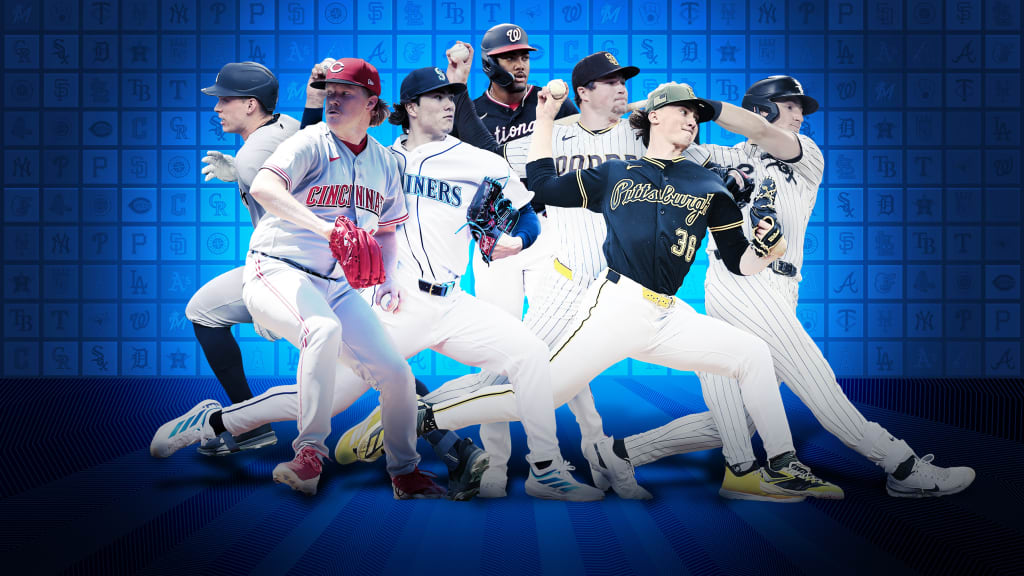
We say it every year, and it bears repeating again: the Draft is hard. Front offices spend years scouting and analyzing a particular Draft class, but even the best baseball minds can’t predict what will happen with absolute certainty in the years after.
Take the 2021 class ahead of its five-year anniversary this summer.
More from MLB Pipeline:
• Top 100 prospects | Stats | Video | Podcast | Complete coverage
The story at the time was about big-name prep shortstops (Marcelo Mayer, Jordan Lawlar, Kahlil Watson), Vanderbilt righties (Jack Leiter, Kumar Rocker) and the Louisville catcher who went first overall (Henry Davis). As things stand today, the theme is undervalued college arms. Of the top seven in career bWAR entering Wednesday, five are former collegiate pitchers taken outside the top 20 picks, including second-rounder Andrew Abbott (12.3), fifth-rounder Tanner Bibee (8.2) and third-rounder/all-world closer Mason Miller (6.6).
Keep all of that in mind as we look at each club’s best 2021 Draft pick, while considering both past performance and future projection:
Jump to: AL East | AL Central | AL West | NL East | NL Central | NL West
AMERICAN LEAGUE EAST
Blue Jays: Matt Svanson, RHP (13th round)
Third-rounder Ricky Tiedemann still has the most upside of anyone in this group, but while we wait for him to be healthy at a consistent level and debut in the bigs, we go 10 rounds later to Svanson, who was taken as a $50,000 senior sign out of Lehigh. The right-hander was traded to the Blue Jays two years later for Paul DeJong and joined the St. Louis bullpen last year when he posted a 1.94 ERA and 0.88 WHIP with 68 strikeouts in 60 1/3 innings. His sinker-sweeper-cutter mix has been pounded more in Year 2, but his early success still pops among a Blue Jays class that has produced only two Major Leaguers so far (Gunnar Hoglund being the other).
Orioles: Colton Cowser, OF (first round)
The Orioles took Cowser out of Sam Houston with the No. 5 overall pick and saved some money doing so, signing the No. 10-ranked prospect for more than $1.25 million under slot. He reached the big leagues for the first time in 2023, then broke out in his first full season in 2024, hitting 24 homers to finish as the runner-up in American League Rookie of the Year Award voting.
Rays: Carson Williams, SS (first round)
This is still an upside pick, much as it was when Tampa Bay took the San Diego-area prep shortstop 28th overall five years ago. Williams’ power-speed combination and his defensive skill at a primary position made him a mainstay on Top 100 Prospects lists right up until his graduation this spring, but the holes in his swing continue to be an issue at the top level with a career 40 percent strikeout rate in the Majors entering Wednesday. Still only 23, Williams has time to make adjustments and hit his ceiling as a toolsy shortstop, and that gives him an edge over Kyle Manzardo (second round) and Mason Montgomery (sixth round) here.
Red Sox: Marcelo Mayer, SS (first round)
MLB Pipeline's top-rated prospect in the 2021 Draft, Mayer fell into the Red Sox's lap with the fourth overall pick (their earliest since 1967) and signed for a franchise-record $6,664,000. Described as a potential combination of Corey Seager's bat and Brandon Crawford's glove, the California prep product starred throughout the Minors but still is establishing himself in the big leagues, batting .219/.273/.346 with six homers in 92 games at ages 22 and 23 the last two years.
Yankees: Ben Rice, C (12th round)
Rice flew under a lot of scouting radars because he played in just 30 games in three years at Dartmouth because the pandemic truncated the 2020 season and cancelled the 2021 Ivy League schedule. The Yankees scouted him in summer ball both those years and stole him in the 12th round. After improving his ability to manage the strike zone and drive balls in the air as a pro, he slammed 26 homers in his first season as a big league regular in 2025 and currently leads the American League with a .615 slugging percentage.
AMERICAN LEAGUE CENTRAL
Guardians: Tanner Bibee, RHP (fifth round)
The Guardians drafted 40 percent of their current rotation in 2021, grabbing Gavin Williams in the first round and Bibee 133 selections later. Known more for his strike-throwing than his stuff at Cal State Fullerton, Bibee followed Cleveland's mandate to throw with more intent and added 3-4 mph to all of his pitches in his first pro season. He cracked the big league rotation in early 2023 and has gone 34-30 with a 3.72 ERA and 545 strikeouts in 561 innings since.
Royals: Carter Jensen, C (third round)
Kansas City made headlines for taking Frank Mozzicato seventh overall five years ago, but the savings used on signing the Connecticut prep lefty allowed the group to sign local products Ben Kudrna and Jensen for above slot in the second and third respectively. It’s Jensen who has emerged as the best talent from this class as he methodically developed both sides of his game to become a well-rounded backstop. After a loud debut in 2025, he’s been quieter offensively to begin his age-22 season, but the potential is still there for him to take up the primary catching torch from Salvador Perez in KC.
Tigers: Jackson Jobe, RHP (first round)
The Oklahoma native was the first prep player off the board when Detroit selected him third overall in 2021, and with his high-spin breaking stuff and impressive fastball velocity, he was one of the top pitching prospects in baseball for much of his time in the Minors. Jobe debuted in 2024, pitched twice during the Tigers’ magical postseason run that fall and made 10 starts last year before needing Tommy John surgery. He threw a bullpen as recently as Tuesday as part of his rehab, and while TJ recovery still doesn’t have a perfect record, Jobe’s arm talent is too good to ignore when healthy. A special mention should go to seventh-rounder Brant Hurter, who has been a key piece of Detroit’s bullpen since ‘24.
Twins: David Festa (13th round)
Six members of the Twins’ Draft class in 2021 have at least touched the big leagues, though not all of them have come with Minnesota (first-rounder Chase Petty netted them Sonny Gray). In terms of bang for the buck, look no further than Festa, the Verona, NJ, native taken on Day 3 of the Draft out of Seton Hall. He signed for $125,000 and registered double-digit big league starts in 2024 and 2025, though a shoulder injury has kept him on the shelf.
White Sox: Colson Montgomery, SS (first round)
A baseball and basketball star as an Indiana high schooler, Montgomery drew repeated comparisons to Corey Seager as a big-bodied, lefty-hitting shortstop before the White Sox drafted him 22nd overall. He flew through the Minors until stalling at Triple-A in 2024-25, then found his power stroke when summoned to Chicago last July. He has homered 34 times in his 123 big league games while slashing .232/.316/.503.
AMERICAN LEAGUE WEST
Angels: Chase Silseth, RHP (11th round)
While first-rounder Sam Bachman has established himself as a solid part of the Angels’ big league bullpen, we’ll give the nod to Silseth, who was a bit of a surprise over-slot signing ($485K) to kick off the Angels’ Day 3 effort in their all-pitching Draft. Silseth was rushed to the big leagues as a starter in 2022 but is now hanging out with Bachman in the bullpen and has an ERA under 2.00 in 2025 and so far in 2026.
Astros: Spencer Arrighetti, RHP (sixth round)
Arrighetti pitched at three colleges in three years, relieving at Texas Christian in 2019 before starting at Navarro (Texas) JC and Louisiana-Lafayette the next two seasons. After taking him in the sixth round, the Astros helped him add 3 mph to his fastball and upgrade his slider, significantly raising his ceiling. He led American League rookies with 171 strikeouts in 2024, missed most of last season with a broken right thumb and rebounded this year to go 6-1 with a 1.32 ERA in his first seven starts.
A’s: Mason Miller, RHP (third round)
One of eight big leaguers from this class, Miller’s story is a movie script waiting to happen. Nearly done playing at Division III Waynesburg University in Pennsylvania, he was diagnosed with Type 1 juvenile diabetes. Once discovered and treated, he added weight and strength, started throwing harder, transferred to Division I Gardner-Webb and pitched his way into the third round. He missed nearly all of 2022 and didn’t pitch a ton in ‘23, though he did make it to the big leagues. The 2024 season was when he started to emerge as one of the most dominant closers in the game, before getting shipped to the Padres at the 2025 Trade Deadline, where he has become completely unhittable.
Mariners: Bryan Woo, RHP (sixth round)
The Mariners got both Woo in the sixth and Bryce Miller in the fourth of this Draft and deserve kudos for both. Woo was particularly impressive because he had Tommy John surgery in April of that season at Cal Poly, and Seattle was able to sign him and rehab him in house. He returned to the mound in 2022 and reached the big leagues just a year later, and outside of some injury issues in 2024, he’s been a mainstay in the rotation since, earning his first All-Star nod and getting Cy Young Award votes in 2025. He has the third-highest bWAR (7.8) of any member of the 2021 Draft class.
Rangers: Jack Leiter, RHP (first round)
The 2021 Draft's top-rated pitching prospect, Leiter no-hit South Carolina in his first Southeastern Conference start, tied Vanderbilt teammate Kumar Rocker for the NCAA Division I strikeout lead with 179 in 110 innings and helped the Commodores reach the College World Series finals. The No. 2 overall pick that July, he struggled with his command early in his pro career and got pounded for an 8.83 ERA in his first taste of the Majors in 2024. He finished second among rookies with 10 wins and 148 strikeouts last year and has gone 2-4 with a 4.75 ERA in 11 starts this season.
NATIONAL LEAGUE EAST
Braves: Spencer Schwellenbach, RHP (second round)
Schwellenbach won the John Olerud Award for college baseball’s best two-way player in 2021, and there were plenty of teams who liked him as a shortstop. He didn’t pitch at Nebraska until that year because of a previous elbow injury, serving as the Cornhuskers’ closer. He had the stuff to start, and the Braves developed him as such. He’s on the shelf right now rehabbing from bone chip removal from that elbow, but when he’s healthy, he’s been very effective in the rotation, with a career 3.23 ERA, 1.007 WHIP and .222 BAA over 38 starts.
Marlins: Joe Mack, C (supplemental first round)
The second prep catcher selected (31st overall) in 2021, Mack struggled offensively for most of his first three pro seasons. The New York high school product then turned his career around when he started to hunt fastballs early in counts, leading to 45 homers in 2024-25 while he also established himself as one of the best defensive backstops in the Minors. Called up to Miami for the first time earlier this month, he batted .211/.262/.263 in his first 19 games in the Majors.
Mets: Christian Scott, RHP (fifth round)
The Mets’ decision to select Kumar Rocker 10th overall and then not sign him after reviewing his medicals was one of the stories of the 2021 Draft. Five years later, it looks like the club got its rotation option four rounds later anyway. Coming off Tommy John surgery in late 2024, Scott has been one of the Mets’ bright spots in 2026 with a 3.20 ERA and 30 strikeouts in six starts (25 ⅓ innings) while relying mostly on a four-seamer, cutter and sweeper in his mix. Eighth-rounder Mike Vasil deserves mention too after a stellar rookie year out of the White Sox bullpen in 2025 before he needed his own TJ this spring.
Nationals: Daylen Lile, OF (second round)
On many nights over the last two years, you may have seen 2021 picks take up all three starting outfield spots for the Nats in Lile, seventh-rounder Jacob Young and Padres selection James Wood (more on him later). Young has blossomed into one of the best defensive center fielders in baseball, but we’ll go here with Lile, who is proving to be a centerpiece of Washington’s upstart offense and an improved defender himself in left. The former Louisville high-schooler finished fifth in NL Rookie of the Year voting in 2025, and he remains league-average to slightly above (depending on the metric) in his sophomore campaign.
Phillies: Andrew Painter, RHP (first round)
He’s still figuring things out in his rookie year, but his last three starts have been particularly solid (five earned runs over 17 1/3 IP for a 2.60 ERA while filling up the zone) to get him into positive WAR territory. It’s been such a long journey, with him missing two full years of regular season competition and development, that it’s easy to lose sight of the fact that the 6-foot-7 right-hander is still just 22 years old for all of the 2026 season.
NATIONAL LEAGUE CENTRAL
Brewers: Sal Frelick, OF (first round)
Entering Wednesday, Frelick’s 394 career games played and 1,358 at-bats were most of anyone from the 2021 Draft class, and since his debut on July 22, 2023, he ranks third among all Brewers Major Leaguers in both categories. The Boston College product’s availability is only part of the story of course. Frelick already has a Gold Glove award from 2024, and he appeared to take a step forward offensively in 2025 with a .288/.351/.405 line and career-high 12 homers over 142 games. Though much of the data under the hood is similar and even improved in terms of overall contact, his offensive performance hasn’t been at the same level early in ‘26, but that isn’t enough to knock Frelick from being Milwaukee’s everyday right fielder.
Cardinals: Michael McGreevy, RHP (first round)
Joshua Báez has the high-slugging upside to overtake this spot, as he’s shown recently, but McGreevy is also in the midst of his best Major League season yet, one in which he’s become St. Louis’ best starter. A control artist dating back to his days at UC Santa Barbara, the right-hander has a 2.98 ERA and 1.09 WHIP despite only striking out 43 through 60 ⅓ innings. He throws seven different pitch types to keep batters uncomfortable, and with just a 5.5 percent walk rate in 2026, he doesn’t beat himself with free passes.
Cubs: Jordan Wicks, LHP (first round)
Wicks went from an unheralded recruit to setting Kansas State records for single-season (118) and career (230) strikeouts and becoming the first college left-hander drafted (21st overall) in 2021. He breezed through the Minors and went 4-1 with a 4.41 ERA in seven starts with the Cubs at the end of 2023. He hasn't been able to sustain that success, logging a 6.40 ERA in intermittent big league action since.
Pirates: Bubba Chandler, RHP (third round)
The Pirates’ strategy to save money on taking Henry Davis No. 1 overall while aggressively going after high-end high school talent with their next three picks hasn’t worked out perfectly. Chandler, still only 23, has a chance to be the standard-bearer for the class. The super-athletic former two-way player has more than enough stuff to get big league hitters out (9.0 K/9 and a .206 BAA in his brief career to date), though he’ll have to find a way to command the ball better to stay in games longer and remain in a rotation long-term.
Reds: Andrew Abbott, LHP (fourth round)
Matt McLain was the Reds’ first-rounder in ‘21, and he’s a solid big leaguer, but Abbott is the real story here. Abbott bet on himself, going back to Virginia to start for his senior year after being a reliever for his first three seasons. The gamble paid off as he was a quality senior sign by the Reds and he’s made at least 20 starts in each of the last three seasons, earning an All-Star nod -- and Cy Young votes -- last year while currently leading the overall Draft class with 12.3 WAR.
NATIONAL LEAGUE WEST
D-backs: Chad Patrick, RHP (fourth round)
There still might come the day when Jordan Lawlar fulfills the promise he showed as the sixth overall pick and a former Top 100 prospect, but he hasn’t found established big-league success in part due to injuries (the latest being a broken right wrist). We turn instead to Patrick, who signed for $350,000 out of Purdue, was traded twice in 2023 and has found a place on the Brewers pitching staff -- first as a starter last year and as more of a swingman in ‘26. Patrick enters Wednesday with a 2.63 ERA this season, 20th-best among 130 Major Leaguers with at least 40 frames.
Dodgers: Justin Wrobleski, LHP (11th round)
Wrobleski bounced from Clemson to the State JC of Florida (Manatee-Sarasota) to Oklahoma State in three years of college and had Tommy John surgery two months before the 2021 Draft, yet still landed an over-slot $197,500 bonus. He got stronger during his rehab and came back with improved velocity to go with his advanced feel for spin. A World Series hero last fall with four critical scoreless appearances against the Blue Jays, he has settled nicely into the middle of the Dodgers' rotation this season, going 6-2 with a 3.07 ERA in eight starts and one relief appearance.
Giants: Landen Roupp, RHP (12th round)
Roupp didn't light up radar guns but starred for four seasons at UNC Wilmington, and the Giants liked his ability to spin the ball enough to sign him for $75,000 as the 356th overall pick in 2021. He has been one of San Francisco's best pitchers since making the club's 2024 Opening Day roster, posting a 13-14 record and 3.61 ERA with 217 strikeouts in as many innings.
Padres: James Wood, OF (second round)
We could be debating who was the better pick from the Padres’ 2021 crop for years to come. Jackson Merrill went first at 27th overall, but it was Wood who signed for more ($2.6 million vs. $1.8 million) as San Diego’s second-round selection. The two were close during their brief time together in the farm system before Wood was traded to the Nats in the Juan Soto blockbuster, and while Merrill emerged first with a tremendous rookie year in 2024, Wood hasn’t just closed the gap, he seems to have passed it with some of the best pure, all-fields slugging ability in the game at just 23 years old. The lefty hitter is well on his way to another 30-plus-homer season in DC with career bests in all three slash-line categories if current trends hold, while Merrill’s bat has taken a step back in Year 3.
Rockies: Hunter Goodman, C (fourth round)
Goodman’s carrying tool coming out of the University of Memphis was his tremendous raw power, but there were questions about his ability to get to it at this level, as well as his chances to stick behind the plate defensively. While his approach is far from pristine, he answered the first question with 31 homers en route to an All-Star nod and Silver Slugger Award a year ago, and he’s tied for eighth in the NL with 12 dingers this year. As for the second question, he may never win a Gold Glove, but he caught over 100 games last year and should be a serviceable backstop moving forward.