


In many places on many days in March and April, the conditions, to paraphrase W.C. Fields, ain’t fit for man nor beast nor baseball.
And yet early storylines always emerge that make us feel warm and fuzzy, regardless of whether the sun cooperates.
You could actually field a full team of feel-good stories in 2026, so let’s do that here.
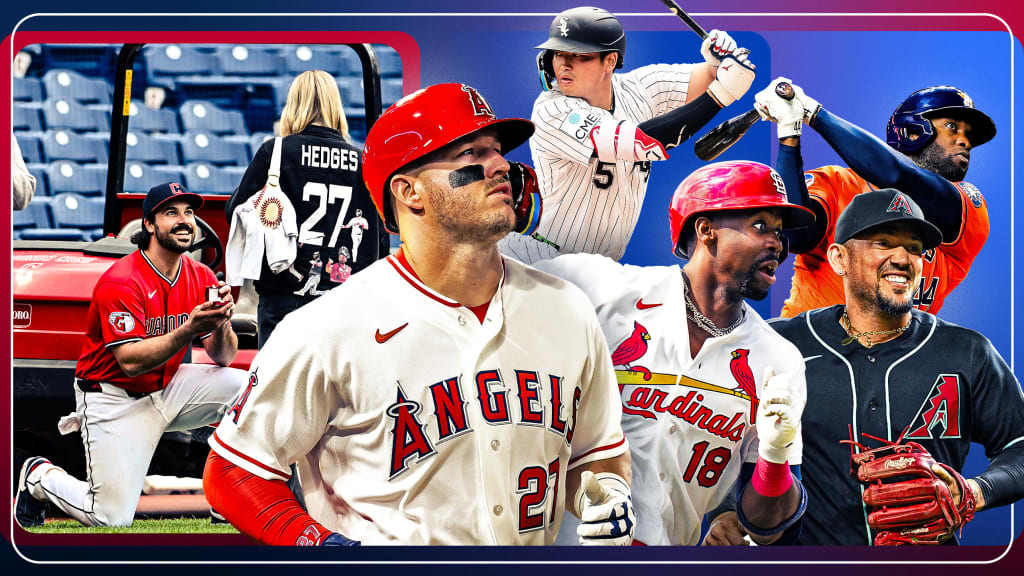
Catcher: Austin Hedges, Guardians
How good of a defensive catcher and clubhouse presence is Hedges? So good that, even as he hit a combined .185 in his first 11 seasons, teams kept giving him money and playing time.
So it’s been fun to watch Hedges have a meaningful breakthrough with the bat. His average (81 points) and on-base percentage (58 points) are both well above his norm. It doesn’t seem a coincidence that the Guardians are 9-0 when Hedges starts and 5-12 when he doesn’t. And he even got engaged on the field after a recent win! A fun start for a tremendous pro.
First base: Munetaka Murakami, White Sox
The prevailing media opinion going into the offseason was that Murakami, the all-time single-season home run leader for a Japanese-born player in Nippon Professional Baseball, could command a nine-figure contract in his move to MLB. He wound up signing a two-year, $34 million deal with a White Sox team coming off 102 losses. Not exactly high profile.
There were big concerns about Murakami’s swing-and-miss issues, and those issues are real. But so is his power. After tying the MLB rookie record with a homer in five straight games, Murakami has 10 on the season. While the 30.8% strikeout rate could catch up with him before long, it hasn’t so far. The guy referred to as a baseball “god” in Japan has been an early-season sensation for a South Side squad that’s become much more watchable.
Second base: Nico Hoerner, Cubs
There was a lot of trade buzz surrounding Hoerner in the offseason after the Cubs signed Alex Bregman. With Hoerner a season away from free agency and the infield newly crowded, it made sense to at least field calls.
Instead, the Cubs wound up extending Hoerner to the tune of $141 million over six years. That was a big commitment to a player whose biggest assets were a dynamic glove, a steady-but-not-spectacular bat and an emerging leadership presence behind the scenes. But now, the respected Hoerner is turning heads with his power: He’s already hit four homers, just three shy of his 2025 total.
Shortstop: Otto Lopez, Marlins
Prior to moving to Montreal as a child when his father got a teaching job there, Lopez’s only baseball experience had come on the streets in his native Dominican Republic, using an empty water cup as a ball. But he played organized ball for the first time in Canada, returned to his native D.R. for a year as a teenager to train further and wound up getting signed by the Blue Jays.
Alas, Lopez was put through the professional wringer from there. Both the Blue Jays and Giants designated him for assignment before the Marlins picked him up on waivers two years ago. He played for the Fish each of the past two years, but his offensive numbers didn’t jump off the page until now. With a .315/.366/.511 slash to go with his terrific range and speed, Lopez looks like a keeper.
Third base: Max Muncy, Dodgers AND Max Muncy, A’s
Just prior to the season, we ran my annual (inaccurate) guesses on the top 10 lineups in MLB (please ignore most of that, especially the Mets), and a reader e-mailed to inform me I had mistakenly listed Max Muncy on the A’s. When I wrote back to tell him that there are, indeed, two third basemen in MLB named Max Muncy, it felt like I was laying out some kind of weird conspiracy theory.
But no, it’s true. Two guys named Max Muncy, at third base and in the state of California … and they even have the same birthday (Aug. 25, 12 years apart). It’s a great sport, isn’t it, folks? And in 2026, this has morphed from fun fact to fruitful one. Because the younger Max Muncy (the A’s one) has two triples among his nine extra-base hits, emerging as a productive player. Kinda like Max Muncy!
Left field: Austin Martin, Twins
Much more was expected of Martin than we had seen entering 2026. His elite contact, as well as his power, speed and instinctive baserunning, made him a premier Draft prospect at Vanderbilt, and his college coach Tim Corbin compared him to Michael Jordan in terms of his cutthroat competitive disposition. The Blue Jays took him fifth overall, only for Martin to put up tepid offensive numbers in five Minor League seasons and ultimately get pigeonholed as a platoon player in the bigs.
A different Martin is emerging early on in his age-27 season. Though he continues to primarily play against lefties, he’s making a case for a more pronounced role with a team-best .311 average and .492 on-base percentage.
Center field: Mike Trout, Angels
Just typing “CF” next to Trout’s name felt good. And it’s felt doubly good watching him look like Mike Trout. In his prime, Trout’s greatness was methodical, not extravagant. He never had one of those Aaron Judge seasons that knock you over the head. Never topped 45 homers or 111 RBIs. Often led the league in rate stats and WAR but rarely counting stats aside from runs. His superpower was the orderly nature of his impact in every facet of the game.
Then Trout started getting hurt a lot, and a new generation of baseball fans could be forgiven if they didn’t understand what all the fuss was about. But now, in Trout’s age-34 season, they’re getting a true taste of what we loved about Trout. He’s ripping extra-base hits, swiping bags, playing center and, yes, leading the AL in runs (25) as I type this. You were missed, Mike.
Right field: Jordan Walker, Cardinals
It would be nice if player development timelines perfectly aligned with our expectations, but baseball doesn’t really work that way. It sure didn’t work that way for Walker, who in 2023 was listed by MLB Pipeline and many others as a top-five prospect in all of MLB. Our prescription at the time was that Walker “should hit enough to feature anywhere [in the lineup] and might not need much more offensive seasoning in the Minors.”
Unfortunately, Walker proceeded to post a .680 OPS in his first 1,039 plate appearances across three seasons and did, in fact, require more seasoning … as well as an overhaul of his swing mechanics. And now we’re seeing a more disciplined hitter whose .292/.357/.607 slash and eight homers have been a big bright spot. Walker turns 24 next month. Turns out, he’s right on time.
Designated hitter: Yordan Alvarez, Astros
Since his 2019 arrival, Alvarez’s offensive production, as measured by OPS+, is second in MLB only to Aaron Judge (166 vs. 186). But persistent and various injury issues limited Alvarez to two games in the shortened 2020 season, 114 in 2023 and just 48 last year. In limited time in 2025, Alvarez was not the dynamic offensive force he had been, and that’s understandable given that he was navigating a power-sapping injury to his hand.
Any doubts that Alvarez could return to an elite level have been quickly and convincingly erased here in 2026. The bat speed, discipline and pure power that made him one of the Astros’ great scouting success stories are all back with a vengeance, and he enters the weekend with an MLB-best 11 homers and 1.245 OPS.
Utility: Ildemaro Vargas, Diamondbacks
“Journeyman utility player” might be the least sexy job description in MLB, and it applied to Vargas entering 2026. He was signed as a teenager in Venezuela by the Cardinals and spent seven years in their Minor League system before latching on with the Bridgeport Bluefish in indy ball. The D-backs signed him out of the Atlantic League in 2015 and he bounced around with various teams, getting part-time big league opportunities.
Finally, here at age 34 and back with the D-backs, a breakout. A big one. Vargas had a two-homer game this week and enters Friday with an out-of-nowhere .357/.375/.671 slash in 18 games.
Starting pitcher: José Soriano, Angels
It’s no secret the Angels have struggled to develop or otherwise acquire premier pitching. So watching it emerge virtually out of the blue in the form of Soriano has been a blast.
Soriano was an accomplished arm coming into this year, having logged an ERA+ that was 9% better than league average over his first 91 career appearances. And you didn’t have to squint too hard at his fastball to know it was potentially special.
But no one saw this coming. Soriano is six starts into his season and has given up just one run. His 0.24 ERA is the lowest in a pitcher's first six starts of a season since earned runs became official in both leagues (1913). The late bloom of this two-time Tommy John recipient has been breathtaking.
Relief pitcher: Louis Varland, Blue Jays
We could salute the absurd Mason Miller here, but we already knew he was an elite closer with an amazing back story (a Division III product) coming into 2026.
Instead, let’s highlight Varland, for the simple fact that he and his arm are both still intact after a 2025 postseason in which he set a record with 15 appearances, totaling 16 innings. It looked like the Blue Jays were running their midseason trade acquisition into the ground in pursuit of a title, but Varland has hit the ground running this year with 13 innings without allowing an earned run across 12 appearances, 19 strikeouts and only three walks.
Apparently, despite all the wear and tear of October, Varland still feels good. And that makes us feel good.