



Brandon Marsh is a fine baseball player. A second-round Draft pick out of high school by the Angels in 2016, Marsh has spent most of the last five seasons roaming the outfield for a Phillies team that has been one of the most successful in the game over that time. He’s played in a World Series, and played well, posting a .913 OPS in Philadelphia’s 2022 loss to Houston. Quietly, after a slow start last season, he’s spent the last-year plus being a top-30 hitter in the game.
A fine player, indeed.
Yet for all the work Marsh has done in this sport, he’s never received a Most Valuable Player vote or appeared in the All-Star Game. He’s more often been a platoon player than a full-time, everyday starter. He’s not exactly at “never has to buy a drink in Philadelphia again” territory, though he and his beard are likely to be well-remembered enough that he’ll get a nice discount on Broad Street should he ever come back to visit.
All of which is to say: Marsh is putting together a nice career, yet you wouldn’t exactly expect him to appear between two of baseball’s sepia-toned legends on an all-time leaderboard (at least since 1913, when this data begins). Yet that’s exactly where he finds himself, ahead of every other National League hitter to ever get 2,000 plate appearances, and behind only the legendary Ty Cobb overall.
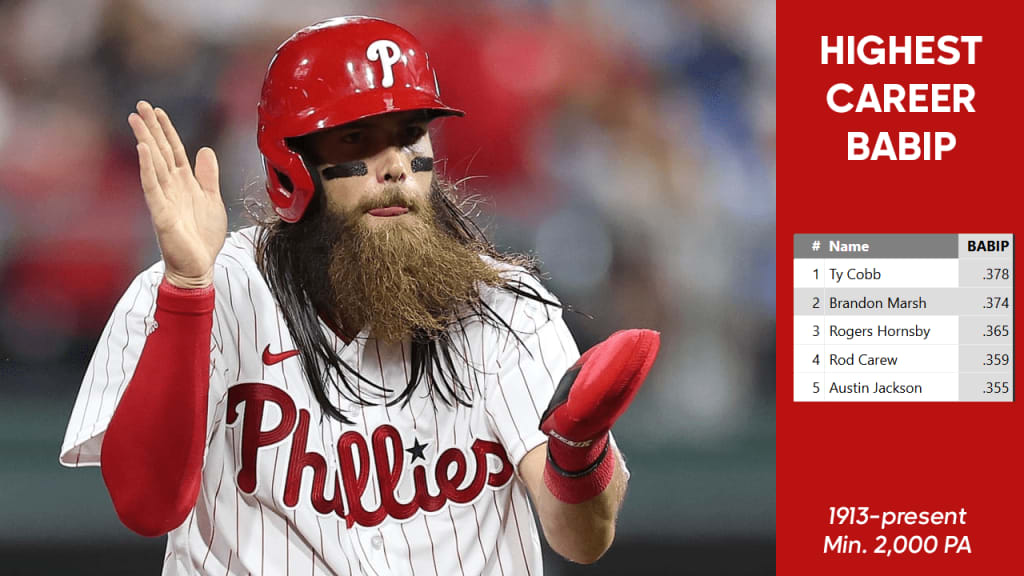
Mays, Mantle, McCovey, McGwire, no. Marsh ... yes.
This is Batting Average on Balls In Play, which is exactly what it sounds like. If regular, garden-variety batting average is about how many hits you get out of times to the plate (excluding walks, hit by pitch, and sacrifice flies), then BABIP adds the “In Play” component by removing strikeouts and home runs, too. The point being – these are at-bats where you make contact and the ball doesn’t leave the park. In theory, the defense is able to make a play on all of these chances. What’s your average then?
It has, traditionally, been used as a proxy for ‘luck,’ though it’s a little more nuanced than that. While speedy runners can’t outrun a fly ball to center, they can certainly beat out a few more infield hits than their slower colleagues. If you hit the ball so hard that fielders simply don’t have time to get to it, and they’re forced to position themselves differently, that can have an impact, too, as we saw with Aaron Judge last year.
But also, yes, at times it can be luck, and used to project forward. Detroit’s Riley Greene is an established player having an excellent year. He’s also absolutely not going to keep running a .436 BABIP all year, which would be the highest in baseball history by a lot. It essentially cannot happen. It’s as close as a guarantee you’ll find.
While the Major League average has been around .295 for years – though this year is the lowest since 1992, thanks largely to excellent defensive skill and positioning – Marsh has never been below .348, not once, once getting as high as .403, back in 2021. That’s another way of saying that in that year, 40 percent of his non-homer contact found grass, or dirt – but not gloves. (This season, he's at .394, entering Friday night's series opener at Dodger Stadium.)
Over the last five seasons, here’s the full list of players to have a BABIP of .348 or better in each year, in seasons of 250-plus plate appearances:
- 5, Marsh
- 4, absolutely no one
- 3, no one here either
- 2, a handful of hitters
So what, exactly, is this special skill that Marsh has that no one else seems to possess?
It’s not speed, mostly. While he once had elite speed (94th percentile as a rookie) and is still above-average now (74th over the last three years), that alone isn’t the draw here. Similarly, he’s plus-but-not-elite at hard-hit skills, too. It’s probably not that. “Above-average speed and above-average hard-hitting” makes for a good baseball player, but lots of players fit that description.
It’s this. It’s this play right here.
It’s this, too.
Those are hardly booming blasts. Marsh, however, is not a Luis Arraez-level bat control savant – quite the opposite, actually. Marsh’s career strikeout rate of 30.6% is about five times as high as Arraez’s 5.9%, though there’s something interesting in that, too. For the first four years of Marsh’s career, he was one of baseball’s biggest whiffers, north of 30% each year. Last year, that was cut to 25.9%. This year, he cut it further to 21.6%. For the first time, he’s striking out less than Major League average – though it’s come with a large drop in walk rate, too.
It hasn’t changed the BABIP numbers at all, and you’d have thought it might. After all, BABIP excludes strikeouts, and while a Marsh strikeout and an Arraez groundout to second might not have much difference on the field, it would make all the difference here. It hasn’t. It hasn’t mattered.
What Marsh appears to do best is to hit the ball hard, but not too hard – to be difficult to play defense against. Over the last five seasons, more than 200 batters have put at least 800 non-homer batted balls into the world. Looking at Statcast’s estimated success rate – which grades each opportunity by difficulty, mostly by time and distance needed, only four batters have created opportunities more difficult for fielders than Marsh has.
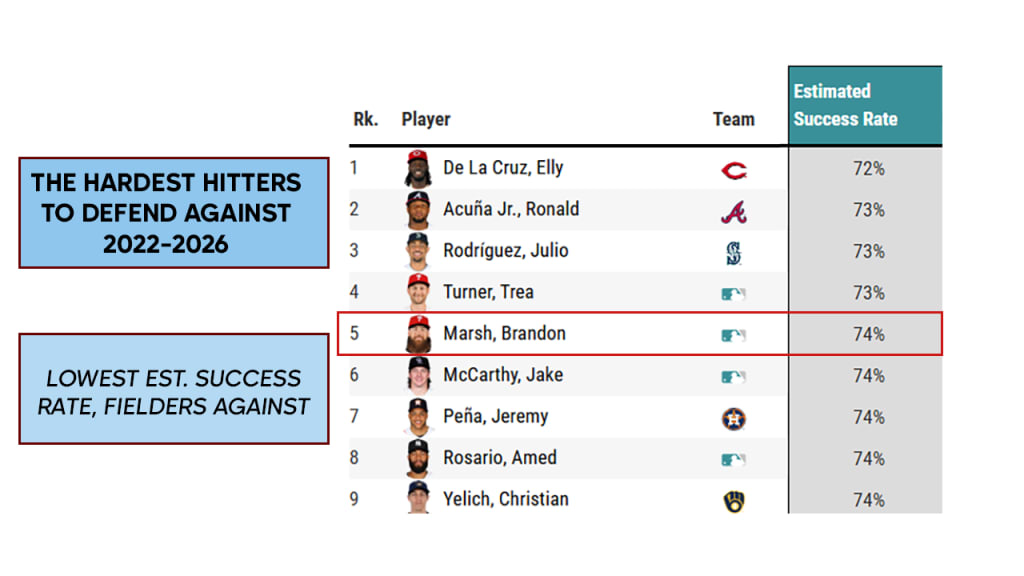
Even that comes with a caveat. De La Cruz is a speedy switch-hitter, which is a different positioning animal entirely. Rodríguez and Acuña Jr. are more of the traditional power-speed stars you’d expect. Turner, Marsh’s teammate, is now and seemingly forever blessed with elite speed. (On the other end, you'll find dead-pull lefties at 84%, like Max Muncy or Marsh's teammate Kyle Schwarber. Good hitters, yet not hard to defend.)
Then there’s Marsh, tied with a few others for giving fielders the fifth-hardest chances to make – which, again, they largely do not. You can’t after all, do a whole lot about this:
… or this.
What Marsh does, a little, is to be hard to position against by having very few noticeable tendencies in his hitting profile.
While Schwarber is a boom-or-bust, dead-pull hitter, Marsh is average or close to it in most ways you can slice it: grounders, pull-side, this way, that way, etc. You could use Marsh’s career spray chart as a stand-in for showing what the Major Leagues as a whole do, with one exception – his popup rate is less than half the average, and that’s key here, because popups are basically strikeouts, in terms of how likely they are to become hits. (They have an .014 average the last two seasons. Don’t hit popups.)
But more than anything, it’s about what Marsh does that’s most like a pair of very, very unexpected comparables: Freddie Freeman and, yes, Arraez.
Freeman is a nine-time All-Star, almost certainly headed to the Hall of Fame, known best for whatever version of “being a pure hitter” you’d like to apply. Arraez isn’t going to Cooperstown, but he’ll always be remembered as one of the greatest bat-to-ball hitters who ever lived.
What they do is simple to explain, if difficult to execute. They hit the ball at the right angles. Not too high, which would carry flies and liners to waiting outfielders. Not too low, which would end up with balls hit to middle infielders. They’re experts at the right kind of “get it over the infield” hits that are nearly impossible to defend, because the average center fielder starts 324 feet deep, and the average middle infielder starts 149 feet deep, and there’s a lot of room in between there.
While the phrase "launch angle" gets a little overused, it’s also the only way to describe what’s happening here. If 0° is right back at the pitcher, and anything over 40° gets into popup land, you might want to get into the sweet spot of that range. Like, say, between 8° and 32°, which as this image shows, is the Goldilocks zone – not too high. Not too low.
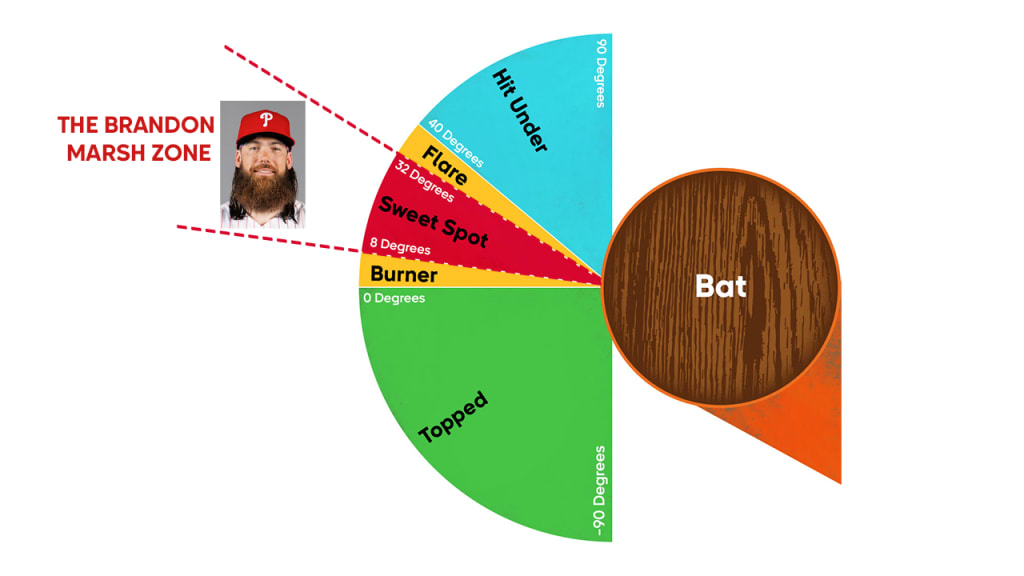
Over the last five seasons, there’s 200 players with at least 1,000 batted balls. No one has a higher rate of getting it into that launch-angle sweet spot than Freeman, which makes sense. Fourth is Arraez, which also tracks, given his lack of power. In the middle, second on the list? Brandon Marsh. Fine player. Elite at … this.
Who has the highest rate of batted balls in the launch angle sweet spot?
- 44.0% Freeman
- 42.0% Marsh
- 41.6% Josh Jung
- 41.5% Arraez
- 41.4% Mike Trout
- Batted balls between 8° and 32°. Min 1,000 batted balls, 2022-'26.
All three have steeper-than average swing paths, which helps with that profile. If you want to go so far as to say “the only thing keeping Marsh from being Freeman or Arraez is that he strikes out too much,” well, we might not go all the way with you, but it wouldn’t be completely far off, either.
Marsh, unlike anyone in recent times, has hacked the luck stat. For most anyone else, it tells you a little about how the balls are falling in, or not, and isn’t something that keeps up year to year. For him, it is, and it’s not an accident. For all the desire that batters find a way to “hit it where they ain’t,” the one batter who seems to be able to do that reliably is also the one with a career 30% strikeout rate. Even when baseball gives you what you want, it still doesn’t.