



PHOENIX -- Spring Training is a time for smart teams to push boundaries, and the Brewers found the limit this week as they explored optimizing MLB’s new Automated Ball-Strike (ABS) System.
If you watched the dugout closely during Milwaukee’s 10-8 win at the Rockies on Thursday, you would have seen one of the coaches -- “game preparation strategist” Evan Martin, or “Ninja” as he’s known -- occasionally affixing a green index card to the railing. It signalled to everyone on the field that the conditions were right to challenge a pitch if the opportunity presented.
From the Brewers’ perspective, it was a way to help players understand when it’s a smart time to challenge a pitch, and when it’s better to swallow personal pride and preserve those precious two challenges for the team.
From MLB’s perspective, according to Brewers manager Pat Murphy, it was a no-go. The rules state that a player must decide whether to challenge on his own, without assistance from the dugout or other players. An umpire can disavow a challenge if he or she believes the player had help. Murphy said the Brewers were informed that their new system went too far.
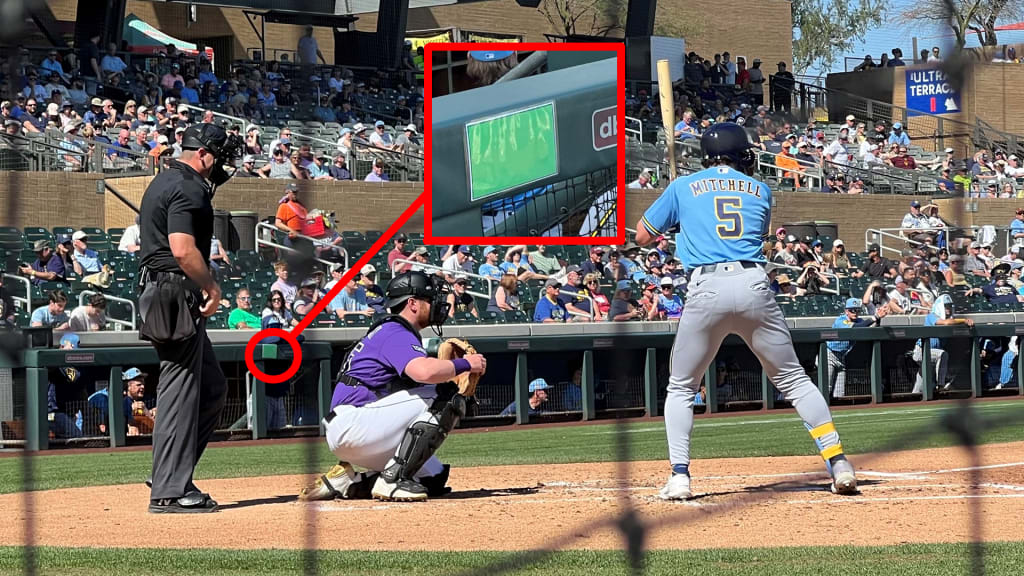
So, the green index card was nowhere to be seen for Friday’s 6-2 win over the D-backs at American Family Fields of Phoenix.
“Yeah, it’s gone,” Murphy said. “You can’t do anything that’s not in the spirit of the rule.”
The plan to try the strategy was finalized during a meeting in Murphy’s office on Thursday morning that included Milwaukee’s research and development department, the folks who work behind the scenes identifying small edges to help the small-market Brewers punch above their weight year after year.
Perhaps those folks will go back to the drawing board now that the green index card has been retired. There are other times to educate players about the optimal moments to challenge, and ways to communicate on the field that don’t involve hanging a sign on the dugout rail for everyone to see. Anyone who has ever watched a third base coach between pitches knows that.
“They hire these really, really smart guys that talk about these things that get your brain -- for me, it’s, like, a real uncomfortable area,” Murphy said. “But they do a great job of bringing things to your attention.
“We had five [research and development] guys in here with our baseball staff saying, ‘How are we going to present this? Does this make sense? What are you worried about from a strategy standpoint?’”
Players were alerted to the green index card strategy before game time on Thursday.
Right before game time.
“Three minutes before I went up to bat,” said leadoff hitter Garrett Mitchell, who got the word from Martin.
He didn’t need the card this time. Mitchell hammered the game’s first pitch for a 462-foot home run.
But in his second at-bat, with runners on first and second with one out in the second inning, the card came out and Mitchell had the green light to challenge. He didn’t use it, walking on six pitches.
“I think it’s awesome, actually,” Mitchell said before the ban was put in place. “It takes some of the guessing out of it, the, ‘What are they thinking?’ It gives you confidence. If you think it’s a ball, go for it.”
Only the catchers had advance notice about the system before Thursday’s game. The starting catcher, Jeferson Quero, who is already well versed in the ABS system from his time in Triple-A, practiced looking for the card on Thursday morning before the Brewers departed for the game in Scottsdale. Also in that gathering was Reese McGuire, who was in the lineup at catcher for Friday’s game against the D-backs -- when, notably, the Brewers didn’t challenge a single pitch.
“I think that’s key for us to make it a little bit easier,” Quero said before the ban. “It was my first time using it. I had to pay more attention on every pitch, because it changed every pitch.”
“At first, they considered having a yellow for in the middle, or something. But at that point you would be unsure,” McGuire said.
Those concepts remain in play, even if the green index card does not. For teams across baseball, approaching the ABS System remains a work in progress.
For example, Quero challenged a called ball in the first inning against the Rockies because he was certain the pitch was a strike. He was right, and the Brewers won the challenge. But because the pitch was relatively close, and the green card wasn’t out, Murphy considered it an inadvisable decision.
Coaches are gaining experience, too. In the fifth inning with two outs on Thursday, Luis Rengifo was called out on a pitch below the zone. But before he challenged, Erickson inadvertently tapped his helmet at third base. Home-plate umpire Pete Talkington waived off the challenge, and the inning was over.
“Matty did it on accident, and he knew the minute he did it, it wasn’t right,” Murphy said. “Rengifo hesitated. We looked at the high home [camera] and that’s exactly what happened. The umpire was correct.”
There are more layers to add to the Brewers’ strategy, Murphy said, and plenty of time to sort it all out while remaining within the rules.
“It’s complicated. That’s why I called in smart people,” Murphy said. “I don’t want to reveal all of our strategy, but the key is to not lose challenges early, but also not to have challenges when you end the game.
“It’s situation-based. Count is more important than runners on base, and [game] situation is more important than anything.”