



MIAMI -- This summer, Marlins right-hander Eury Pérez could be counted among baseball’s elites.
During a 13-start stretch from May 22-Aug. 22, Pérez posted a 1.67 ERA (second lowest in the Majors) and 2.5 fWAR (seventh in the National League). His past three starts, however, would humble even the most experienced of pitchers.
Pérez allowed a career-high 10 hits on a career-high-tying seven runs (five earned) in just four innings in Monday afternoon’s 9-4 loss to the Mets at loanDepot park.
Miami (72-73) fell five games behind Arizona (77-68) for the third and final National League Wild Card with 17 games remaining.
“To be honest, I don’t know exactly what to say specifically what’s going on,” Pérez said via interpreter Luis Dorante. “I think going out there, things are not going well. I go out there and try to make adjustments every time, every inning. They’re attacking every time I’m throwing in the zone. They’re making good contact, good swings.”
Over his last 11 2/3 innings, Pérez has given up 18 runs (16 earned) on 21 hits. He has walked at least three batters in five straight starts.
So what has changed -- if anything?
“It's more he's just not able to access the zone with as many offerings,” Marlins manager Clayton McCullough said. “He's just been in worse counts here over those last few starts than he was before, and you get boxed in some. And the big leagues is a good league. It's tough, and guys are good, and so [when] you're not able to gain count leverage, and you can't threaten with other pitches at various points within an at-bat and within counts, you make it tough.”
Despite an average fastball velocity of 98.1 mph (98th percentile), batters had a .400 average and a 1.100 slugging against Pérez’s four-seamer over his previous two starts. Including Monday, eight of the 15 batted balls against the pitch have been “hard hit” (95-plus mph exit velocity). Compare that to the earlier 13-start stretch, when hitters batted .140 with a .209 slugging and a 40.7% hard-hit rate.
If Pérez can’t access the zone as often, especially with his secondary offerings, that takes away the effectiveness of his best pitch.
“I’ve been missing with some of those secondary pitches,” Pérez said. “That could be one of the factors that’s affecting the fastball. It’s something that we’re working on. … I would say a bit of mechanics. It’s just a matter of making the same movement when I do the fastball [as] with the secondary pitches.”
Never was that more apparent than on Monday. Take a look at the location of the pitches Pérez threw to give up hits.
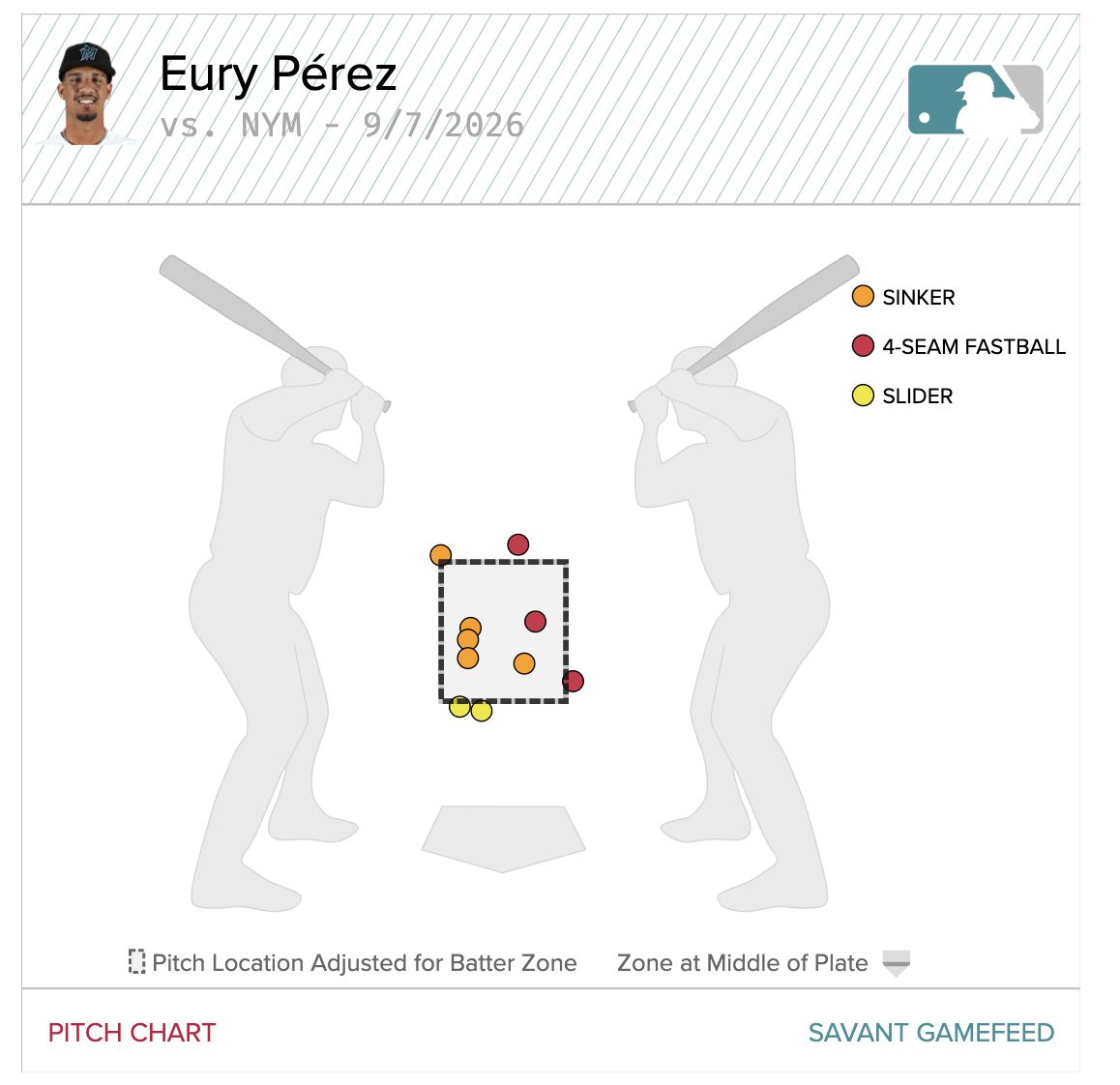
Pérez allowed two unearned runs in a 22-pitch first inning because of two throwing errors. New York added a run in the second on Nick Morabito’s softly hit RBI single.
After the Marlins took a 4-3 lead in the second, Pérez couldn’t work a shutdown inning in the third. Marcus Semien doubled to lead off the frame and A.J. Ewing reached on an infield single. Francisco Alvarez later produced an RBI single.
In his final inning, Pérez gave up another three runs. Francisco Lindor, Juan Soto and Bo Bichette hit back-to-back singles to plate a run. Following consecutive outs, Ewing sliced a two-run double down the left-field line.
“There was grind, even the outs [Pérez] got,” Mets interim manager Andy Green said. “You're facing one of the best arms in baseball, and you're putting that kind of pressure on him, it was a really good day from the offense."
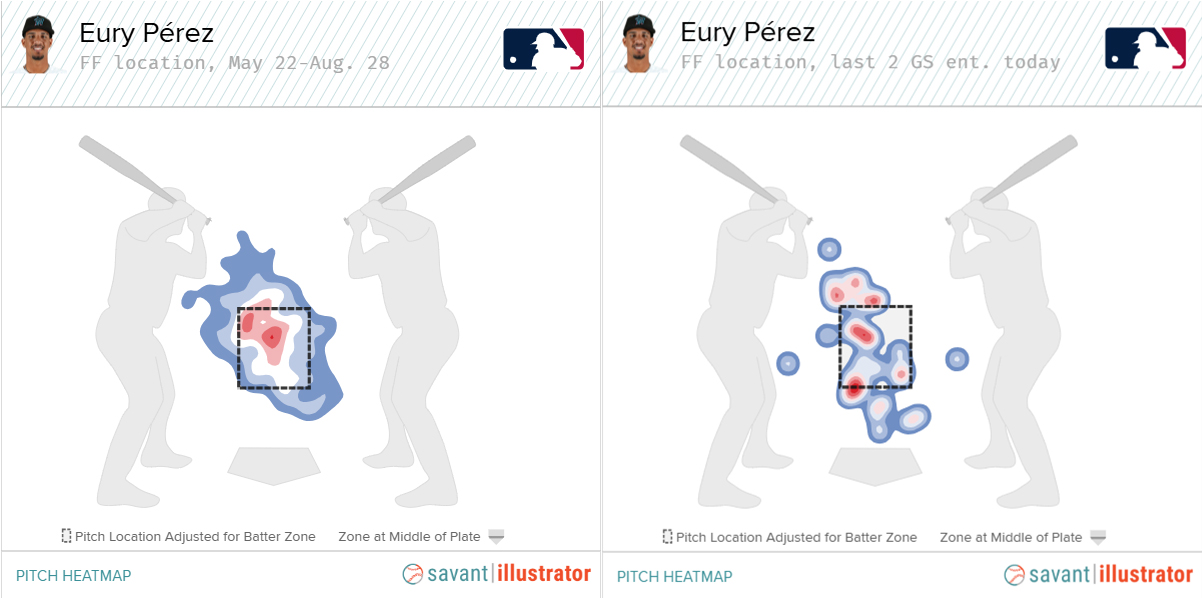
Although Pérez has surpassed his career highs for starts (26, previously 20) and innings (139 1/3, previously 95 1/3), his underlying metrics are in line with his season averages. There are no health concerns.
“We haven't had any conversations about what the back half of this month looks like,” McCullough said. “Right now, planning on getting him prepared and ready for his next start, and going into today, there were no limitations on number of pitches or innings. If it had been a different level of performance today, if it had gone different, he'd have gone deeper into this one.
“I don't think the performance right now and how it's been the last couple starts has anything to do with workload. I really don't. I just think that he just hasn't executed as well as he did for a 13-start stretch.”