



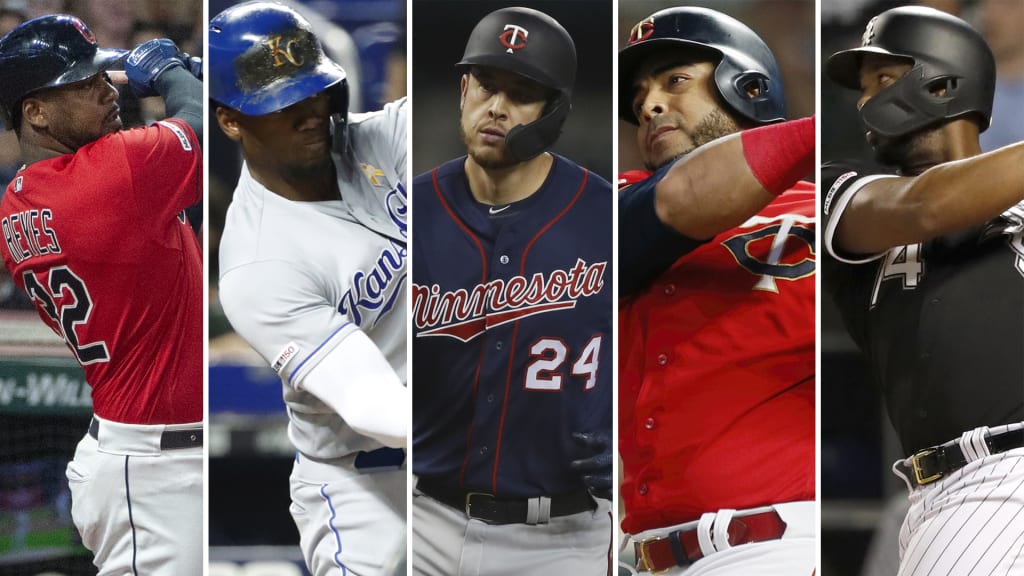
No matter how much baseball changes from year to year, decade to decade or generation to generation, there's one constant that will never be altered: the love for a towering home run.
Modern-day statistical analysis has changed perspective on some of the ways we analyze what really matters to a team that's built for success, but when it comes to majestic home runs, and the ability to hit them, all 30 clubs can agree: Home run hitters never go out of style.
For our division notebook this week, we tasked our beat writers with identifying who on their clubs has the most power, hitting-wise. Here's what we came up with among American League Central teams:
Indians: Franmil Reyes
For those who had the chance to witness Reyes during Spring Training this year, there’s no question as to who has the most power for the Tribe. Indians fans did not get to see all of that potential in the second half of last season while the slugger was adjusting to being traded in the three-team deal that sent Trevor Bauer to the Reds. But between the Padres and Indians, Reyes still launched 37 homers with a .512 slugging percentage in his first full Major League season. Despite the limited experience, he’s quickly become a Statcast favorite because his power lights up the exit velocity radar guns each night. His exit velocity average of 93.3 mph last season wasn’t just the highest for the Tribe, but it was also the second best in the big leagues among hitters who had at least 300 batted balls last season. With the same parameters, Reyes’ hard-hit percentage (51 percent) was the third highest in 2019 behind Nelson Cruz and Kyle Schwarber. -- Mandy Bell
Royals: Jorge Soler
This was pretty much a no-brainer. Soler broke the franchise record for home runs in 2019 with 48, and he did so with majestic power down the stretch. Statcast's estimates of the distances for his last eight home runs were 447 ft, 446 ft, 439 ft, 450 ft, 431 ft, 437 ft, 444 ft and 465 ft. They were not cheapies.
The most certain thing about Soler’s power is when he barrels a ball, it goes a long way. And he barrels the ball frequently. Last season, his 70 barrels led all of MLB.
“I’ve never seen anyone hit baseballs as hard and as far as Jorge,” teammate Hunter Dozier said. “When he’s at the plate, it’s like watching a video game.”
Former manager Ned Yost often said Soler had the most raw power of anyone he managed.
“He’s just so strong,” Yost said. “He can take any pitch and drive it out of the park in any direction. From the field level, it’s amazing to watch. It’s so loud.” -- Jeffrey Flanagan
Tigers: C.J. Cron
Since we can’t nominate the likely first overall pick in this year's Draft, Spencer Torkelson -- at least not yet -- Cron gets the nod, having hit 55 home runs with 52 doubles over the past two years with Tampa Bay and Minnesota. That power is a big reason the Tigers signed him alongside his 2019 Twins teammate, Jonathan Schoop, in their search for more offensive punch. Schoop actually hit for a higher slugging percentage than Cron last year (.473 to .469) and has a higher career mark in home runs, 32 to 30. Cron’s 30-homer season came in 2018, one year after Schoop’s big year in Baltimore. Cron also has five career homers at Comerica Park, including three in eight games last year. -- Jason Beck
Twins: Nelson Cruz
There's also a very good argument to be made here that Miguel Sanó deserves this spot, but when in doubt, you kind of have to go with the guy who has 401 career big league homers. Though Cruz was 38 years old when he signed with the Twins ahead of the 2019 season, he didn't show it at all, overcoming a ruptured tendon in his left wrist to post arguably the best power numbers of his career: 41 homers, a .639 slugging percentage and 1.031 OPS. Cruz is the decade's leader for home runs in the 2010s and has clubbed 37 or more homers in each of the last six seasons, making it a rather easy decision for the Twins to exercise his club option for 2020.
The scary thing for opposing pitchers is that the underlying metrics don't show any reason to believe Cruz will slow down any time soon. In 2019, Statcast showed Cruz to be second in expected slugging percentage among qualified hitters behind only Mike Trout. He was third in the Majors in average exit velocity, third in hard-hit percentage and first in barrels per plate appearance. How does he still do this? Tune into one of Cruz's intense quarantine workouts on Instagram Live, and it's easy to see how the designated hitter continues to stay ahead of Father Time with a dogged work ethic. -- Do-Hyoung Park
White Sox: Eloy Jiménez
The 6-foot-4, 235-pound Jiménez hit 31 home runs during his rookie season, launching 16 in the first half and 15 after the All-Star break. But there was little doubt he really started to figure things out as a hitter in those final three months, especially in September, when Jiménez produced a 1.093 OPS with nine homers, eight doubles and a .340 average over 107 plate appearances.
Jiménez was acquired as the centerpiece of a five-player trade with the Cubs in 2017 that sent left-handed starter Jose Quintana to the North Side, and Jiménez’s most prominent 2019 homer came in the ninth inning at Wrigley Field off of Pedro Strop to break a 1-1 tie. He almost hit the pitch out of Wrigley Field to left-center field, but broke his bat on the swing. Jiménez has 50-homer potential, let alone 40, and has exhibited the ability to hit with power to all fields. In fact, Jiménez only had two truly pulled home runs in ’19, per Baseball-Reference, with 11 to center and seven to right. -- Scott Merkin