



Dylan Cease throws a changeup nowadays and, technically, that's not anything new. The Blue Jays right-hander threw 37 changeups with the Padres last season.
But that offering was more of a "Bugs Bunny" pitch, a term first coined by Ethan Katz, Cease's former pitching coach with the White Sox. Last season, the average velocity on Cease's changeup was just 78.3 mph.
"Really goofy," is how Cease described his old changeup last month inside the visitors' dugout at Yankee Stadium. "It was a trick pitch, really. It was such an unusable pitch. It wasn't something that I could rely on," he said.
The new changeup is a different story.
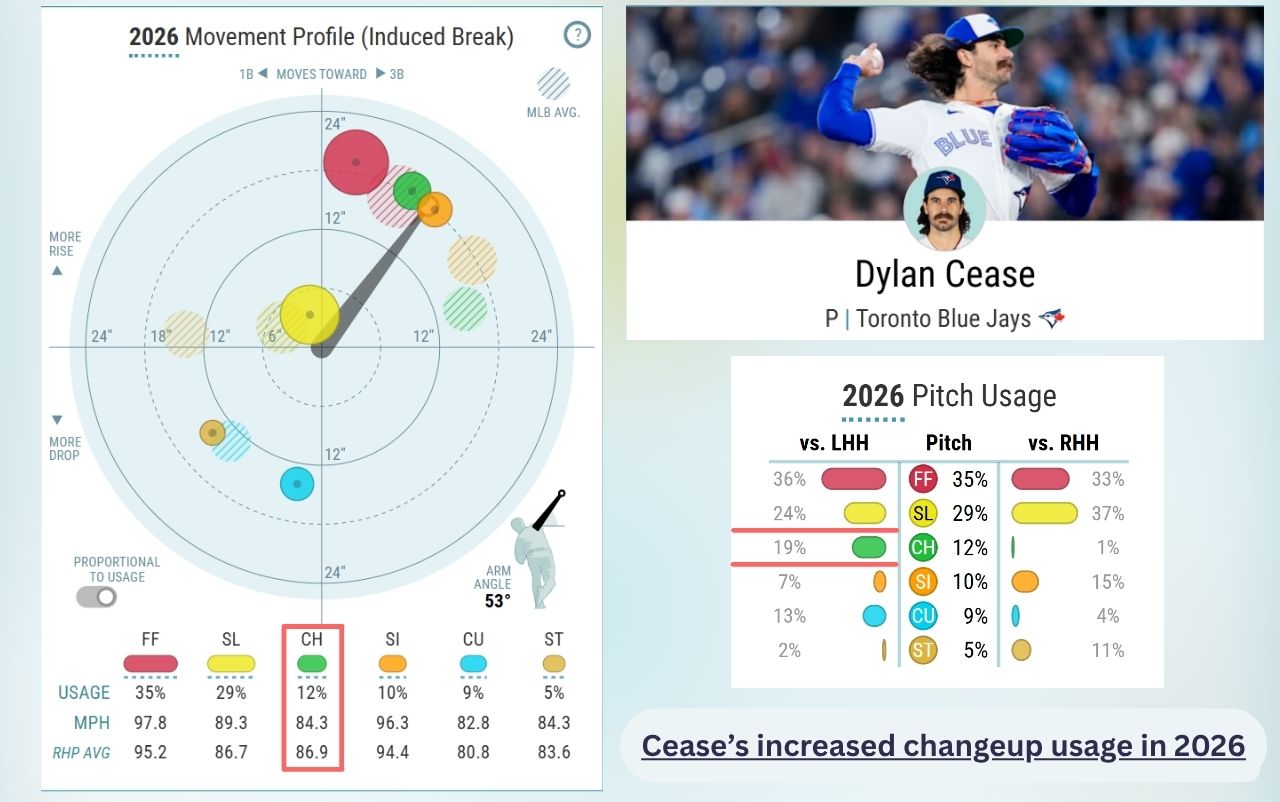
In line to make his next start against the Red Sox on Tuesday night, Cease is throwing his changeup 19% of the time against left-handed hitters (he's used the pitch just four times to righties). The opposition is 4-for-20 against Cease in at-bats that end with a changeup. It has generated 29 misses on 46 swings -- good for a 63% whiff rate, which is the second highest off any changeup in the Majors this season (min. 25 swings).
Last Tuesday, in his first start off the IL following a hamstring injury, Cease deployed it at will. He threw 15 changeups -- his second-highest total in a game this season -- and induced eight misses on nine swings.
"I haven't figured it out yet," Cease cautioned. "But I'm actually treating this one like a real pitch. Before, I was lobbing it in there. Now, I'm treating this like a real pitch. Arm speed, body movement, everything."
The Blue Jays were aggressive in their pursuit of Cease last winter, signing him to a seven-year, $210 million deal in November. Cease's surface-level stats -- including a 4.55 ERA -- made his free-agency case a curious one. He has never made an All-Star team. But through these first few months, he is pitching like an ace.
One major difference: his arsenal.
Last season, Cease threw his four-seam fastball and slider a combined 83% of the time. He struggled to find any sort of consistency with a third pitch. This year, he's using that pair just 64% of the time. In addition to the changeup, he's also honed a two-seam fastball.
"It helps me show a wider variety of attack," Cease said. "It helps me so I don't have to show my best stuff every pitch. It also sets up the other pitches better. It makes me more unpredictable. I've always thought that the more shapes and variety and ways that you can attack, the harder it is to make a good game plan against you."
This is still a work in progress for Cease. In Spring Training, he focused on his body and made a few mechanical adjustments -- among them, as Pitching Ninja pointed out, he learned to turn his head so as to not stare at the catcher's mitt during his delivery. The changeup took a backseat, even as he featured it in Grapefruit League play. At the end of camp, his mechanics felt better. Most of the work on his changeup has come since Opening Day.
"It's about getting comfortable moving my body," Cease said. "The gut instinct is to baby it until you get really comfortable with it."
Although Cease is still learning how to use it, the changeup is very much a real offering. It comes in at 84.2 mph, six miles per hour faster than the "Bugs Bunny" variant.
But it is still wonky.
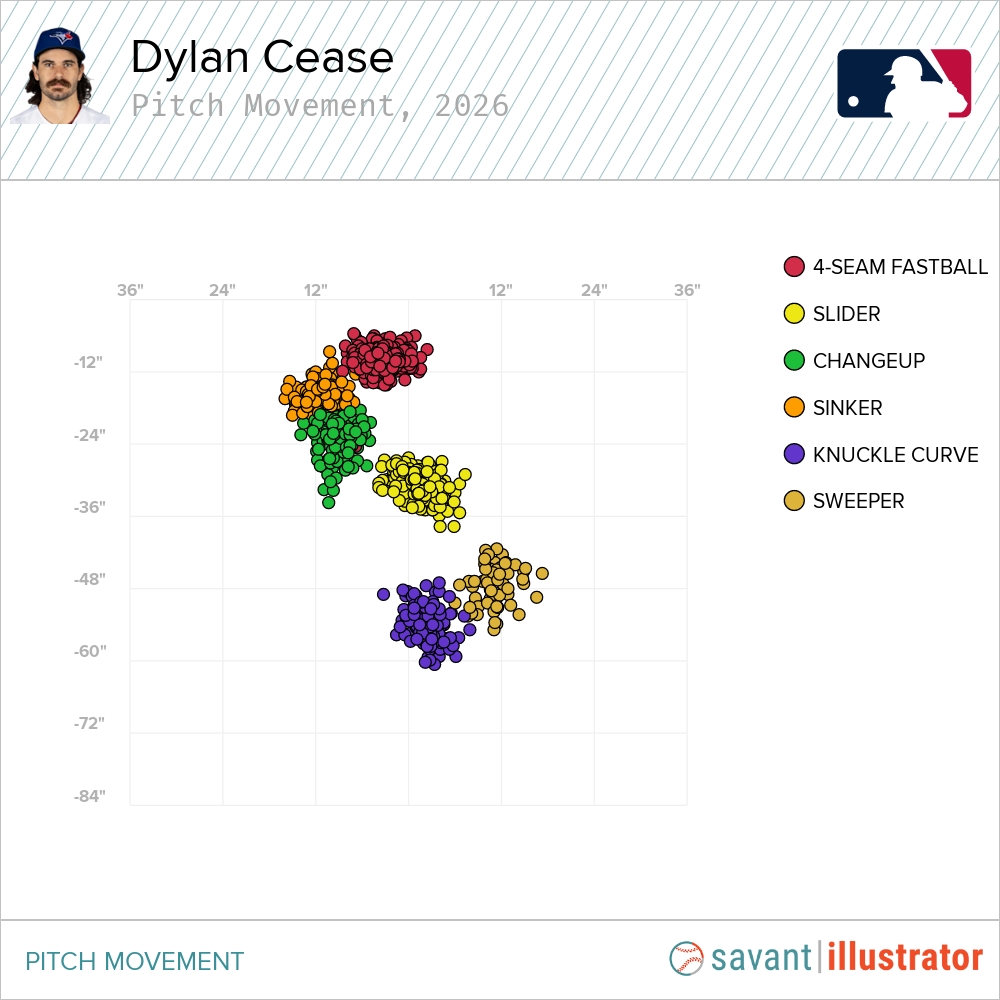
Changeups are designed to do one of two things: run away from a hitter or dive beneath a hitter's bat. Cease's changeup does neither. It drops 9.6 inches less than comparable changeups (based on velocity and release point), which is the lowest among all qualified changeups. It is effectively a "riding" changeup. In fact, Cease's changeup averages 15.7 inches of induced vertical break (IVB), or carry. The average four-seam fastball from a right-handed pitcher has 16.0 inches of IVB.
Cease's changeup has a unique movement profile
- Cease: 84.3 mph // 9.3 in. arm-side run // 22.3 in. drop
- Avg. RHP: 86.9 mph // 14.7 in. arm-side run // 32.5 in. drop
"I know the movement on it is not nice," Cease said. "It's not good. It's definitely not a metrically good pitch."
Hitters don't see many changeups like the one Cease throws. The closest comparison comes via Dodgers left-hander Alex Vesia, whose changeup drops 9.2 inches less than comparable pitches, in part because of his extreme over-the-top arm angle. Interestingly enough, Vesia took a similar path to this point: After years of tinkering, he finally found something that worked in the offseason, with help from the Dodgers coaching staff. Vesia is the only pitcher with a higher whiff rate on their changeup than Cease.
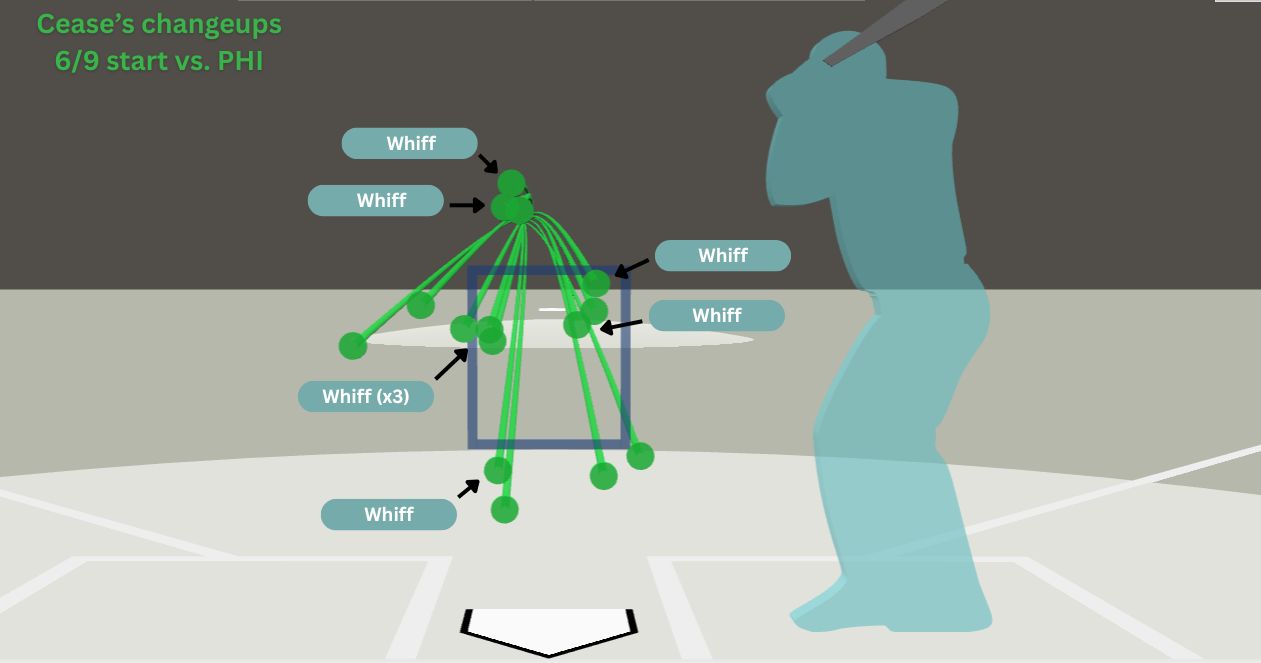
What's more important than the shape itself is the way that Cease's changeup fits in his arsenal. Changeups are rarely judged in a vacuum. They are meant to complement a pitcher's heater. And that is why Cease's works, despite the lack of drop or arm-side run.
"It's just the change of speeds," Cease said. "When I'm throwing it in the mid-80s and they have to gear up for 97, 98, that alone is beating them."
Hitters are nowhere close to Cease's changeup, and we can measure this using Statcast's new miss distance metrics. Cease's changeup has gotten hitters to "flail" -- or, swing for a pitch beyond their barrel -- on 79% of their swings. That's the third highest flail rate on any pitch this season (min. 25 swings).
This is also partially a story of modern pitching development. Cease last threw a changeup in the 80 mph range in 2020. Thanks to a new grip, he has found his way back. He uses a basic two-seam grip to throw his changeup (his "Bugs Bunny" changeup was a splitter grip, and his sinker is a one-seam sinker). Pitchers have always shared grips with one another and tried different things. Now, though, the process of finding what works for you is easier.
"It's massively different," Cease said. "It's way more advanced. For the most part coaches know, if you're a seam-shifted guy, your fingers go here. Your arm angle is this. So, this is the movement profile we're expecting."
Cease is a natural supinator, which is a fancy term that essentially means he has a tough time throwing a changeup -- and anything with arm-side movement -- because of the way his wrist rotates. What works for others won't necessarily work for him. So, he relied on the Blue Jays coaching staff and player development personnel to find a grip that worked. Because this is not a finished product, the group carries out ongoing discussions to figure out what's best.
"It's very early still," Cease said. "Best case, I get more feel with it and I keep throwing it in the zone and get more strikes with it. Very best case, we've got to find a way to get to it a little bit more."
Things are certainly trending that way.