


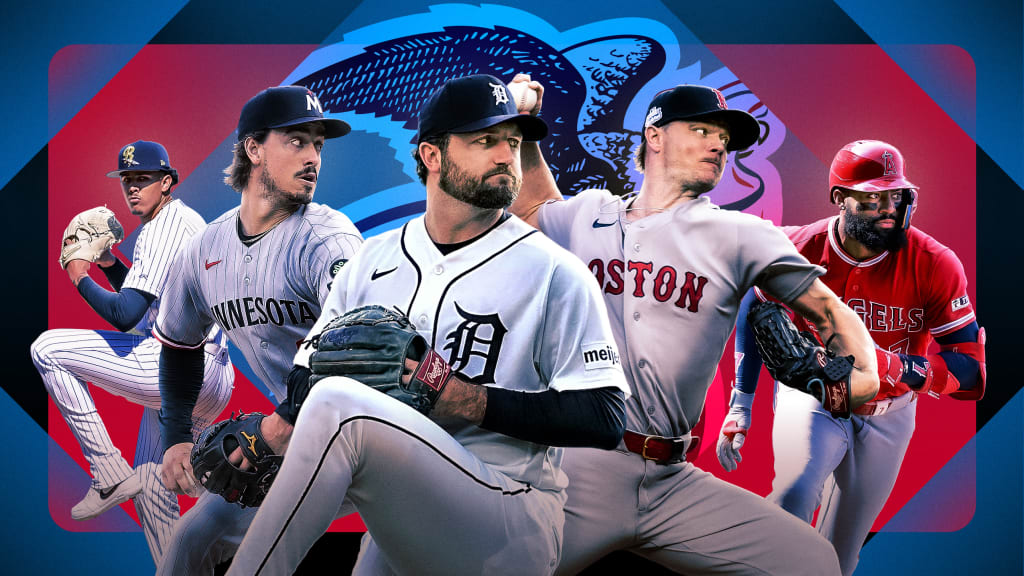
As we detailed earlier this week, the postseason picture is as muddled as we’ve ever seen it heading into July. Twenty-five teams stand within six games of a playoff spot, making it nearly impossible to differentiate potential Trade Deadline buyers and sellers.
2026 Trade Deadline: Aug. 3, 6 p.m. ET
• Everything you need to know
• Latest trade buzz and rumors
The next three or four weeks should help clarify where many teams stand, but with the Trade Deadline set for Aug. 3, there’s still a month to go before we have any firm answers.
This week, MLB.com will look at a number of questions to consider as we approach the month-long run to the Deadline, starting with the American League.
1. Do records really matter in the AL?
Historically, being under .500 in July isn’t a formula for setting yourself up to be a potential buyer. But in the 2026 American League, anything is possible!
The Mariners are in possession of the final AL Wild Card spot with a 44-43 record, while the Royals, whose 35-52 record is the worst in the AL, are only nine games out of that spot.
That’s not to say that Kansas City is prepared to buy, but given that all nine teams not currently in playoff position are under .500 -- and seven of those clubs are within six games of a postseason spot -- it seems unlikely that many (any?) clubs will be ready to throw in the towel and become sellers until later this month.
2. Do the Yankees have internal answers for their issues?
The theory goes that getting an injured player back in late July or early August is the equivalent of making an addition at the Deadline. If that’s the case, then the Yankees are in position to make some pretty big acquisitions.
Left-hander Max Fried, designated hitter Giancarlo Stanton and outfielder Trent Grisham are all due to return sometime in July, while reigning AL Most Valuable Player Aaron Judge could return from his fractured rib sometime in August.
Is that enough for general manager Brian Cashman to stay quiet at the Deadline? Unlikely.
The Yankees have needs in the bullpen and behind the plate, though No. 4 prospect Carlos Lagrange was moved to the bullpen last month, giving the Yankees a look at whether the hard-throwing right-hander could help in the Majors during the second half.
Cashman has a history of making the moves he deems necessary at the Deadline, so the Yankees will likely add a relief arm or two. Catcher is a different situation; despite their offensive woes at the position, introducing a new catcher into the mix could disrupt the pitching staff, which currently owns the best ERA in the Majors.
3. Will the Rays go for it?
Tampa Bay has been a Jekyll-and-Hyde club in 2026, looking like world-beaters at times and also-rans at others. Are the Rays the club that went 22-4 from April 22-May 22? Or are they the one that followed that stretch with a 9-18 slide?
The Rays’ current seven-game winning streak lifted them back into first place in the AL East, giving president of baseball operations Erik Neander plenty to think about with a month left until the Deadline.
Neander has been aggressive in years past when the Rays are in contention for a division title. Will that be the case this season? This is also the first Trade Deadline for the club’s new ownership group, so there’s no blueprint for how things will go.
The bullpen has struggled this season (4.35 ERA) and the top-heavy lineup has relied on Junior Caminero, Yandy Díaz and Jonathan Aranda, so there are multiple spots for Neander to focus on if he decides to buy. Luis Arraez might make sense for Tampa Bay, which has gotten little production from its second basemen.
Then there’s the rotation, which has been effective to this point but includes some starters whose innings will have to be monitored during the second half.
With that many potential holes to fill, will the Rays spread their resources to make multiple moves or attempt to take a big swing for an impact addition?
4. Can the Tigers afford not to be sellers?
You only need to look back at 2024 to argue that the Tigers can still be a factor in the playoff picture, but Detroit’s 38-49 record is the fourth-worst mark in the AL, presenting a huge challenge to get to October.
Tarik Skubal will be the top name mentioned between now and Aug. 3, because the two-time defending AL Cy Young Award winner is headed for free agency and would be the biggest difference-maker if he was to be dealt.
Can the Tigers hold on to Skubal with the hope of getting back into the playoff race? If they do, they will receive only a comp pick if he ultimately signs elsewhere, though Detroit drafted Kevin McGonigle with the No. 37 pick in 2023 -- so it is possible to land an impact player in that area of the Draft.
The Tigers’ farm system ranked fifth in MLB Pipeline’s preseason organizational rankings, though it should be noted that all four of its Top 100 prospects at the time were hitters. Detroit’s system remains thin on the pitching side, something president of baseball operations Scott Harris could address with trades of players such as Skubal, Gleyber Torres, Casey Mize, Kyle Finnegan, Kenley Jansen and Jack Flaherty.
5. Will the White Sox be buyers after their surprising first half?
GM Chris Getz has rebuilt the White Sox from historic loser into contender in only two years, but it seems unlikely that Chicago will deal away any of its young pieces for a short-term run at the postseason.
That said, there should be a number of controllable players available, many of whom would help the White Sox make a playoff push in 2026 while contributing in future years, as well.
Are the White Sox good enough to win the AL Central? It’s a very winnable division, and with Munetaka Murakami due back from injury sometime in July, Chicago will add a big bat back into its lineup. If the Sox decide to buy, the pitching staff will likely be the focal point, and while Getz won’t sacrifice the future, getting to the playoffs only two years after a 121-loss season would be a remarkable achievement.
6. Will the Mariners be aggressive for a second straight Deadline?
Seattle made big moves last summer, adding Josh Naylor and Eugenio Suárez to bolster a roster that ended up making a run to the ALCS. Will president of baseball operations Jerry Dipoto go after it again this summer with his team firmly in the thick of both the AL West and Wild Card races?
The AL West has been relatively weak this season, so while the division is attainable, Dipoto will have to assess whether he believes the Mariners can be a true World Series contender again in 2026. If he does, he could get aggressive in this year’s trade market.
Seattle’s needs aren’t as obvious as they were a year ago, but the Mariners need bullpen help along with a right-handed bat -- preferably one that can play third base or a corner-outfield spot -- giving Dipoto some areas to target.
7. Will Mike Elias get the ace the Orioles need?
The Orioles had an unusually aggressive offseason, signing Pete Alonso to a nine-figure contract while making trades for Shane Baz and Taylor Ward. The one area that wasn’t addressed was the top of the rotation, which has had a void since Corbin Burnes departed at the end of the 2024 season.
President of baseball operations Mike Elias has said he plans to be a buyer, and after last year’s disappointing 75-win season, a return to the postseason would help Baltimore recapture some of the momentum it picked up with its successful 2023 and '24 seasons.
The rotation should be the focus, specifically the top, where the Orioles would benefit from the addition of a No. 1 starter. Trading a haul of prospects for a two-month rental like Skubal isn’t Elias’ style, but a controllable arm such as Joe Ryan or Sonny Gray could make sense.
8. How will John Mozeliak handle his first (and only?) Deadline with the Angels?
The Angels dismissed GM Perry Minasian last week, hiring former Cardinals executive John Mozeliak as a baseball operations consultant and interim GM for the remainder of the 2026 season.
Mozeliak, of course, had a long, successful run in St. Louis, but the Cardinals were rarely in the position the Angels find themselves in right now. Los Angeles is 36-51, sitting in last place in the AL West and eight games out of the final AL Wild Card spot.
It would make all the sense in the world for the Angels to be sellers -- José Soriano, Reid Detmers and Jo Adell would all garner significant interest -- but owner Arte Moreno has shied away from that approach in past years. Can Mozeliak convince ownership to change its ways and embark on a true rebuild?
9. Do the Rangers have the capital to be buyers?
It was only two years ago that the Rangers boasted a Top 10 farm system, one ranked No. 7 by MLB Pipeline prior to the 2024 season.
This year, Texas ranked No. 25 on that list after graduating four top-10 Draft picks to the Majors in the past three years and using eight other prospects in trades for MacKenzie Gore and Merrill Kelly.
At 44-43, the Rangers have are tied with the Mariners for first place in the AL West (and the final AL Wild Card spot), putting them in position to reach the postseason for the first time since their 2023 World Series championship season.
President of baseball operations Chris Young made big splashes leading up to that 2023 Trade Deadline, adding Max Scherzer, Aroldis Chapman and Jordan Montgomery among others. Young and the Rangers have been quieter in their Deadline approach during the past two years, but after dealing for Gore and Brandon Nimmo last winter, it won’t be surprising to see Texas go for it again this summer.
The question is, if the Rangers decide to buy, what assets do they have to use in those trades? Texas has only two prospects in MLB Pipeline's Top 100, infielder Sebastian Walcott at No. 10 and right-hander Caden Scarborough at No. 66, but Walcott is rehabbing from February’s internal brace surgery on his right elbow.
More than anything, the Rangers need to get healthy -- their IL currently includes Nimmo, Montgomery, Wyatt Langford, Jack Leiter, Jalen Beeks and Danny Jansen, among others -- but if the playoffs are within sight, Young could try to bolster his roster for another second-half run.
10. Will the Twins buy, sell or do a little of both?
Despite their 42-46 record, the Twins only 4 1/2 games behind the first-place White Sox in the AL Central -- and only 2 1/2 games out of the final AL Wild Card spot.
If Minnesota decides to buy, it has a number of top prospects from which it can deal, including four players in MLB Pipeline’s Top 100. A number of those players are believed to be Major League-ready, giving the Twins some options. Could they trade players off the big league roster to fill needs, then bring up young players they believe are ready to take their place?
Should the Twins opt to sell, that sale won’t include Byron Buxton, who has a full no-trade clause and no desire to leave Minnesota. But Joe Ryan and Ryan Jeffers could bring back healthy returns, giving GM Jeremy Zoll some options if he takes the sell route.