



Gary Sheffield was signing autographs after speaking at an annual youth baseball fundraiser in Greeley, Colo., this past January.
Sheffield’s connection to Greeley is a deep one -- his former manager with the Padres in 1992, Greg Riddoch, hails from the Northern Colorado city and the two have remained close to this day.
As he was talking to fans who were standing in line to meet the former slugging outfielder, Sheffield’s phone rang.
“What’s up, man?” he said after picking it up and putting it on speakerphone. Then he looked up at the people around him.
“This is my son, Noah, at Florida State.”
A fan leaned in and asked Noah a question as Gary held out the phone:
“Do you hit like your dad?”
Without hesitation, Noah responded with a pithy answer that clearly expressed pride in his father’s career, which included 509 home runs and a .907 OPS over 22 Major League seasons:
“Yeah, I do.”
Noah was entering his sophomore season at Florida State, and every time he stepped to the plate for the Seminoles, he not only resembled his father physically, but also in his batting stance.
And Gary’s stance from his playing days is one of the most iconic in baseball history.
If you were a baseball fan growing up in the 1990s, chances are you instantly recognized it the instant a friend started emulating it while playing in the backyard.
It was so aesthetically and viscerally pleasing with the intense bat waggle, bent knees and pigeon-towed stance, that you couldn’t resist breaking into it even if you didn’t have a bat in your hands -- an empty paper towel roll or a roll of unopened wrapping paper would suffice.
And Noah was no exception.
“When I was, I think, 14 years old, and I started really trying to take baseball seriously,” Noah said, “I told my dad I wanted to do his swing, because why not learn from the best and then try to mimic everything in what he did?”
Gary wasn’t having it.
“I basically told him it’s a hard thing to do,” Gary said. “Because it’s a hard thing to repeat every day. But it came natural to me.”
The origin of Gary’s stance was a case of ingenuity born of necessity. After he was drafted sixth overall by the Brewers in 1986, he began using a wood bat and was out in front so often that he was losing several potential home runs down the left-field line.
When he came out of Hillsborough High School in Tampa, Fla., Gary’s stance was more like Julio Franco’s -- his hands were high and the bat was positioned over his head and pointed at the pitcher.
“So I was just messing around in BP, and I started moving it faster,” Gary said. “And when I started doing the wiggle, I hit 10 balls out in a row. And then when I took it into a game, I hit two home runs.”
Sheffield’s bat was one of the quickest anyone had ever seen. When asked if he thought his bat speed was the best in the game during his time, he said he couldn’t say.
But when told the high end of average swing speed according to Statcast today is about 80 mph, he didn’t hesitate.
“I’m sure I could get to that,” he said with a smile.
For Gary, the unorthodox stance was natural and it worked really well. But Noah’s response to Gary’s objection to him adopting his dad’s style at the plate was surprising.
“He said, ‘Well, Dad, it feels natural to me,’” Gary remembers. “And I was like, well, it’s always that one child, you know? Because he was always on my hip pocket. Everywhere I go, he wanted to go.
“I thought when he got older, it would change, right? But it hasn’t yet.”
It hasn’t yet. And it shows in the conversations they have about the game. After he was kind enough to answer some questions about how he came to emulate his father’s famous batting stance, Noah talked with Gary about how things were going in Florida.
The conversation spanned from the weather to Noah’s mechanics at the plate. And the love between father and son, through the lens of baseball, was abundantly evident.
“So, y’all just worked inside, right?” Gary asked, referring to the unseasonably cold weather in Florida. “What’s the temperature there? … In the 30s? That’s crazy.”
At this point, Dad made sure his son was properly prepared in a part of the country where the temperature was about 30 degrees below the average for that time of year.
“Just keep your -- yeah, just keep stuff around your neck,” Gary said. “And don’t be like, when you go in and outside … that’s what I’m saying. Because when you’re going in and out and your body changes, that’s how you get sick. So make sure you maintain.”
Next, the conversation shifted to the family business. Gary listened as Noah told him what he was working on in the indoor batting cage. While Noah is seeking to carve out his own path in the game, he and his father share a tight bond over baseball -- and a batting stance.
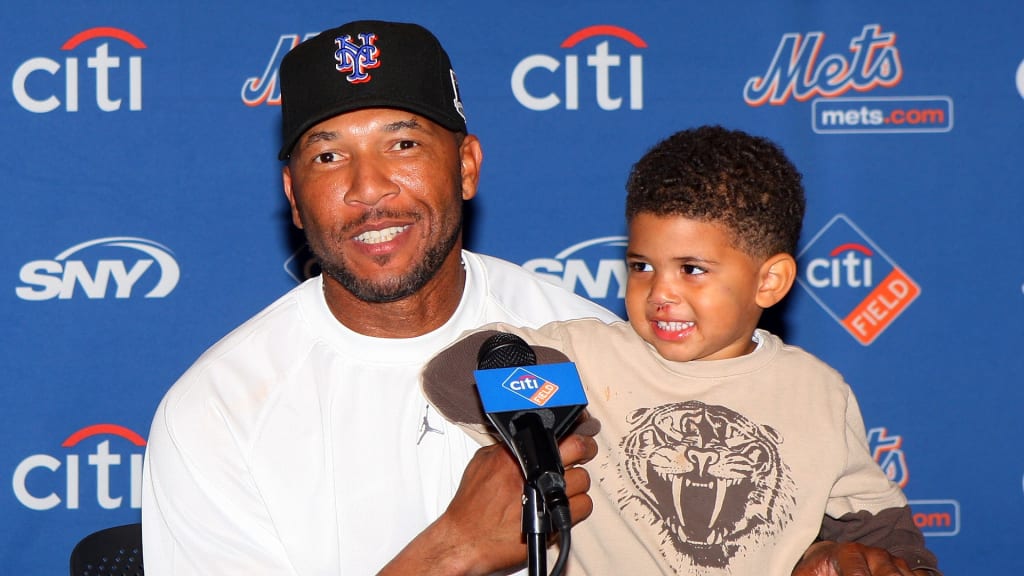
“You just stay in there a little longer,” Gary told him. “Always go to the ball with that left shoulder closed. Keep that left shoulder closed, then use the ground to turn. You’re looking good, man. I’ll see you soon.”
Fathers, sons and baseball. The combination has been a special part of the game’s long and storied history. And in the case of Gary and Noah Sheffield, it’s an extension of what they’ve had all along.
At the end of the call, Gary told his son that he’d be flying to New York that night, then down to Georgia and then down to Florida to see him. And as only a father can, he knows the feeling of how the atmosphere in the room changes when he’s together with his son.
“It just does something to him when I show up,” Gary said. “He could be going through whatever, in his game or whatever, and then he’ll see my face, and it’s over.
“Now he’s back to himself. Because he goes back to his childhood.”