

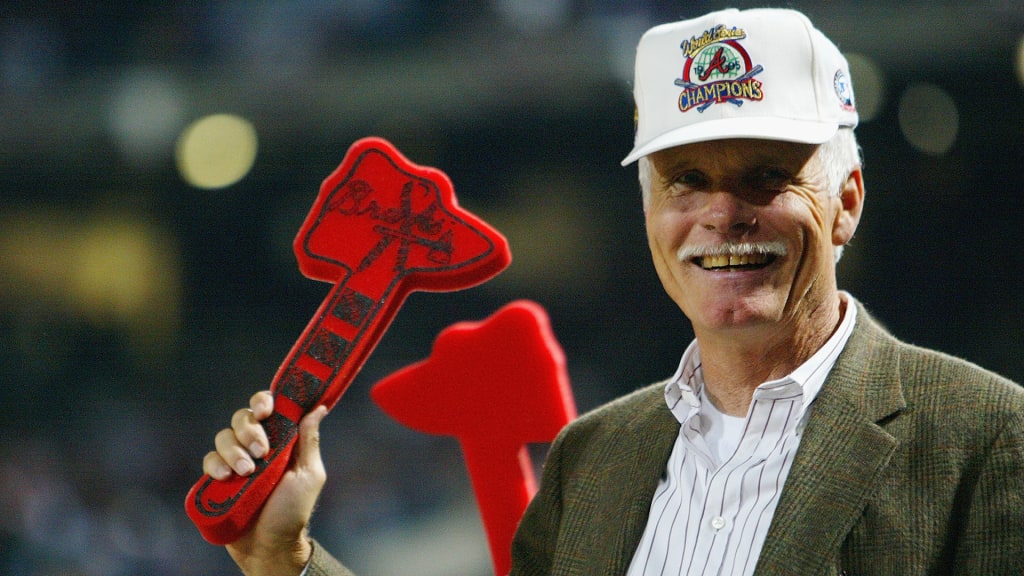
Ted Turner never threw a pitch or swung a baseball bat. But he will forever be remembered as one of the most legendary figures in Braves history.
Turner revolutionized the satellite and cable television industries and brought the Braves into living rooms across the United States on a nightly basis throughout the summer months. Baseball fans will continue to celebrate and benefit from the contributions of this pioneer, who passed away on Wednesday at the age of 87.
"Ted Turner was a visionary whose impact on the media landscape transformed how fans experience sports,” MLB Commissioner Robert Manfred said in a statement. “A dedicated philanthropist, he championed countless charitable causes while leading with a style uniquely his own. Through his leadership, the Atlanta Braves reached millions of households nationwide on TBS, helping build a legacy of sustained excellence that included the franchise’s first championship in Atlanta with the 1995 Braves.
"We are grateful for Ted’s pivotal role in expanding the reach of the Braves and elevating our National Pastime. On behalf of Major League Baseball, I extend my deepest condolences to Ted’s family and his colleagues with the Braves."
One of the world’s great media moguls, Turner founded WTBS, which is now known worldwide as TBS, and CNN, the first 24-hour cable news channel. Other ventures included spending time as the owner of the Atlanta Braves, Atlanta Hawks (NBA) and Atlanta Thrashers (NHL).
During Turner's time as the Braves' owner, the team experienced its greatest sustained run of success in franchise history, including an MLB-record run of 14 consecutive division titles from 1991-2005, five National League pennants and the 1995 World Series title, the franchise's first championship since it relocated to Atlanta in 1966.
"Our good friend and former owner, Ted Turner, was one of a kind -- a brilliant businessman, consummate showman and passionate fan of his beloved Braves," the team said in a statement. "Ted's visionary leadership and innovative approach to broadcast television transformed the Braves into 'America's Team.' Under his stewardship, the ballclub experienced one of the greatest runs of sustained success in Major League Baseball history and brought a World Series championship to Atlanta in 1995."
"Ted was also a legendary philanthropist whose compassion and generosity extended across the globe. We will miss you, Ted. You helped make us who we are today, and the Atlanta Braves are forever grateful for the impact you made on our organization and in our community."
Robert Edward Turner III was born in Cincinnati in 1938 but spent much of his adolescent years in the Atlanta area after his father moved his billboard company to Georgia. Ted gained ownership of the company after his father's death in 1963. His success over the next few years led to the purchase of some television stations, including UHF Channel 17 WJRJ (which is now Peachtree Network), despite the fact UHF channels had very little coverage area at the time.
Knowing the television market was going to change, Turner’s gamble was rewarded in 1976, when the FCC began allowing the satellite feed to be transmitted to cable providers across the country. This same year, the entrepreneur bought the Braves. A year later he purchased the Hawks. These purchases provided content for this satellite channel the world would come to know as SuperStation WTBS.
“I don’t want to see any more headlines calling Atlanta ‘Loserville USA,’” Turner said at a news conference announcing his purchase of the team. “I want to see ‘Winnersville USA.’”
As folks in Hawaii, Iowa, Montana and other areas far from Atlanta were given the opportunity to watch Turner’s Braves on a nightly basis, they were first introduced to a young Bobby Cox, who began his managerial career in Atlanta in 1978, and young versions of both Dale Murphy and Bob Horner. At the game, fans were entertained by Turner’s pregame promotions and desire to seemingly buck the rules.
The Braves' success under Turner's ownership was inextricably linked to Cox, whom Turner hired for his first managerial job in 1978 and then reluctantly fired after the 1981 season, when he famously said he was making a change just to make a change and that he’d be looking for somebody like Cox to fill the role.
After winning the 1982 NL West title, the Braves slipped and served as a bottom-feeder through most of the decade.
Turner brought Cox back to Atlanta as the general manager after the 1985 season and watched him overhaul what was a weak farm system. Cox returned to the dugout in 1990, and a year later the Braves won the first of 14 consecutive division titles.
Turner was visible at the ballpark, often seen with his wife Jane Fonda, President Jimmy Carter and many other dignitaries who sat around him next to the Braves’ dugout at Atlanta-Fulton County Stadium and later Turner Field, which was named after him.
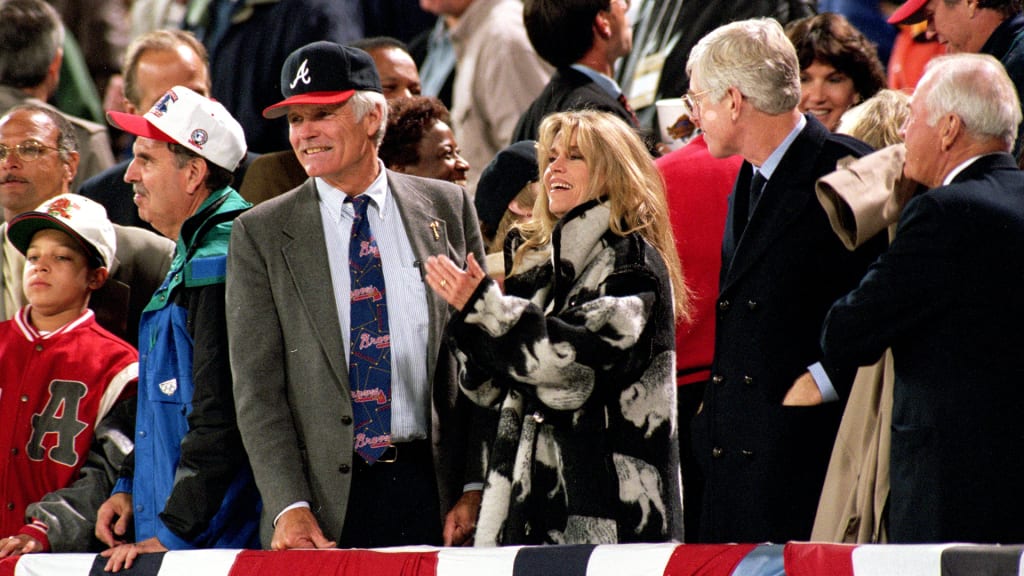
After a long wait, including World Series losses in 1991 and '92, Turner celebrated the Braves’ World Series title in 1995. He continued to control the team until his power was lessened following AOL’s merger with Time Warner in 2003.
Turner's ownership tenure included some trials and tribulations. He irked fellow owners when he gave Andy Messersmith one of the first huge deals provided during the early days of free agency. He then irked National League president Chub Feeney when he attempted to advertise his station by giving Messersmith a jersey that had “Channel” above No. 17.
Commissioner Bowie Kuhn punished Turner for tampering with Gary Matthews in 1976, but the Braves owner got his one-year suspension overruled by a judge. He further angered Kuhn when, in an attempt to stop a 16-game losing streak, he appointed himself as the Braves’ manager. The ploy lasted just one day as Feeney pointed out a rule was in place that said owners could not manage their teams.
“They must have put that rule in yesterday,” Turner told The Washington Post the next day. “If I’m smart enough to save $11 million to buy the team, I ought to be smart enough to manage it.”
Turner’s days as the Braves’ owner officially ended when Time Warner sold the team to Liberty Media in 2007. But his legacy remains with an organization that enjoyed its greatest years under his control.