



Zac Gallen is a workhorse starting pitcher with two top-five Cy Young finishes in the past four years who's still just 30 years old. Sounds like a top-tier free agent.
But instead, he's a polarizing one because of his rocky 2025 season. Gallen still pitched 192 innings and recorded 175 strikeouts for the D-backs, but his ERA spiked to 4.83, one of the highest among qualified pitchers, and he just didn't look the same as the ace-level Gallen of 2022-23.
Now, Gallen is one of the last big-name starters remaining in free agency. And the big question is, how will his 2026 team fix him? Gallen is in the upper tier of Major League starters when he's at his best, but he needs to get back to what he was.
Here are four areas Gallen can target to bounce back with his next team.
1) Focus his curveball on putting hitters away
Gallen's knuckle-curve is typically one of the best curveballs in baseball. But he had a much worse curveball performance in 2025, and that was a driving force behind his worse overall performance.
Over the previous three seasons, from 2022-24, Gallen's curveball was worth a total of +27 runs prevented, according to Statcast's run value stat, making it one of the top-five most valuable curveballs in the Majors. Last season, his curveball run value dipped into the negative, meaning it cost his team runs.
Most valuable curveballs, 2022-24
- 1. Framber Valdez: +33 runs prevented
- 2-T. Blake Snell: +29 runs prevented
- 2-T. Charlie Morton: +29 runs prevented
- 4-T. Zac Gallen: +27 runs prevented
- 4-T. Max Fried: +27 runs prevented
Gallen's knuckle-curve in 2025: -4 run value
Getting Gallen's curveball right will have to be a top priority for his new team in 2026.
There are some reasons for optimism already. Gallen still struck out 78 batters on knuckle-curves in 2025, fifth-most of any pitcher and right in line with his K totals from previous years. He also generated just as many swings and misses as usual, with a 39% whiff rate on his curveball.
But Gallen also gave up more damage on his knuckle-curve than usual -- a career-high nine home runs and 20 extra-base hits, resulting in a career-worst .438 slugging allowed. That damage typically happened in early counts or after Gallen fell behind. He also left more curveballs in the heart of the zone than usual, allowing hitters to drive them in situations where Gallen was trying to steal a strike with the curve.
There was probably some bad batted-ball luck involved there -- Gallen's expected slugging percentage against his curveball was only .333 (based on hitters' quality of contact), over a hundred points lower than his actual slugging allowed. But if he hones back in on situations where he can throw his curveball as a putaway pitch in 2026, Gallen can probably make even more of that damage disappear.
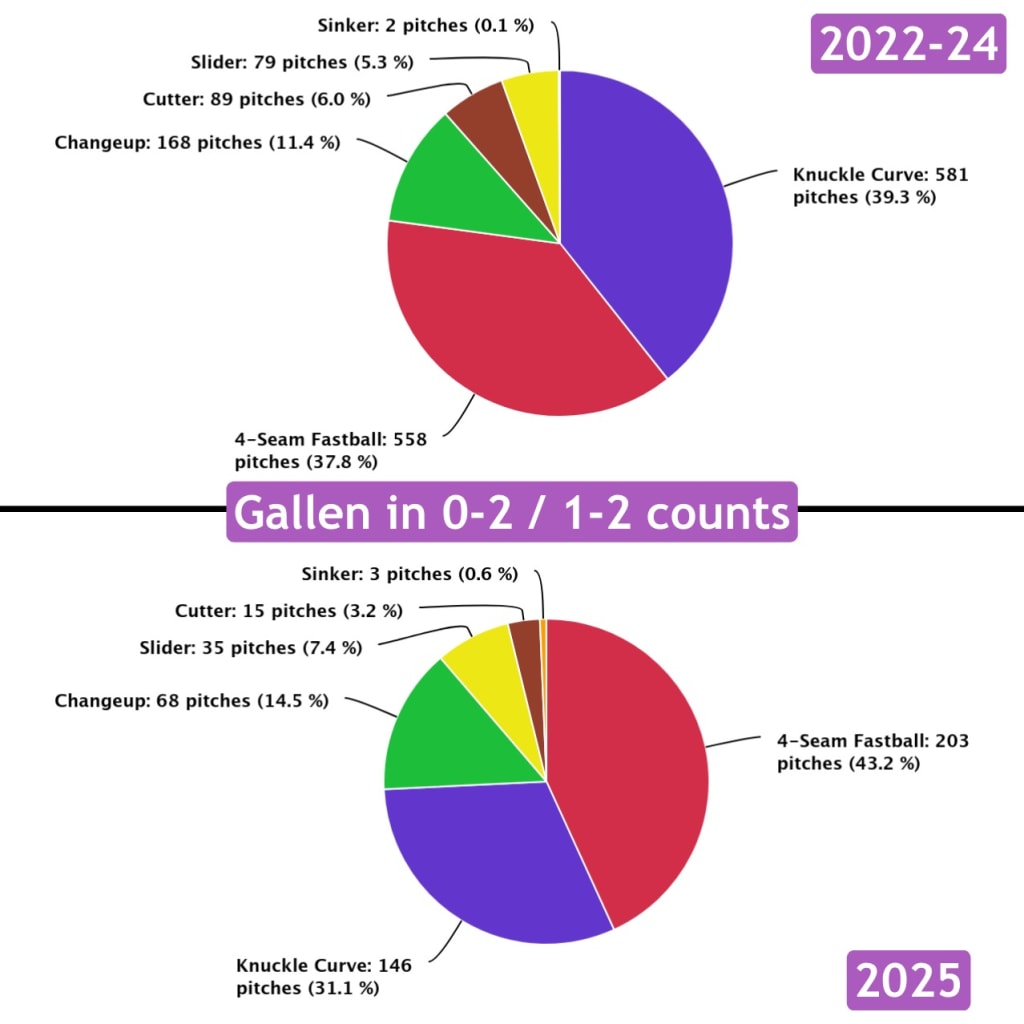
Gallen's knuckle-curve usage in 0-2 and 1-2 counts
- 2022-24: 39%
- 2025: 31%
% of Gallen's total knuckle-curves coming in 0-2 and 1-2 counts
- 2022-24: 28%
- 2025: 20%
When Gallen throws his curveball ahead in the count like that, he can hammer it on the bottom edge of the strike zone or below, and it becomes more of a pure strikeout pitch. That's where it can generate the most value.
2) Bring his high fastball back
Gallen's fastball has been a little bit of a problem for the past two seasons. From 2022-23, his four-seamer was worth +42 runs prevented, the single most valuable fastball in the Majors. But in 2024, his four-seamer dropped all the way to a -7 run value, and even though it flipped back to a +4 run value in 2025, that's a far cry from Gallen's fastball at its peak.
Gallen doesn't throw a big, overpowering heater, generally sitting around 93-94 mph. But he does get pretty good rising movement, and when he's at his best, he has top-of-the-line command. So even without high-end velocity, he can still get swings and misses and strikeouts with his fastball. He's lost some of that in the past two seasons, though.
Gallen's 4-seamer by season
- 2022: 88 K's, 20% whiff rate
- 2023: 92 K's, 19% whiff rate
- 2024: 53 K's, 13% whiff rate
- 2025: 63 K's, 13% whiff rate
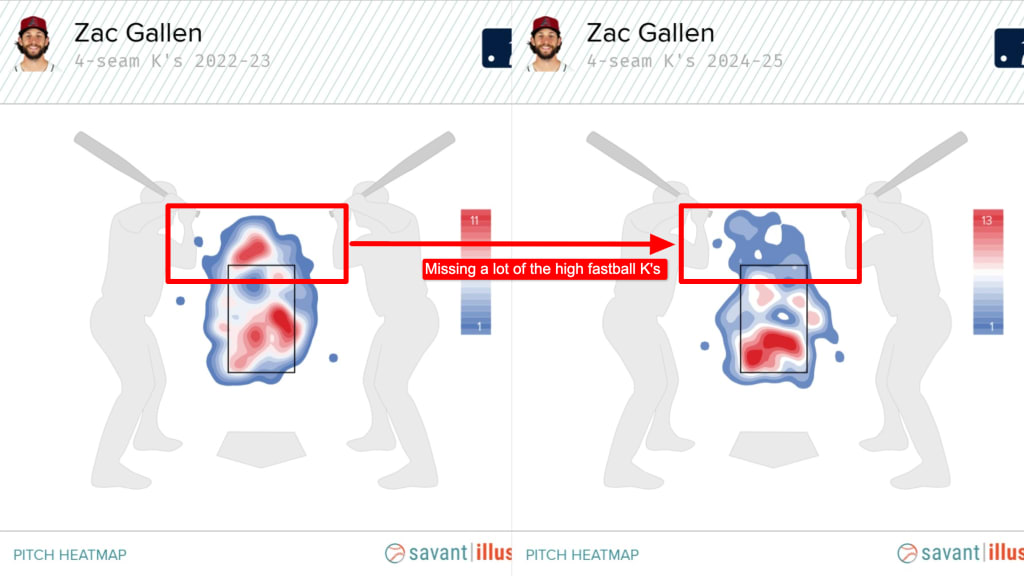
Those numbers have dipped because hitters have stopped chasing Gallen's high fastballs -- the fastballs they're most likely to swing and miss at. Those high fastballs also make Gallen's knuckle-curve and changeup more effective, which drop down from underneath the four-seamers.
From 2022-23, when Gallen went up and out of the strike zone with his heater, hitters chased it a third of the time. Since the start of 2024, when he's thrown those high fastballs, hitters have barely been chasing it one fifth of the time.
Chase rate vs. Gallen's 4-seamers above the strike zone
- 2022: 33%
- 2023: 34%
- 2024: 22%
- 2025: 19%
If Gallen's four-seamer is going to perform like it did in his best seasons, his team in 2026 will have to tap back into those high fastballs. Gallen will get punchouts on low fastballs, too, especially called strikeouts, because of his ability to paint the bottom of the zone. But going back upstairs for the swinging K's would add back that extra dimension to his fastball.
To do that, Gallen might try to better use his other fastball varieties to set up the four-seamer. He has all three types of fastball in his arsenal: four-seamer, sinker and cutter. That's the modern style of pitching -- throw a wide variety of pitch types, including multiple fastballs. But Gallen has work to do there.
The sinker and cutter give him two more areas to target in 2026.
3) Lean into his sinker
With his four-seamer not successfully carrying the load that it used to on its own, Gallen started throwing a new sinker halfway through the season last year.
That sinker should be an important weapon against right-handed hitters, which Gallen can use to jam them inside. Plus, if those righties have to respect the sinker that runs down and in onto their hands, they'll also have a harder time laying off the four-seamer that keeps carrying up to the top of the zone.
After introducing the sinker in July, Gallen threw it about 10% of the time to righties for the remainder of the season. That took some of the pressure off his four-seamer, which he went from throwing 52% of the time to righties over the first three months to 40% of the time over the last three months.
Gallen's sinker was a fine pitch, sitting at just over 93 mph, similar to his four-seamer, but with 11 inches of arm-side run, compared to just four inches on his four-seamer. It generated a +2 run value.
The sinker is a pitch that should let Gallen cover all parts of the strike zone more easily. He doesn't have a ton of stuff that moves side to side -- his two best pitches especially, the four-seamer and knuckle-curve, are true up-and-down vertical pitches.
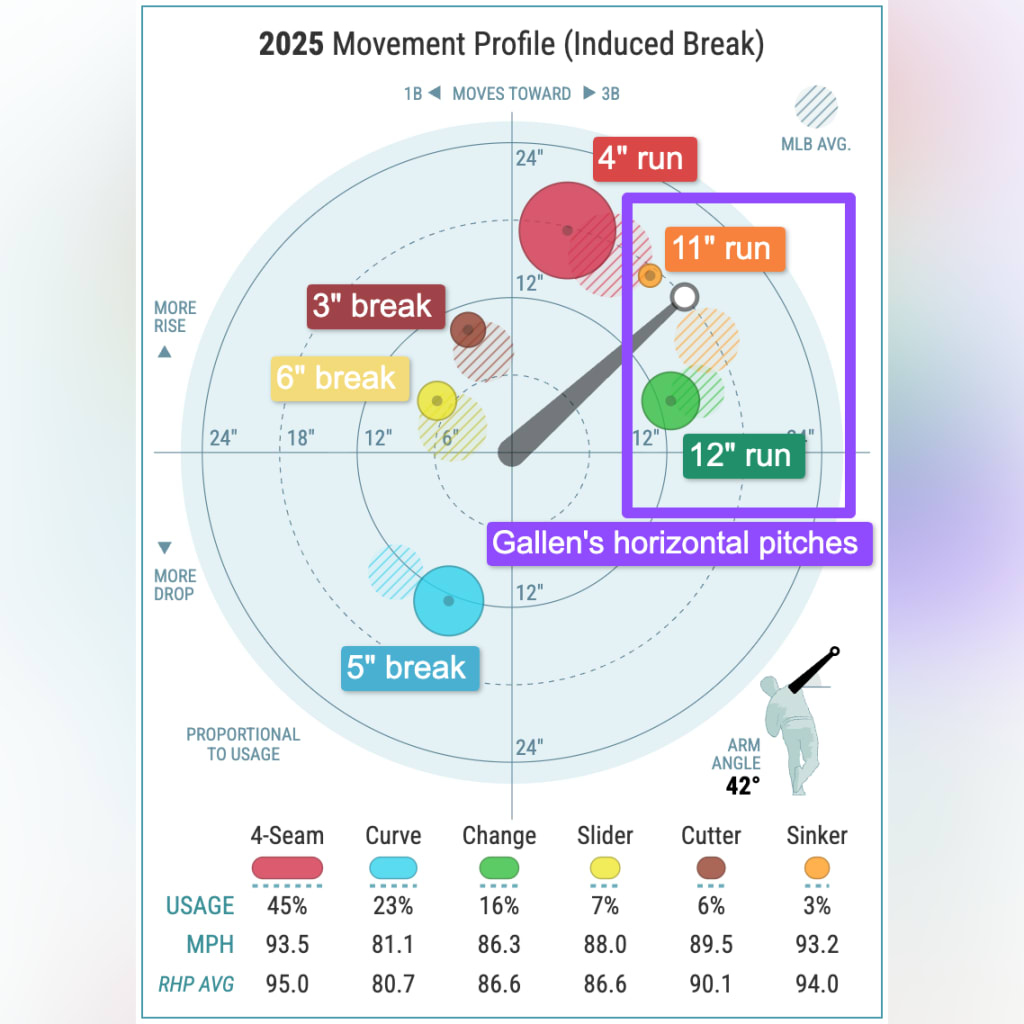
His sinker and changeup are the only horizontal pitches he has, and he doesn't throw a ton of changeups to righties. Now that he has a half-season of throwing the sinker under his belt, Gallen could try to use it even more in 2026. Maybe he even signs with a team with a good pitching lab that, for example, makes a tweak to his grip to help him get a little extra movement.
4) Salvage his cutter
Gallen's sinker should help him keep right-handed hitters off his four-seamer. His cutter should help him do the same thing against left-handed hitters.
It's a cutter that sits around 90 mph with sharp enough glove-side break to bust lefties up and in. Sounds good in theory. But in practice, Gallen's cutter has just been a bad pitch.
It was his worst pitch in 2025, allowing a .370 batting average and .761 slugging percentage and producing an ugly -7 run value. Gallen allowed five home runs on his cutter last season, and got just two strikeouts with it.
There's some evidence from back in 2022, though, that Gallen's cutter can at least be a serviceable pitch. That season, it generated a +3 run value and was his most-thrown pitch after his four-seamer and knuckle-curve.
A lot of the difference probably comes down to command -- as great as Gallen's command is overall, his cutter locations have seemed much spottier since that 2022 season, including a bunch to lefties in 2025 that just didn't quite get up and in enough. It was more one or the other -- either up, but out over the plate, or in, but not elevated to the top of the zone.
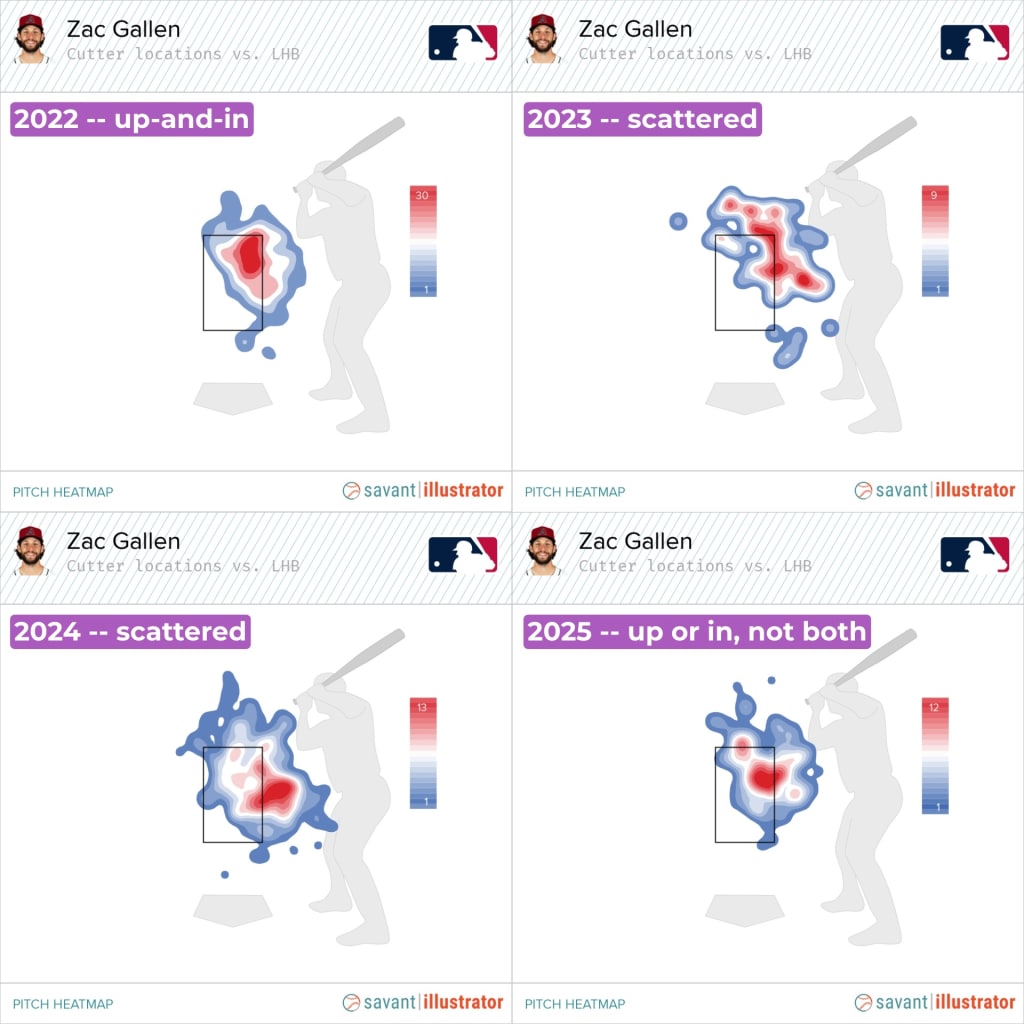
If Gallen can get that cutter where it needs to be more consistently -- or maybe even more importantly, if he goes to a team that can help him adjust it to make it a nastier pitch -- that could go a long way toward Gallen returning to form this season.