



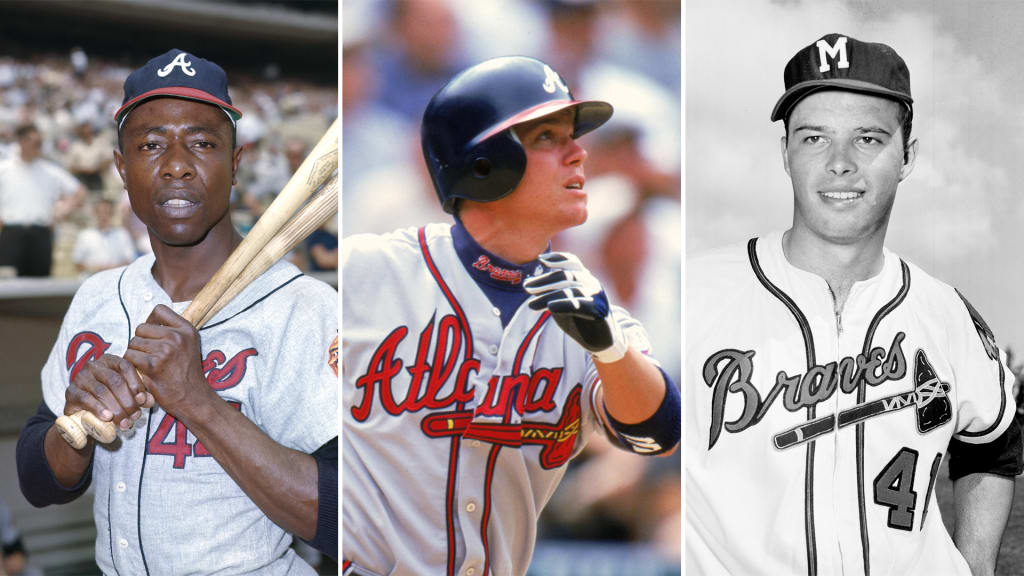
When constructing a list of the top five seasons ever produced by a Braves position player, one of the challenges is determining how many of Hank Aaron’s greatest seasons to include.
Aaron accounts for two of the top four OPS (on-base percentage plus slugging percentage) marks ever produced in franchise history (min. 130 games played). He also produced three of the top four OPS+ marks, a metric that accounts for variables such as ballpark factors and indicates how much better the player was than league average that season. A 100 OPS+ is average and anything higher is considered above average.
But while Aaron has undoubtedly been the best player in Braves history, he wasn’t the only Hall of Famer who produced epic seasons with the club.
Here is a look at the five best seasons produced by a position player in Braves history:
1. Hank Aaron, 1959
Key stats: .355 batting average, 39 HR, 183 OPS+, 1.037 OPS, 8.6 bWAR (Baseball Reference’s WAR Model)
Aaron produced a higher OPS (1.079) and OPS+ (194) while primarily playing first base at 37 years old in 1971. He also had a strong 166 OPS+ when he captured his only MVP Award in 1957. But his most impressive season was constructed in 1959, when he tallied 400 total bases, a number that still hasn’t been matched in franchise history. Nor has another Brave ever hit .350 with 35-plus homers in a season.
Aaron finished third in NL MVP balloting behind the Cubs’ Ernie Banks and Braves teammate Eddie Mathews. Banks had a higher bWAR (10.2), but like Mathews, his OPS (.970) and OPS+ (156) were trumped by Aaron’s.
2. Rogers Hornsby, 1928
Key stats: .387 batting average, 21 HR, 202 OPS+, 1.130 OPS, 9.0 bWAR
While spending his only season with the Braves, Hornsby produced what remains the franchise record for OPS and OPS+. The Hall of Fame second baseman led the league in batting average, on-base percentage, slugging percentage, OPS and walks. He did all of this while serving as a player-manager after manager Jack Slattery was fired a month into the season.
3. Ronald Acuña Jr., 2023
Key stats: .337 average, 41 homers, 73 stolen bases, 1.012 OPS, 171 OPS+, 383 total bases
When it was time to update this list, I assumed Acuña’s historic season would move into the top spot. It might be a while before somebody removes the distinction of the 2023 NL MVP being the only person in MLB history to steal 70-plus bases during a 40-homer season. But I think too much value might be placed in that franchise-record stolen base total.
Acuña had a 8.4 bWAR in 2023. Aaron had a higher mark in five seasons. You don’t like defensive metrics? OK. Looking just at offensive bWAR, Acuña had an 8.6. Aaron had two higher offensive bWAR marks during his career.
As for OPS+, Acuña’s 171 was the seventh-highest mark in franchise history. I doubt I’ll ever see a season as great as the one Acuña constructed. But the numbers indicate that those who watched Aaron and Eddie Mathews would say they saw at least a couple of seasons that were more impressive.
4. Chipper Jones, 1999
Key stats: .319 batting average, 45 homers, 169 OPS+, 1.074 OPS, 6.9 bWAR
Jones homered 31 times over his last 80 games and captured his only MVP Award at the conclusion of what was the most memorable season of his illustrious career. The Hall of Fame third baseman’s 1.074 OPS from the 1999 season still stands as the third-best mark produced in franchise history. His performance, which was highlighted by a dominant September against the Mets, allowed the Braves to overcome the absences of Andres Galarraga, who was diagnosed with cancer before the season, and Javy Lopez, who suffered a season-ending knee injury in June.
Like with Aaron, there was at least reason to question which was Jones’ finest season. The 1999 season was just slightly better than 2007, during which the legendary switch-hitter produced a 1.029 OPS and a 165 OPS+. A year later, at the age of 36, he became the oldest switch-hitter to win a batting title.
5. Eddie Mathews, 1953
Key stats: .302 batting average, 47 HR, 171 OPS+, 1.033 OPS, 8.1 bWAR
Choosing the greatest of Mathews’ seasons might be even more challenging than doing so with Aaron and Jones. From 1953-55, the Hall of Fame third baseman hit 40-plus homers and constructed a 170 OPS+ on an annual basis. But the first of these seasons seemed to be his best. The Braves moved to Milwaukee in 1953 and immediately saw a 21-year-old Mathews hit a career-best 47 homers with a .627 slugging percentage.
Mathews’ 8.1 bWAR was the second-highest mark he ever posted, trailing only the 8.2 mark produced in 1959, when he finished ahead of Aaron in MVP balloting.