



Jake Bauers signed with Boston, and Teruaki Sato is more of an unknown, coming over from Japan's NPB. But if we're talking about still-available free-agent bats with MLB track records, the best option is clearly a right-handed outfielder who will play next season at 32 years old and just turned down a Qualifying Offer. Over the last four seasons, he’s been worth 14 Wins Above Replacement (WAR) via FanGraphs, with a 25% strikeout rate and an 11% walk rate, which works out to overall offensive production approximately 30% better than league average. For his career, he’s reached base 35% of the time.
That’s a good player, and it’s clearly Randy Arozarena we’re talking about.
Except … it’s also Seiya Suzuki. Every word of the above applies to both players, equally. It’s almost eerie. The lines don't lie.
Arozarena, who just had a career year with the Mariners, and Suzuki, who had more or less the exact same very good hitting year he always has with the Cubs, both find themselves in advantageous situations. That's especially true given the relatively weak free-agent hitting class and the general sport-wide difficulty in finding good right-handed bats.
Both players should do well in terms of finding a new contract. But if they don’t have much competition from others on the market, they do have competition from one another. If you’re a team out there with a need in the outfield corners and/or for righty bats, which one would you prefer? (That means you, Phillies, Blue Jays and Orioles, not to mention the Mariners and Cubs, who both face losing one of these two.)
Or, perhaps put more accurately: If the top-line numbers don’t separate these two, what does? It might just define which one fits better than the other in particular situations.
The case for Arozarena (as a hitter)
That’s easy: He did just have a better season at the plate. One of the best in baseball, really.
- Arozarena: .280/.381/.484 | 26/26 HR/SB | 151 wRC+
- Suzuki: .270/.368/.473 | 26/3 HR/SB | 134 wRC+
(Like OPS+, wRC+ is a park-adjusted metric scaled to a league average of 100.)
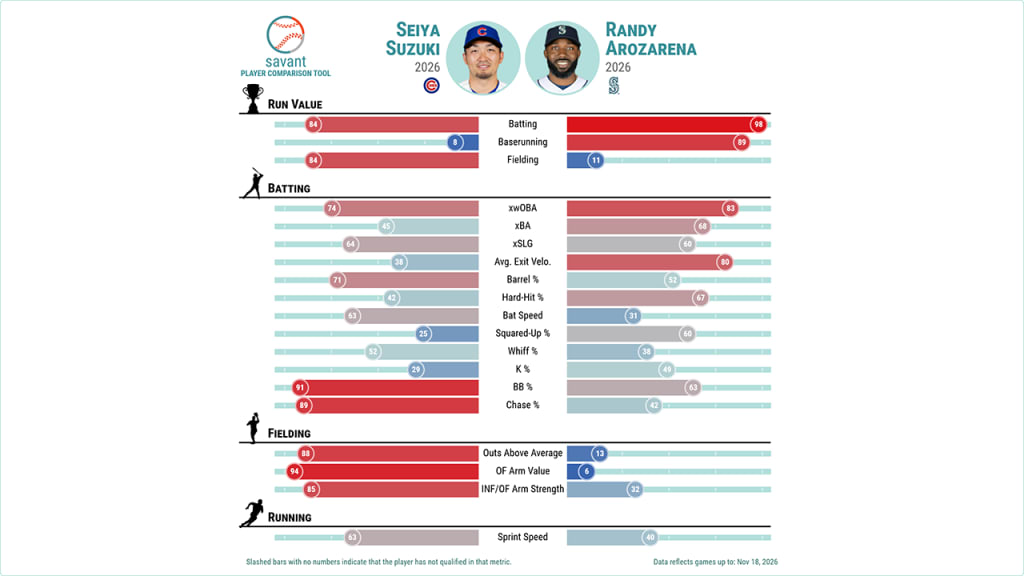
The surface numbers (steals aside) aren’t that different, really, but since Arozarena did that in a brutally difficult hitter’s park in Seattle, the park-adjusted numbers made him the third-best qualified hitter in the game, with Suzuki at 18th. You can see why, because Arozarena was solid at home (.788 OPS) and fantastic on the road (.933). A lot of the usual T-Mobile park factors applied, as he hit the ball harder away, and hit more grounders at home – though he never had produced on the road anything like that before.
While no one really views him as a top-five hitter, he’s also been a consistent one before his recent outburst, essentially posting the same exact season in each of the five between 2021 and ‘25, which is to say “around 22 homers and 20% above average every year.” That’s all useful. In 2026, Arozarena cut his strikeout rate to a career-low 21.6%, one of the largest decreases in the game, and which will likely be a popular marker in a sport always searching for more contact.
This all leads to a question that’s hard to answer. Adding contact is generally good; losing a ton of bat speed to do it is a red flag. (Arozarena was 65th percentile in bat speed in 2023-’24, but just 31st percentile, or below-average, in 2026.) What followed is exactly what you’d expect: Arozarena’s squared-up rate jumped up, his hard-hit rate and barrel rate collapsed, and he hit the ball on the ground, and to the opposite field, far more than he had in years. At the same time, his chase rate was near a career high.
Is that a good thing? (There’s at least a little echo of the strategy the Brewers rode to a title.) Or is it a bad thing? (Declines in bat speed, running speed, and plate discipline in your 30s generally tell a story of a downward slide starting to happen.) It’s not fully clear, and that’s a little worrisome.
The case for Suzuki (as a hitter)
That’s easy, too: The underlying metrics we look at for future performance generally favor him.
Suzuki vs Arozarena, 2026 Statcast percentiles
| Metric | Suzuki | Arozarena |
|
Bat speed |
63rd | 31st |
|
Barrel rate |
71st | 52nd |
|
Chase rate |
89th | 42nd |
|
Ground ball % |
84th | 11th |
|
Whiff % |
52nd | 38th |
That last line is interesting. While Arozarena (21%) had a better strikeout rate than Suzuki (24%), it was Suzuki who had the better contact rate, especially on pitches inside the zone (89%, to Arozarena's 79%).
Generally, you’d prefer the player who swings the bat faster, chases less, makes more contact, and hits the ball hard in the air more. That’s doubly true if we’re talking about ages 32-35 over a four-year deal, when the effects of aging will really show themselves.
So, it’s Suzuki easily, right? Well … not exactly.
How’s this for a red flag: His hard-hit rate dropped by 10 points, and that was a top-five decline in the game. The only player on the top-10 decliner list who had a season they’d really be proud of is Kyle Schwarber, and he was starting from such a top-of-the-scale elite place that he was able to give some back and still be pretty good.
Since the bat speed didn’t decline and the chase rate didn’t increase, it’s mostly that his squared-up rate fell apart, from regularly above-average to merely 25th percentile. It means he was mis-hitting the ball more than previously, and that cost him some contact quality. While it didn’t end up hurting him that much overall, it’s at least a little odd.
Still, teams are pretty likely to prefer Suzuki’s bat going forward.
What about defense?
Not a strength for either, really … unless it is.
From 2023-’25, Arozarena was a minus-22 in Fielding Run Value, making him one of the weakest defensive outfielders in the game. Suzuki was at minus-6, which seems better, but is also mildly misleading here because it’s only accounting for when he was allowed to play the outfield in the first place. While Arozarena made just 26 starts as designated hitter over the last four seasons, Suzuki made 194, spending much of the 2024 and ‘25 seasons without a glove on as the Cubs had first Cody Bellinger and then Kyle Tucker stationed in right.
Maybe that was more a statement about the outfield depth the team had rather than Suzuki’s skill, but also, maybe not, given the words that he himself shared to the Chicago Sun-Times in May of this past season: “The last few years, with my defense, I think there was a little bit of worry.”
But then a funny thing happened in 2026, with Suzuki returning to right after Tucker departed to the Dodgers. He was good. Actually quite good. The metrics said so, as he went from minus-1 FRV in limited time in 2025 to plus-7 in 2026, with Defensive Runs Saved suggesting even a larger leap. The voters agreed, as Suzuki was named a finalist for the Gold Glove award. So, too, did Cubs general manager Carter Hawkins.
“I think … probably the biggest change for Seiya last year is the defense that he brought,” Hawkins said earlier this month. “We always knew the power; we always knew the offensive profile. He's just a dangerous hitter, but to be a dangerous outfielder as well, in a good way, I think that really rounded out his skill set and why he's as sought-after as he is in this market.”
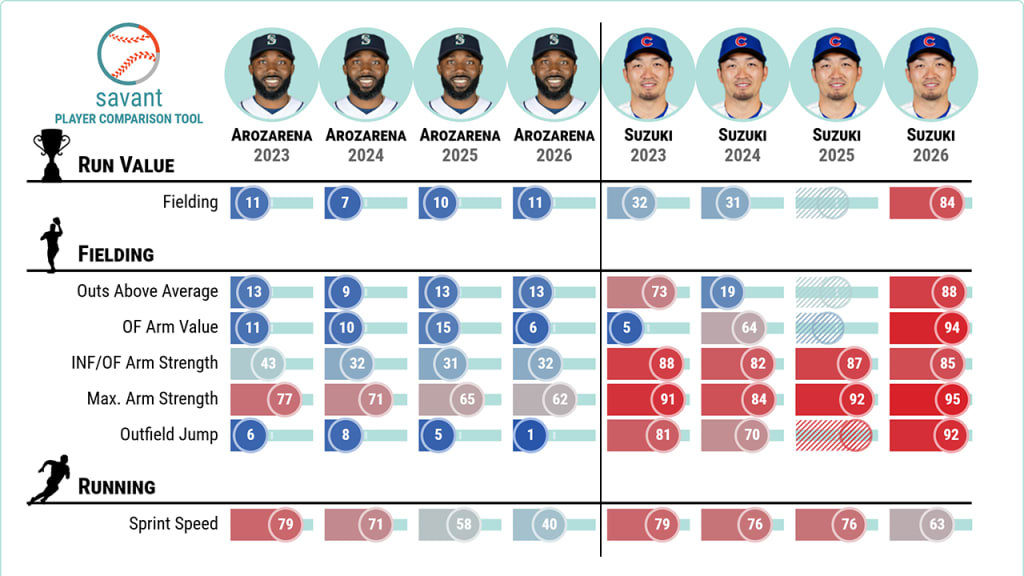
What happened? Suzuki, who had once been among the weakest outfielders in the game at getting off to good jumps, managed to become one of baseball’s best at it in 2026, crediting coach Quintin Berry’s help with a pre-pitch routine that allowed for better reactions. If that sounds familiar, it’s because that’s what Pittsburgh did with Brandon Lowe and what Tampa Bay did with their entire outfield.
It appears to be something that can be taught, and if that's true, then perhaps this skill can stick.
Arozarena, meanwhile, had never really been good at that, and has gradually lost the plus foot speed needed to outrun that flaw.
And on the bases?
If you care only about steals, this is Arozarena, easily. Over the last four years, he has more than three times as many (99 to 30) as Suzuki, and last season it was a massive 26-3 advantage. That overstates things a little, because Arozarena also got thrown out eight times last year, so in terms of runs gained via steals, it was only a 2-0 edge for Arozarena.
Still, an edge is an edge, and when you include the value attained from running the bases, where Arozarena was better, too, you can see why he was an 89th percentile baserunner while Suzuki was merely 8th. That's a lot, and it matters.
So, count this as a point for Randy, though it's also a little confounding. Once a plus speedster, Arozarena's formerly elite speed (96th percentile as a rookie) has declined to below-average (40th percentile in 2026). Suzuki never had top-end speed like that (77th percentile when he joined the Cubs), but he hasn't lost nearly as much either (63rd last year).
That's likely part of what makes Suzuki a better outfielder, though it hasn't translated on the bases.
Which means…
The two players who just had nearly identical four-year runs are projected to have identical 2027 output. We do mean identical, too.
That’s understandable, and perhaps also expected. But we don’t think teams will quite see it that way, either. Arozarena is headed for designated hitter sooner than later, perhaps even next year. Maybe you believe in Suzuki’s defensive renaissance and maybe you don’t, but the stronger arm and better footspeed should at least buy him an extra season or two in the grass. That means there’s less pressure on his bat to produce, and the underlying skillset suggests that it may be a better bet to do just that.
You’d like either one of them, obviously. You don’t look at Arozarena’s great season at a difficult place to hit and hand-wave that away. But neither is signing for just one year, either. Over the course of the next three, four, or five years, you’d probably prefer Suzuki. Probably.