




If baseball is a copycat sport, then everyone in the game this winter is going to be working on copying what the 2026 Brewers did on their way to the championship. That’s probably going to lead to some misconceptions – no, they didn’t necessarily win with small ball or making elite levels of contact – but it’s hard to ignore that over the course of the season, both Milwaukee and AL champion Tampa Bay rolled out youthful, fast lineups who could play strong defense.
That’s how we land in the Pacific Northwest, where the 76-86 Mariners weren’t only arguably the most disappointing team in the sport, but also finished exactly last in two important stats that point pretty directly to, well, speed and defense.
- The Mariners were the slowest team in baseball, both in sprint speed (26.9 ft/sec) and average home-to-first time (4.50 sec).
- Statcast says they had the worst defense, too, at an astonishing 59 runs below average – and 131 worse than the best-in-baseball Cubs.
While a different metric, Defensive Runs Saved, thinks it was more “quite bad” than “literally the worst,” it’s still not good, and president of baseball operations Jerry Dipoto minced no words when talking about his team’s needs at the recent GM Meetings.
“The biggest thing for us right now is improving our defense,” said Dipoto. “Our defense last year was just atrocious.”
“It makes it very hard for a good pitching staff to stay good,” he added, “and it makes it really hard to win games when you’re giving away outs on a nightly basis.”
Atrocious. Giving away outs on a nightly basis. Those are difficult phrases to misinterpret, aren’t they?
It matters, too. Split the 30 teams into the top half and bottom half on defense, according to Statcast’s Fielding Run Value. Among the top half, 10 of 15, or two-thirds, made the playoffs, including all four ALCS/NLCS teams and of course both World Series participants. Among the bottom half, only two, or 13% did – and Houston, at 81-81, didn’t even post a winning record while doing so.
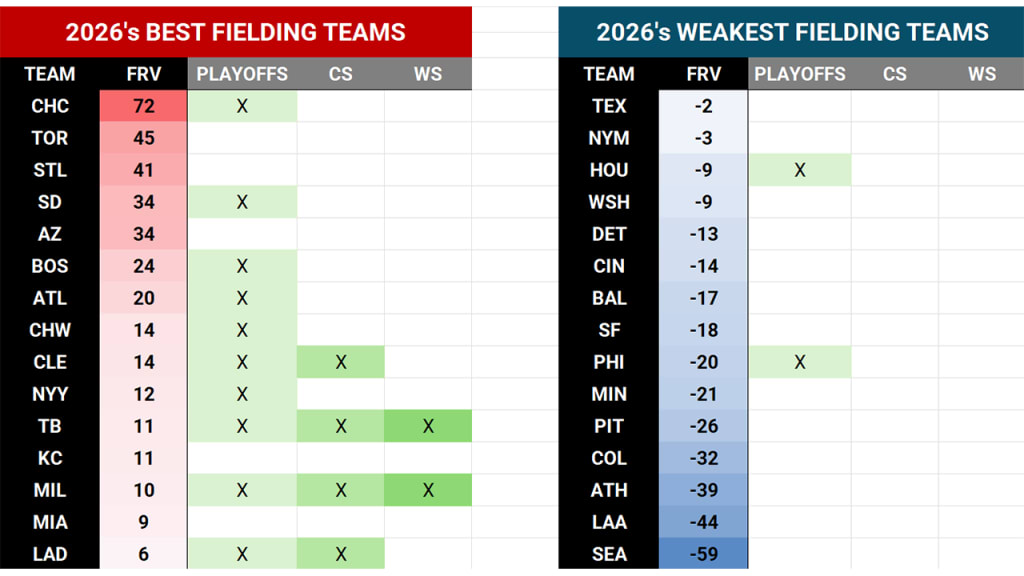
Having an elite defense doesn’t guarantee you a spot in the playoffs, as Toronto and St. Louis proved, though in Toronto’s case much of this was simply about their otherworldly catchers; the non-catching part of their defense was just OK. But it’s different on the other end, where dreadful defense comes pretty close to guaranteeing you won’t get in – or, at least, is a symptom of other, larger, team-wide flaws.
None of this is the only reason why the 2026 Mariners fell apart, of course. They outscored only two other teams – there’s Toronto again – and certainly speed-and-defense issues won’t explain Cal Raleigh’s disastrous follow-up to his incredible 2025 or why Julio Rodríguez had the weakest hitting season of his career. But it’s a place to start, too, and Dipoto made that quite clear, as part of those comments at the GM Meetings.
“We think the lowest hanging fruit is finding players, whether in everyday or role type situations, who can beef up our defense," Dipoto said.
OK, then. Let’s see what we can do to help.
To some extent, part of this problem may solve itself, as many of the team’s weakest defenders are not expected to be back in 2027.
Weakest Mariners defenders, 2026 Fielding Run Value
| Name | Position | FRV |
| J.P. Crawford | SS/3B | -10 |
| Randy Arozarena | LF | -7 |
| Luke Raley | 1B/OF | -7 |
| Mitch Garver | C | -6 |
| Cal Raleigh | C | -5 |
| Brock Rodden | IF | -5 |
| Cole Young | 2B | -5 |
| Weston Wilson | UT | -4 |
Arozarena is a free agent and is likely to be one of the most highly sought-after bats this winter despite the weak glove. Crawford, who lost his shortstop job last season after playing more games there than any Mariner in team history, has already reportedly been told that the team will be moving on.
Raley missed most of the second half with a left elbow injury that required surgery, and while he remains with the team as an arbitration-eligible player, it’s not clear how much of a role is being saved for him in 2027. Garver, meanwhile, retired last month, while Brock Rodden (-5) is probably ticketed as Minor League depth, and Weston Wilson (-4) is also a free agent.
We’ll set aside second baseman Cole Young for the moment, because while he did win a Gold Glove, it came with massive metrical disagreement on his fielding – Statcast thought he was below-average, Baseball Prospectus had him as mildly above-average, and DRS had him as elite – but it doesn’t matter right now, because he’s clearly keeping the job next season.
That's a lot of negative fielding value out the door already. Good start.
It really comes down, then, to these two questions.
1) Can any returning Mariners defenders improve?
It’s not impossible; what the Rays did to up their game in the outfield was one of the biggest reasons for their success this past year. For Seattle, the two biggest names are also the two key places to look.
- A) Raleigh
For all the focus on his offensive calamities, it went less remarked upon that his once-excellent defense declined as well.
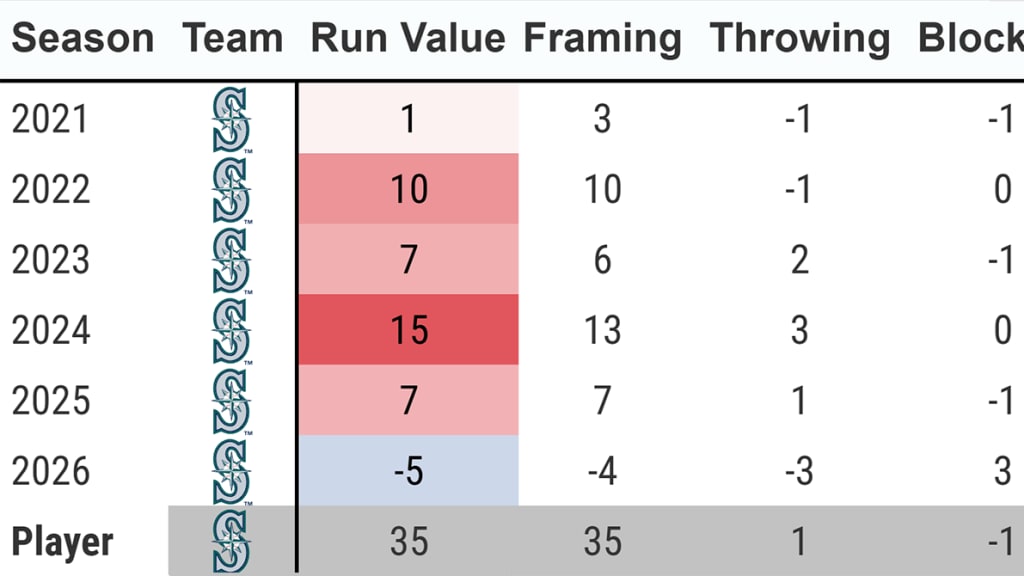
This is almost entirely due to framing, which fell from +7 runs in 2025 to -4 in 2026, and while we couldn’t say for sure that this was about the oblique injury he tried to play through and/or the left (catching) shoulder that required surgery after the season, it would at least make sense. Given how fantastic he’d been over the previous four seasons, rating as a top-five defender, it wouldn’t take that much to think he can be at least improved, if not strong.
- B) Rodríguez
Speaking of mysterious downturns! Why did three-time All-Star Rodríguez sink to a merely average hitter at 25? But what, also, caused his own defensive decline from “tremendous” to “not that great?”
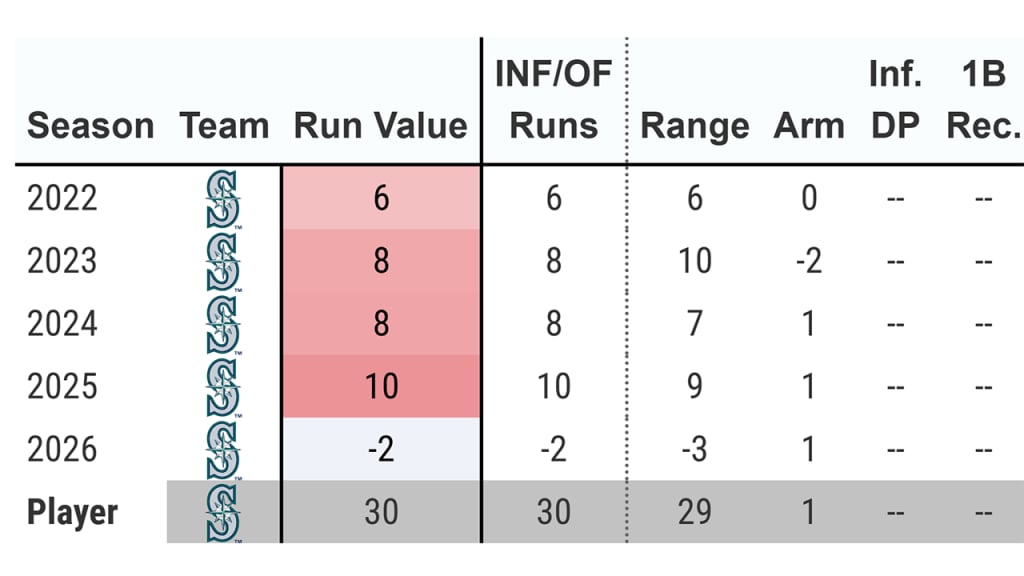
It’s a little about a decline in speed, though going from the 93rd percentile in sprint speed to 85th is hardly enough to make you unable to play center field. It’s a bit about a decline in reactions, too, as his formerly-great ability to get off to good jumps turned into being slightly below-average in 2026, dropping a full two feet from his 2023 peak.
But it’s also about repeatedly one-off weird plays, too. For example:
... or this ...
... or this:
It’s impossible to say why all this happened or if it will get better. Maybe it was related to the team-wide malaise that hurt the hitting; maybe it was the concussion that cost him most of July; maybe the overhauled coaching staff will have a positive impact; or maybe baseball is just a fickle beast. Whatever the case, these mistakes happened and negated Rodríguez's typically reliable defensive value.
We’d add shortstop Colt Emerson here, too, though it’s not fully clear just yet how much guaranteed time he’ll be getting next year. Despite the record-setting contract he signed just after Opening Day, his first season didn’t go great on either side of the ball, with a 66 OPS+ and -3 Fielding Run Value, before missing the final six weeks with left wrist surgery that will keep him from swinging for most of the winter.
But you’re probably not expecting that much different from returning veterans Josh Naylor, Dominic Canzone, or Brendan Donovan. And if rookie Lazaro Montes wins a spot, there’s little in his scouting reports that suggest he’s bringing elite defensive value, though his arm is strong. The same might be said for defensively-limited infielder-moving-to-the-outfield Michael Arroyo, once healed from elbow surgery. It’s got to be the pair of superstars if internal improvement is going to be found.
2) Is there anyone on the market who might be able to juice the defense quickly?
Looking at the 2027 Mariners roster, starters are probably spoken for at catcher, first, second, and center, plus either third or left for Donovan. That means a corner outfielder (or two) and a left-side infielder are the clearest places for an external addition.
This usually means free agency, but also, don’t rule out the idea of trading from the starting rotation to obtain a position player, either. Dipoto isn’t.
“In general, our preference would be to keep all your pitchers. You need them,” he said last week. “But if they can make us or allow us access to a hitter we otherwise wouldn't be able to access through prospect packages, position-player deals or free agency, then we have to be open.”
That might be best, because a quick look at the Statcast Hot Stove leaderboard shows that the best defenders probably aren’t fits for this particular club. Second basemen Brandon Lowe, Luis Arraez, and Jazz Chisholm Jr. all come with some questions about the up-and-down nature of their fielding, and would need to displace Young anyway. Former Mariner Ty France would require a second consecutive multiyear contract given to a first baseman, after Naylor got five years last offseason.
It’s trickier on the left side of the infield. Even powerful free agent bat Teruaki Sato, nominally a third baseman, is more likely to play first or the outfield, which means you’re looking at the well-traveled Isiah Kiner-Falefa as a bench option, or Mauricio Dubón to also play all over.
Otherwise, you’d need to rely on Seiya Suzuki maintaining his unexpected defensive improvement into his 30s, or former Cubs teammate Ian Happ’s reputation (four Gold Gloves) over inconsistent defensive metrics, or bet on once-elite Daulton Varsho rebounding after a series of injuries.
Trade, then?
If you really want to emulate the Brewers and/or Rays, then one way is to acquire some of them, like light-hitting-but-defensively-elite infielder Joey Ortiz (+13 FRV) from Milwaukee or Tampa Bay’s outstanding outfielder Johnny DeLuca (+10), reportedly available since Victor Mesa Jr. could take over center. Miami infielder Otto Lopez (+12) could reportedly be had, for a high price no doubt, or perhaps the Phillies, desperate to shake things up, make Bryson Stott (+6) available.
If they simply want an elite defender with no expectation of hitting enough to be a starter, then Angels outfielder Bryce Teodosio (+13 the last two years) is the best defender no one knows enough about, though it’s difficult to know if or how the Angels will be operating during a leadership transition.
It won’t be easy, but then again, it’s not supposed to be. It’s all but impossible to go from worst-to-first in defense in one winter. Seattle doesn’t need to, though. They just need to get to competent, to good-enough, to defense that won’t by itself keep them from the playoffs. It’s already happening, to some extent, with the departures, but it will also take improvement from within. It’ll take an addition from outside. It’ll take balls finding gloves, not grass.