



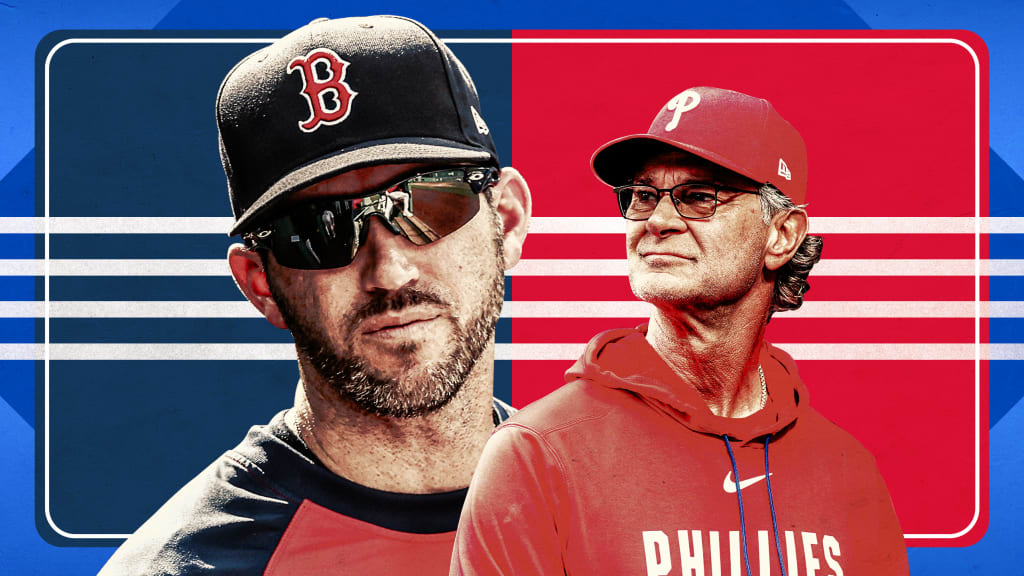
The Phillies and Red Sox have been running on parallel tracks all season, one in the National League and one in the American League. Both expected to contend. Both stumbled badly enough to dismiss their managers before the start of May. And both are now trying to work their way back into contention.
On Tuesday, their paths cross at Fenway Park for the start of a three-game Interleague series that naturally raises the question: which of these teams has a better chance of turning things around?
It’s a rare convergence of teams led by interim managers. According to the Elias Sports Bureau, this will be the first time since 2002 that two teams have met within their first 45 games, both with a different manager than they had on Opening Day. It’s happened only four times previously in the Modern Era (since 1900), and unlike the Phillies and Red Sox, none of the clubs involved were coming off postseason berths the year prior.
- 2002: Tigers (Luis Pujols) vs. Royals (John Mizerock)
- 2001: Devil Rays (Hal McRae) vs. Rangers (Jerry Narron)
- 1966: Tigers (Bob Swift) vs. Yankees (Ralph Houk)
- 1960: Phillies (Gene Mauch) vs. Cubs (Lou Boudreau)
Both the Phillies and Red Sox have played better since their managerial changes. Taking advantage of a soft part of its schedule, Philadelphia has gone 10-3 since it replaced Rob Thomson with interim manager Don Mattingly and sits at 19-22 entering its series against Boston. The Red Sox, meanwhile, have gone 7-6 since interim manager Chad Tracy took over for Alex Cora and are 17-23 overall.
At this juncture, FanGraphs views the Phillies as a much better bet to reach the postseason. Their playoff odds through Sunday were 54.9%, compared to just 30% for the Red Sox. But the Red Sox aren't without hope.
Depending on what you value most, there's a case to be made for either team.
The case for the Phillies: They have the better roster
While both of these teams have their share of flaws, the Phillies’ roster clearly has a much stronger foundation right now, as well as a higher ceiling.
Bryce Harper (10 HR, 159 wRC+), Kyle Schwarber (16 HR, 161 wRC+) and Cristopher Sánchez (2.11 ERA, 10.9 K/9) were expected to be three of the Phillies’ top players this season, and they’ve lived up to the billing amid the club’s slow start.
Zack Wheeler has looked good, too, since returning from thoracic outlet decompression surgery on April 25. He’s recorded a 3.12 ERA with 18 strikeouts, six walks and one homer allowed over 17 1/3 innings.
If you were conducting a draft strictly for the rest of this season, without taking contracts or long-term outlook into account, you can make a case that all four of those Phillies should go before the first Red Sox player is picked.
Even Phillies shortstop Trea Turner, who has produced a .642 OPS over his first 40 games, is projected for a higher fWAR total (2.8) the rest of this season than any Red Sox position player.
The Red Sox’s best hitters this season have been Willson Contreras (8 HR, 135 wRC+) and Wilyer Abreu (6 HR, 134 wRC+), while former Phillies starter Ranger Suarez has anchored their rotation with a 2.77 ERA over 39 innings.
Those are solid numbers, but Contreras, Abreu and Suarez are the kind of players who are best suited to be supporting pieces on a contender -- not as its premier performers.
The Red Sox's best hope for changing that dynamic rests with Garrett Crochet and Roman Anthony, both of whom are on the injured list and have yet to perform like the impact players Boston envisioned when it built this roster.
The case for the Red Sox: They have an easier path to the playoffs
For all that’s gone wrong this season, the Red Sox can take solace in the fact that they aren’t terribly far out of the playoff race in what has been a tumultuous year for the AL as a whole.
While Boston is facing a sizable AL East deficit -- 9 1/2 games behind the Rays and 8 1/2 behind the Yankees -- just two games separate the Red Sox from the Rangers and White Sox, who currently possess the final two AL Wild Card spots with identical 19-21 records.
In fact, the Rays (26-13), Yankees (26-15) and Athletics (21-19) are the only AL teams above .500, and every team besides Tampa Bay (+20) and New York (+73) has a run differential of +4 or worse.
Although the Phillies’ 4 1/2-game deficit in the NL Wild Card race may not sound significantly larger than Boston's, it’s looking like it’s going to be much tougher to nail down a Wild Card spot in the NL.
All three NL division leaders and the top five teams in the Wild Card standings currently have a winning percentage of .537 or higher, and five of those clubs have a run differential of +31 or better. That could be problematic for a Philadelphia club that is nine games behind the first-place Braves in the NL East and will likely need a Wild Card berth to make the postseason.