



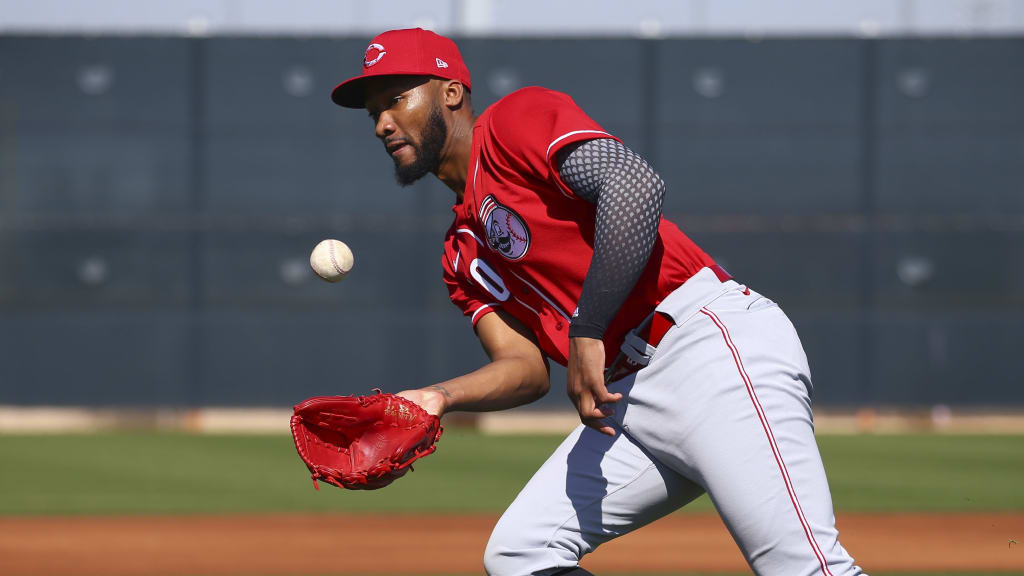
GOODYEAR, Ariz. – In the first half of 2019, Reds left-hander Amir Garrett was one of the best performing relievers in baseball. For a myriad of reasons, Garrett fell well short of that level in the second half as he faded considerably.
There was a left lat strain that put Garrett on the 10-day injured list in July, and an eight-game suspension was served in August for his central role in a July 30 benches-clearing incident against the Pirates. But Garrett was having none of it as reasons for a sharp decline.
“There’s no excuses there. I just tanked and that’s it,” Garrett said. “That had nothing to do with it. I just tanked. That’s how the great ones are great. They can do it for the whole season. Not just a half. Not just a week. I’m a realist. I don’t enjoy hearing, ‘Hey, you’ve been pitching good of late,’ or, ‘You’ve had a good half.’ I want to be good the whole time. I’m always going to be true to myself. The second half, I just fell off.”
Over 42 games before the All-Star break, Garrett had a 1.70 ERA with a 1.22 WHIP and a 13.1 strikeouts-per-nine-innings ratio. In 27 games after the break, he posted a 6.16 ERA and 1.79 WHIP and 11.4 strikeouts-per-nine innings. Overall, Garrett was 5-3 and set career bests with a 3.21 ERA, 78 strikeouts and 69 appearances.
Looking at the data via Statcast, there was little difference in velocity and spin rates for Garrett in the second half vs. his first half.
Four-seam fastball:
First half: 95.8 mph, 2,100 rpm
Second half: 95.7 mph, 2,143 rpm
Two-seam fastball:
First half: 95.1 mph, 2,043 rpm
Second half: 95.1 mph, 2,102 rpm
Slider
First half: 85.7 mph, 1,819 rpm
Second half: 85.8 mph, 1,856 rpm
However, Garrett was susceptible to more hard-hit balls and fewer swings-and-misses.
First half: 85.7 mph avg. exit velocity, 29.3 percent hard-hit rate, two barrels allowed on 77 batted balls.
Second half: 89.6 mph avg. exit velocity, 36.5 percent hard-hit rate, four barrels allowed on 52 batted balls
Garrett’s swing-and-miss rate declined sharply after it peaked in May.
April: 30.9 percent
May: 51.1 percent
June: 38.3 percent
July: 39.1 percent
August: 35.6 percent
September: 34.4 percent
“He had such a strong season, but he did get tired towards the end,” manager David Bell said. “I think he learned from it. I know I learned from it. Just the experience -- it’s different, the types of situations he was pitching in. There was a lot of stressful spots where he had to really bear down mentally and physically. I think it wore on him as the year went on.
“He’s strong, a good athlete. He can handle that. But having that experience of knowing what that’s like will prepare him more for that in the future. There are also ways that I can help with that in the way I use him also.”
Bell used Garrett 13 times on consecutive days and more than one inning in 12 games. Not counted are the times the 27-year-old warmed up in the bullpen but wasn’t used.
“Getting my body into shape more than anything, I feel really good right now,” Garrett said. “It’s just having a routine. You know that if you’re getting into the game, it’s getting sleep accordingly and taking care of your body as well. I thought I’ve been doing a great job of that so far, having a routine -- a better routine than I’ve had in previous years. My body feels really good. Last year, I was always a little bit achy and stuff like that. It’s just some modifications in my diets and some of my habits, I’ve cut out a little bit. It’s about my body feeling better.”
Garrett has three scoreless innings with one hit, no walks and three strikeouts in three spring games. Pitching in his hometown of Las Vegas during an 8-5 victory over the Cubs on Saturday, he worked one perfect inning. He is scheduled to pitch again on Monday against the White Sox.
Bell expects Garrett to be part of a strong back end of the Cincinnati bullpen with closer Raisel Iglesias, Pedro Strop and Michael Lorenzen. Bell didn’t rule out having Garrett close some games as well, especially if the opposing lineup is left-handed heavy in the ninth inning.
“We talked about the innings. They’re a factor -- the adrenaline and all those things,” Bell said. “But it’s even more important with the new rule to look at the opposing lineups, sections of lineups, rather than breaking it down by the inning. Amir could pitch anywhere between the sixth and the ninth, depending on the day, depending on the availability, depending on the opposing lineup.”